
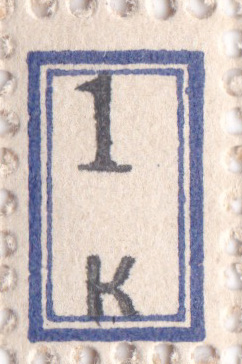
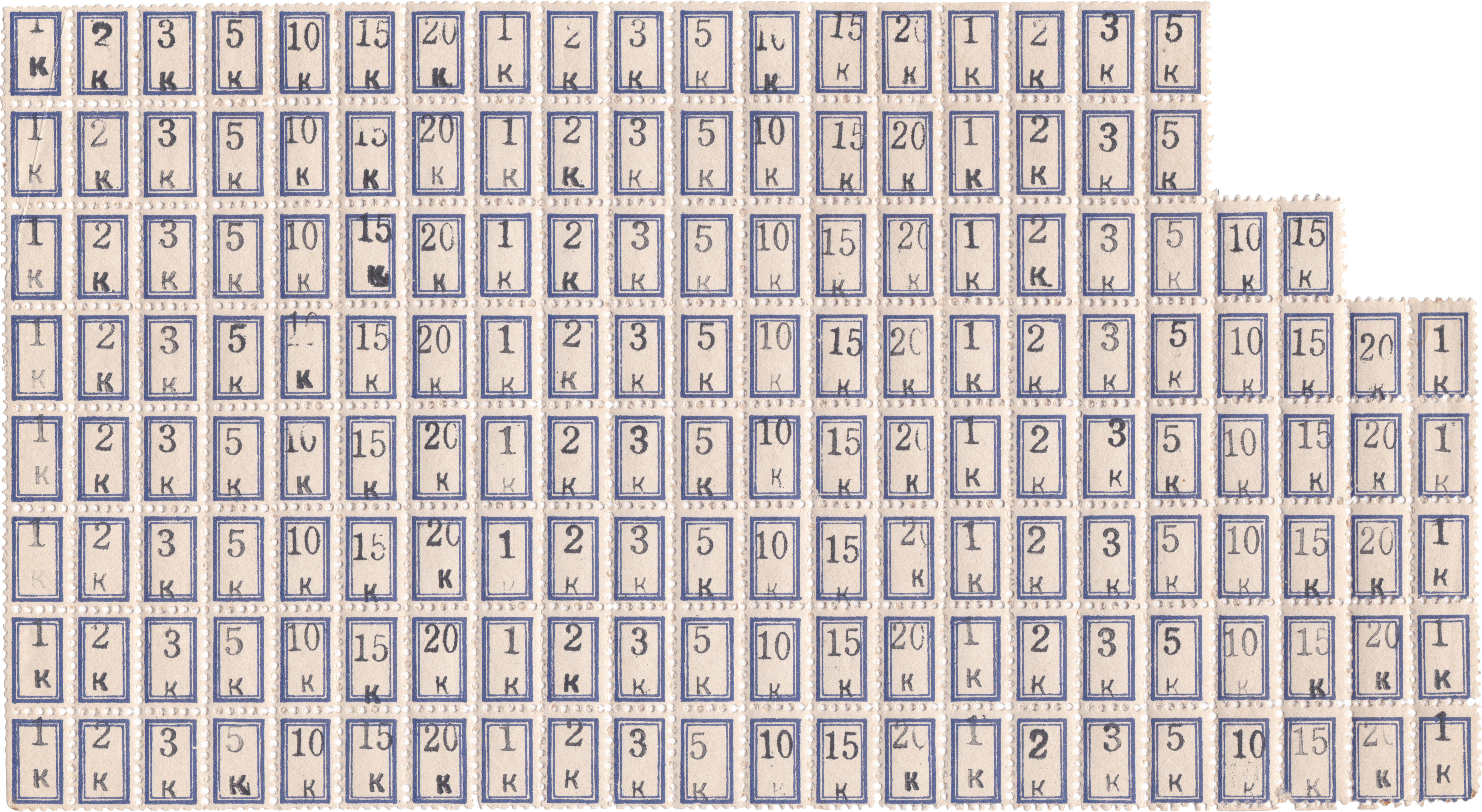
Incomplete sheet of 166 pieces. Denominations: 1, 2, 3, 5, 10, 15, and 20 kopeks.
Tavern tokens-money are a niche in notaphily that has not yet been fully studied. However, with a high degree of confidence one may assume that they were used in numerous tavern establishments in Moscow and Saint Petersburg as a means of payment for specific services.
The sheet was kept in the original printing-house envelope of the German manufacturing company. On the front side of the envelope there is an oval stamp of the shop of the printing house of Konstantin Alexandrovich Grosman in Moscow (Rozhdestvenka, Suzdal Compound), which was one of the official distributors of tavern tokens-money. On the back side of the envelope the name of M. A. Obukhov’s tavern is indicated, where these particular tokens were used.

M. A. Obukhov’s tavern was located at 55/32 Arbat and was quite popular, including among the capital’s intelligentsia. It was here that Boris Bugaev was born and lived for 26 years; he later became famous as the poet Andrei Bely.
The poet wrote about his home as follows: “…white, with balconies, decorated with molded cornices, raised up by a round semblance of a little turret: three stories.” The corner turret Bely wrote about disappeared in the Soviet period, when a fourth story was added.
The future poet’s father, Nikolai Bugaev, was a prominent figure in Moscow at the time: he was interested not only in mathematics, but also in philosophy, psychology, and history; he composed humorous verses and even wrote the libretto for the opera “Buddha.” Guests often gathered in his apartment; the circle included professors of Moscow University, but not only them—Leo Tolstoy, for example, and the composer Sergei Taneyev also visited. The Bugaevs’ neighbor was Mikhail Solovyov, brother of the philosopher Vladimir Solovyov. It was at the Solovyovs’ that Boris Bugaev was given a sonorous pen name—Andrei Bely. The young poet was then studying at the Faculty of Physics and Mathematics (like his father), but became increasingly absorbed in literature, poetry, and philosophy; closest to him were the Symbolists, with their aesthetics and special attitude toward art. His acquaintance with Bryusov and Solovyov—ideologues of Russian Symbolism—had a strong influence on him.
In 1903, here, in Bely’s apartment, the literary circle “Argonauts” arose—“the only Moscow Symbolists among the Decadents,” as they called themselves. The main ideological inspirers of the circle were Andrei Bely himself and his poet friend Ellis (Lev Kobylinsky). Every Sunday numerous guests gathered at the poet’s place; who did not visit here—poets Konstantin Balmont, Maximilian Voloshin, Valery Bryusov, Vyacheslav Ivanov, Jurgis Baltrushaitis, artist Viktor Borisov-Musatov, philosopher Pavel Florensky, and many others; in 1904, it was here that Bely first met Alexander Blok.
In 1906 Andrei Bely left this apartment. In the following years many tenants changed, until in 2000 the Andrei Bely Memorial Museum was opened here, which still exists today.