
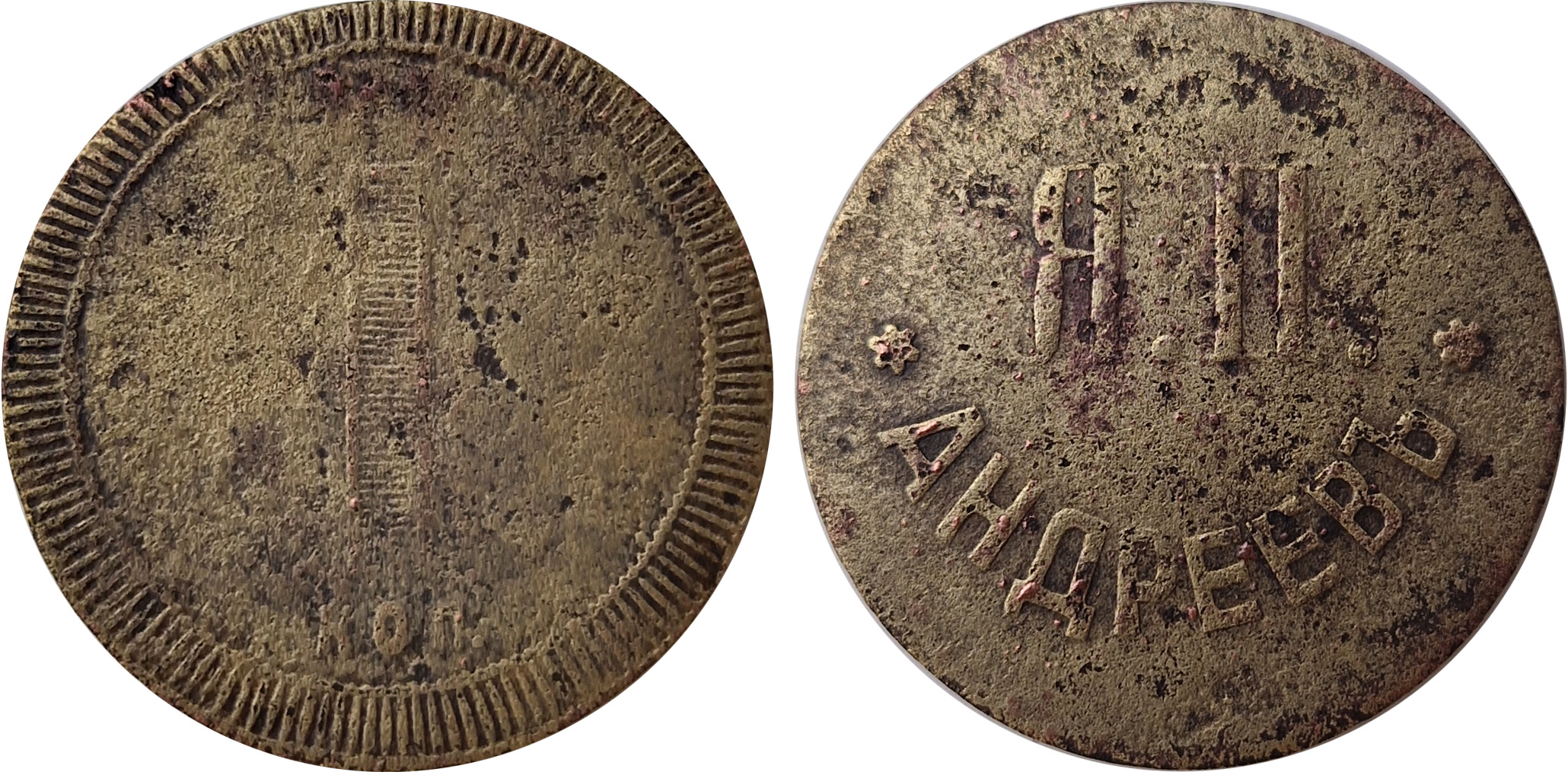
A native of the Irbit Works (in the 18th–19th centuries, the word “works” referred both to the plant itself and to the settlement where its workers lived), Yakov Andreev was no genius of commerce and entered the merchant milieu largely by chance. In 1860 he entered the service of the 1st Guild merchant P. D. Sinitsyn, who in Yekaterinburg held the wine tax-farm.
In 1861 the tax-farming system was abolished, and Sinitsyn launched a distillery and, in addition, opened a network of taverns in Yekaterinburg and several other towns of the province. To manage this troublesome хозяйство, the merchant entrusted matters to “trusted agents,” one of whom was Yakov Andreev. On the owner’s instructions, he first traded alcoholic beverages in Irbit and then in Yekaterinburg.
Sinitsyn repeatedly noted Yakov Prokhorovich’s “sincere diligence” and often held him up as an example to his heirs, who had little desire to take part in their father’s vodka business.
Andreev, for his part, regularly “pleasantly astonished” his employer, month after month increasing sales of rowanberry infusion, bitter orange vodka, and “kubovaya” vodka.
In the late 1860s Andreev tried to start his own business and opened in Irbit a “Rhenish cellar”—a shop that sold grape wines. Income from the new establishment was small, though steady, but Andreev was in no hurry to develop his business.
The situation changed sharply after the death of the merchant Sinitsyn.
According to contemporaries’ recollections, the wine trader had a nasty temper that only worsened in old age. It turned out that Sinitsyn had managed to quarrel with almost all his children and relatives—and so seriously that in his will he assigned them shares of one hundred rubles, accompanying his last will with a sarcastic admonition. A small portion of the money was bequeathed to almshouses in Ryazan Province, where the merchant was born, while the network of taverns, warehouses in Tyumen, Tomsk, and Perm, and the vodka plant in Yekaterinburg he bequeathed... to his clerks “for faithful service and according to merit.” Yakov Prokhorovich received the largest portion of the inheritance: the vodka plant, nine taverns (four in Yekaterinburg, two in Perm, and three in Tyumen), and a warehouse in Tyumen. The heirs did challenge the will in court, but achieved virtually nothing.
In 1870 Yakov Prokhorovich became the full owner of the vodka plant in Yekaterinburg and the chain of trading establishments. First of all, Andreev changed his estate status, becoming an “Irbit merchant of the 2nd Guild,” after which he immediately set about expanding his enterprise. That same year, 1870, he leased a plot of land near the village of Obukhova in Kamyshlov Uyezd of Perm Province, where he founded the Kalinovsky distillery, which went into operation three years later.
The next step in the struggle against competitors was an alliance with the Yekaterinburg 1st Guild merchant M. F. Rozhnov, who had his own спирт plant and an extensive network of outlets and drinking establishments. This alliance allowed Yakov Prokhorovich Andreev to secure a foothold in the market for wine-and-vodka products and to outpace numerous competitors.
However, Andreev understood that he would not be allowed to rest on his laurels for long. In Yekaterinburg, Alfons Fomich Poklevsky-Kozell was gaining strength, while merchants Pavel Dmitrievich Dyagilev (the grandfather of the well-known Russian theater figure Sergei Dyagilev) and Mikhail Gavrilovich Svedomsky were expanding trade in cheap wine. Therefore, the energetic Yakov Prokhorovich decided to launch a new venture that, in his view, could significantly strengthen the financial position of his “empire.” In 1877 he opened a “banking office” in Yekaterinburg, under which a loan касса was organized. At that moment, however, the core capital of Andreev’s bank did not exceed 50,000 rubles. Yet the new undertaking began to generate stable income. Over ten years Andreev managed to turn the office into one of the best private credit and financial institutions in the Urals. A branch in Tyumen, opened by merchant Andreev in the early 1880s, further strengthened both Yakov Prokhorovich’s financial position and his reputation in the business circles of the Urals and Siberia. In the same period, the merchant built on Voznesenskaya Street a large stone house with two wings and outbuildings.
In the basement of the estate’s main residence there was a “Rhenish cellar”—an establishment for retail trade in alcoholic beverages, including grape wines. Sales were strictly takeout, which attracted respectable customers. Somewhat later, groceries were also sold in the “Andreev” Rhenish cellar, bringing a solid additional profit. In 1914, after the outbreak of World War I, by imperial decree Rhenish cellars, along with taverns, were closed everywhere. The “Andreev” one, however, continued to operate: vodka and wine were simply removed from the counters. The house was managed by Yakov Prokhorovich’s wife, Darya Ilyinichna Andreeva. In 1919 the house was requisitioned and later remodeled into a communal apartment.
In 1888 Yakov Prokhorovich Andreev died, leaving to his heirs a “banking office” with branches in Yekaterinburg and Tyumen, a wool-washing establishment and a cloth factory, a broad network of trading and drinking establishments, a distillery and a horse-breeding plant, various real estate in Yekaterinburg, Perm, Tyumen, and Tobolsk, as well as a substantial cash capital. All this Yakov Prokhorovich bequeathed in equal shares to his wife Darya Ilyinichna, two daughters, and four sons.
The wine-and-vodka magnate was buried at Yekaterinburg’s New Cemetery, later nicknamed Mikhailovsky. His grave and monument have survived to this day.