
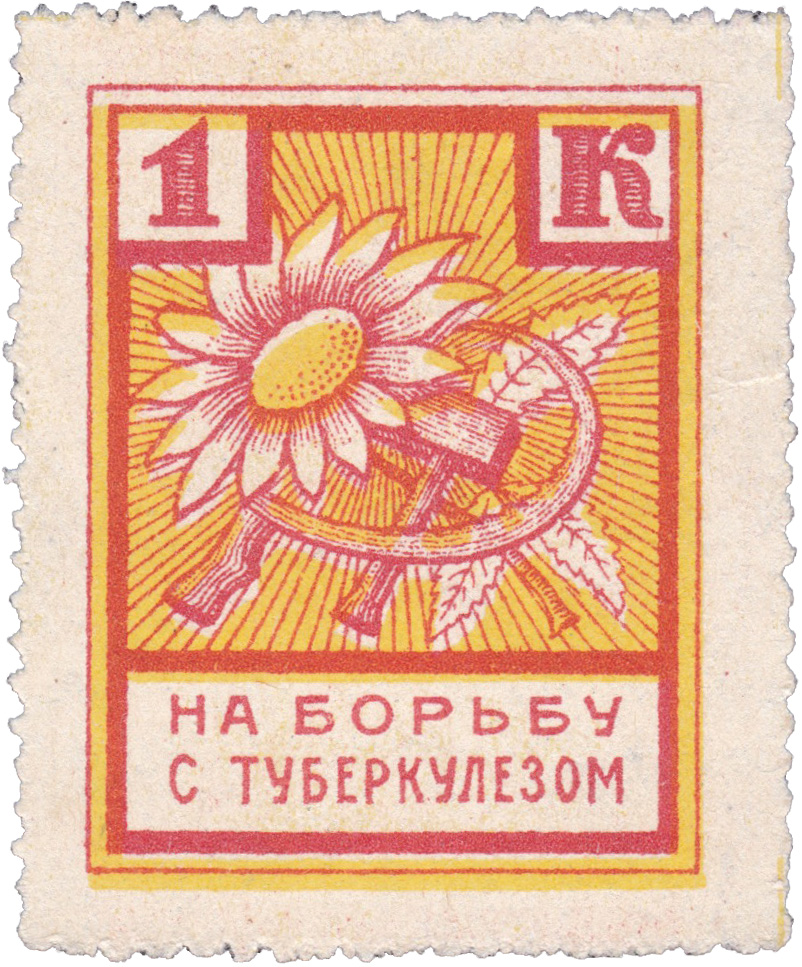
April 20–24, 1910 — in St. Petersburg, the Council of the All-Russian League for the Fight Against Tuberculosis was established.
Its governing board included prominent physicians, scientists, and public figures. The League’s strongest organizations were located in St. Petersburg, Moscow, Kyiv, Odesa, and Kharkiv. The League’s funds came from various sources: membership dues, donations, allocations from local societies, subsidies from city administrations, zemstvos, and the government, and later also income from real estate and interest on capital.
To increase fundraising for the fight against tuberculosis, the League adopted the idea of holding a “White Flower” (“White Daisy”) Day, which originated in the Scandinavian countries. The first “White Daisy” Day was held in Sweden on May 1, 1908. At that time, consumption was incurable, and patients needed moral and material support. Selling a white flower as the emblem of the fight against tuberculosis helped draw public attention and raise funds for anti-tuberculosis organizations. The idea was then taken up in Norway, Denmark, Germany, and other European countries.
In Russia, “Tuberculosis Day”—the “White Flower” Day—was first held in 1911 by the All-Russian League for the Fight Against Tuberculosis together with Red Cross organizations. People from different social groups joined the campaign—from gymnasium students, townspeople, and civil servants to members of the imperial family. A total of 104 cities took part, and half a million rubles were collected—an enormous sum (with that money at the time it was possible to build five new hospitals or sanatoria for 40–50 people).
April 11, 1918 — the All-Russian Tuberculosis League was dissolved, and its property was transferred to the People’s Commissariat of Social Welfare of the RSFSR.
From the first days of its existence, the young Soviet state began an active struggle against tuberculosis as a social evil. Anti-tuberculosis hospitals and dispensaries began to open. All anti-tuberculosis institutions were placed on the state budget.
Specially trained medical personnel, in addition to working in these institutions, were expected to conduct extensive preventive work among the population. One form of combating this social evil at the time was the organization of three-day anti-tuberculosis campaigns, in which, besides medical workers, broad segments of the population also took part.
These three-day campaigns, held throughout the country, became one of the best methods of mass outreach and of raising funds to fight tuberculosis. The movement operated under the general slogan “Protecting the health of working people is the task of working people themselves.” In Moscow, five such annual three-day campaigns were held (1922–1926). Each had its own slogan:
in 1922 — “Dispensaries are centers for the fight against tuberculosis,” in 1923 — “The fight against childhood tuberculosis,” in 1924 — “The fight against tuberculosis as a social disease,” in 1925 — “For improving the work of TB dispensaries,” in 1926 — “Improving the living conditions of working people.”
The emblem of the anti-tuberculosis campaign became the hammer and sickle, adorned with a stylized crimson five-petaled flower.