
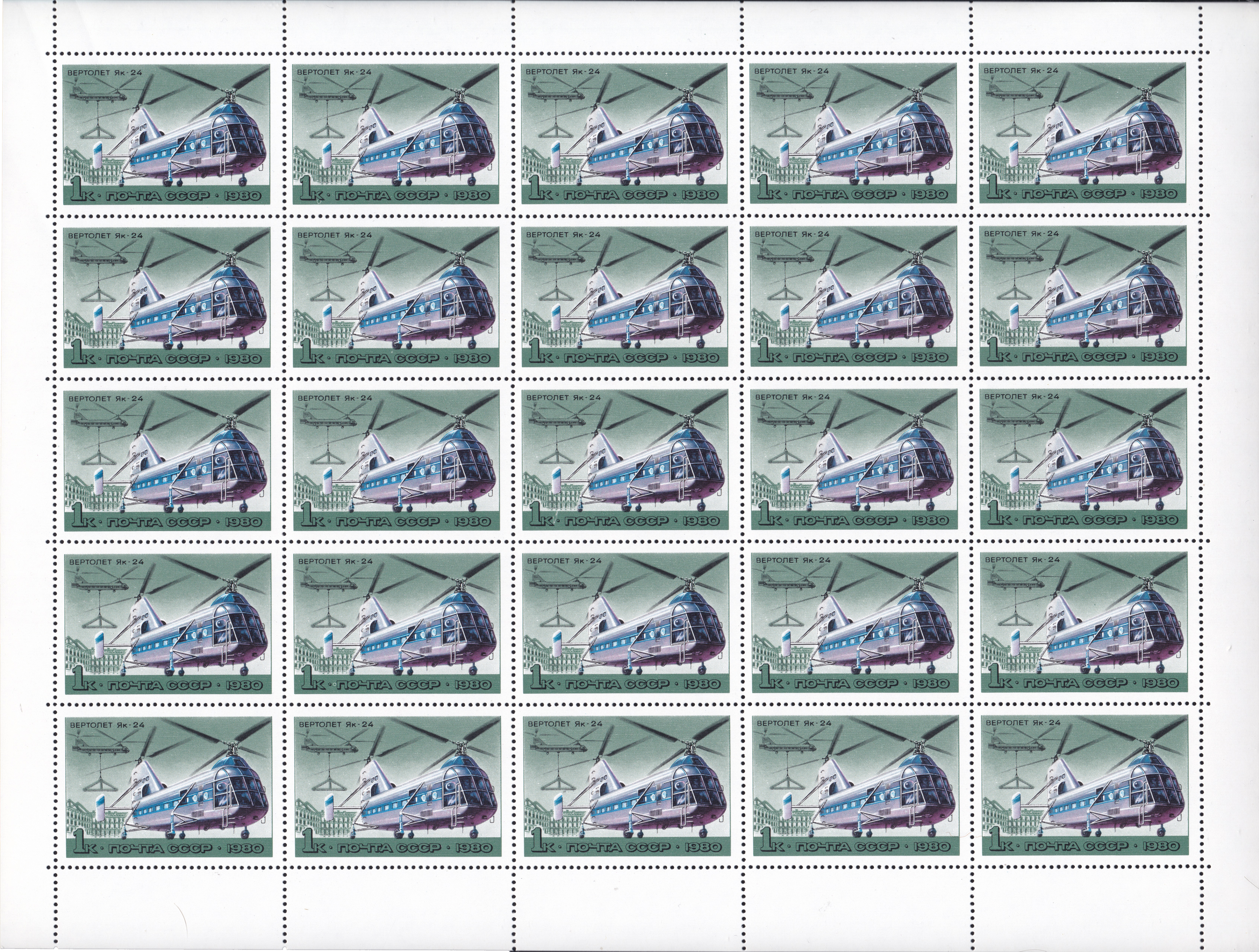
The “Yak-24” stamp from the series “History of Domestic Aircraft Construction, Helicopters” was issued on May 14, 1980. Print run: 7,800,000 copies. Artist: N. Kolesnikov.
By a government decree of October 5, 1951, the Yakovlev Design Bureau was tasked with creating a 24-seat tandem-rotor helicopter powered by ASh-82 engines. A design team was formed consisting of Nikolai Kirillovich Skrzhinsky, Pyotr Dmitrievich Samsonov, Georgy Ivanovich Ogarkov, Sergey Arsenyevich Bemov, Leon Mikhailovich Shekhter, and Igor Alexandrovich Erlikh. A little over two months later, a mock-up commission chaired by Air Marshal N. S. Skripko reviewed and approved the full-scale mock-up and the preliminary design. Structurally, the entire rotor system (blades, main gearboxes) and the powerplant were taken from the Mi-4 helicopter. The helicopter was built in a tandem-rotor configuration and was equipped with two ASh-82V piston engines rated at 1,268 kW.
In January 1952, to set up production of Yak-24 prototypes at Plant No. 272 in Leningrad, I. A. Erlikh was sent there on assignment. Two machines built there were intended for static and dynamic (endurance) tests; two others were delivered to Moscow by rail for flight testing.
On July 3, 1952, S. G. Brovtsev first took the aircraft into the air. A total of 142 flights were performed on two helicopters. The main problem turned out to be vibration; to address it, on the proposal of the head of the research department, K. S. Kildisheva[2], the blades were shortened by 50 centimeters. The problem was partially mitigated, and on November 15, 1952, a decision was made to complete the factory test stage and, despite the aircraft’s clear lack of refinement, to transfer it to state trials at the end of 1952.
State trials were repeatedly suspended. One machine, while still undergoing factory endurance tests, burned down; the other fell to the ground from a height of eight meters.
In April 1955, serial production began, and 40 helicopters were produced with a large fuselage accommodating a crew of 3 and up to 30 fully equipped soldiers or 3,000 kg of cargo.
At the end of 1955, on December 17, pilots E. F. Milyutichev and G. A. Tinyakov set two world records in the helicopter, lifting a 4 t load to an altitude of 2,902 m, then a 2 t load to an altitude of 5,082 m.