
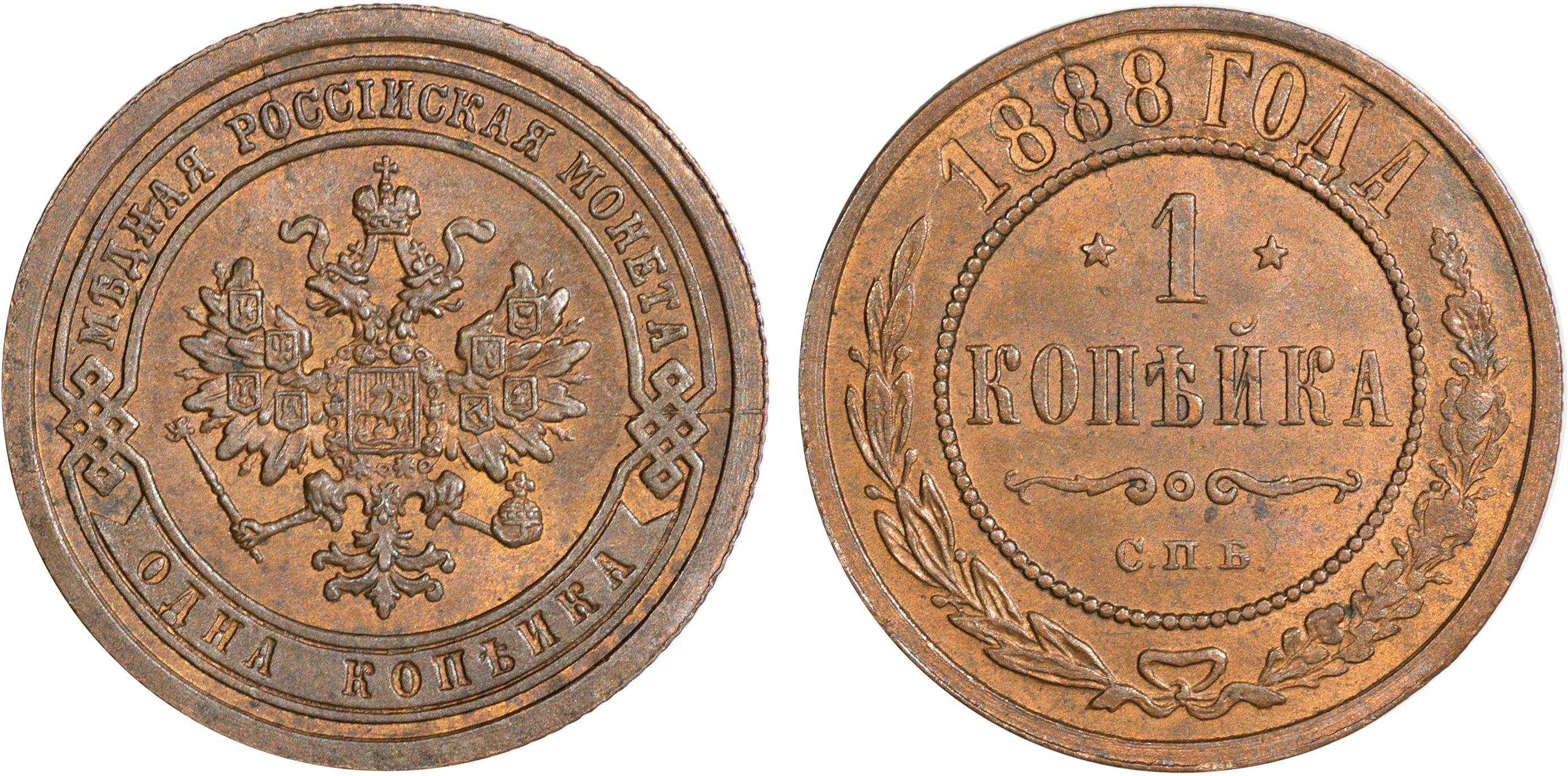
A numismatic society has been opened in Moscow.
On October 17, 1888, near the Borki railway station, located a few kilometers south of Kharkov, the imperial train crashed as Tsar Alexander III, his wife, and their children were returning from a vacation in Crimea.
Despite numerous casualties (20 people died) and severe damage to the rolling stock, including the tsar’s carriage, Emperor Alexander III himself and his family members were unharmed.
At the moment of the crash, Alexander III, his wife, and their children were in the dining car. The car—large, heavy, and long—was mounted on wheel bogies that, in the wreck, tore off, rolled backward, and piled up on top of one another. The same impact knocked out the car’s cross walls; the side walls cracked, and the roof began to collapse. The chamber valets standing in the doorways were killed; the others in the car were saved only because, as it fell, one end of the roof came to rest on the pyramid of bogies. A triangular space formed, allowing the already almost doomed royal travelers to get out of the car—injured, smeared with dirt, but alive. It was said that the tall, strong emperor held up the roof while his loved ones crawled out from under it.
The history of “Kodak” began in 1880, when George Eastman, a clerk at an insurance company, invented a method for making dry negative plates and founded a company called “Eastman Dry Plate Company.” The drive to make photography a mass pastime became the main stimulus for the company’s growth and for the development of methods that simplified the photographic process as much as possible.
In 1888, the firm developed a fundamentally new camera model, a forerunner of modern compact cameras, replacing a cumbersome set of camera, tripod, tent, chemicals, glass plates, and various tanks and containers. The simplicity of the design and ease of use made this camera extraordinarily popular. Foreseeing a mass passion for photography, Eastman proposed giving the camera a name that would sound the same in all languages, be vivid, and be easy to remember and pronounce. Thus the word “Kodak” was born, registered as a trademark in 1888. Many elegant theories were created about the origin of the word.
But it turned out that Eastman simply made it up. Soon it migrated into the company’s name, which in 1890 was renamed “Eastman Kodak Company.” To make photography truly easy and simple, it was important to streamline the process of producing photographs. For this purpose, a network of special photo laboratories was created, where one could bring a camera with an exposed film. The camera would be reloaded with new film, and the exposed one would be developed and prints made. Thus the Kodak slogan was born: “You press the button, we do the rest.” Continuous development and improvement of the business led to a new concept—the creation of a network of photo laboratories united under the common trademark “Kodak Express.”
January 3 — in Washington, a certain M. Stone patented a cocktail straw.
May 18 — in the United States, the first gramophone record was demonstrated for the first time.
August 7 — the first victim attributed to Jack the Ripper was discovered. November 3 — the last victim of Jack the Ripper was discovered. The criminal was never found.
Hertz proved the existence of electromagnetic waves.
Sofya Andreyevna Tolstaya is 44 years old; Lev Nikolayevich is sixty. On March 31, the Tolstoys’ last child was born, a son, Ivan. Two and a half weeks after the birth, Tolstoy, with a knapsack over his shoulder, left for Yasnaya Polyana on foot with Kolichka Ge and secluded himself there. Sofya Andreyevna stayed in the city with the children. At the end of the year, Lev Nikolayevich Tolstoy decided that marriage was a fall, a removal from God, and began to preach chastity. This intention was carried out with great difficulty, and again, as in his youth, Tolstoy tormented himself in his diary over lust, and now he was afraid of his wife’s pregnancy.
In St. Petersburg, a Marxist group of M. I. Brusnev arose, and in Kazan—a circle led by N. E. Fedoseev. Vladimir Ulyanov, having returned from exile to Kazan, immediately joined it.