
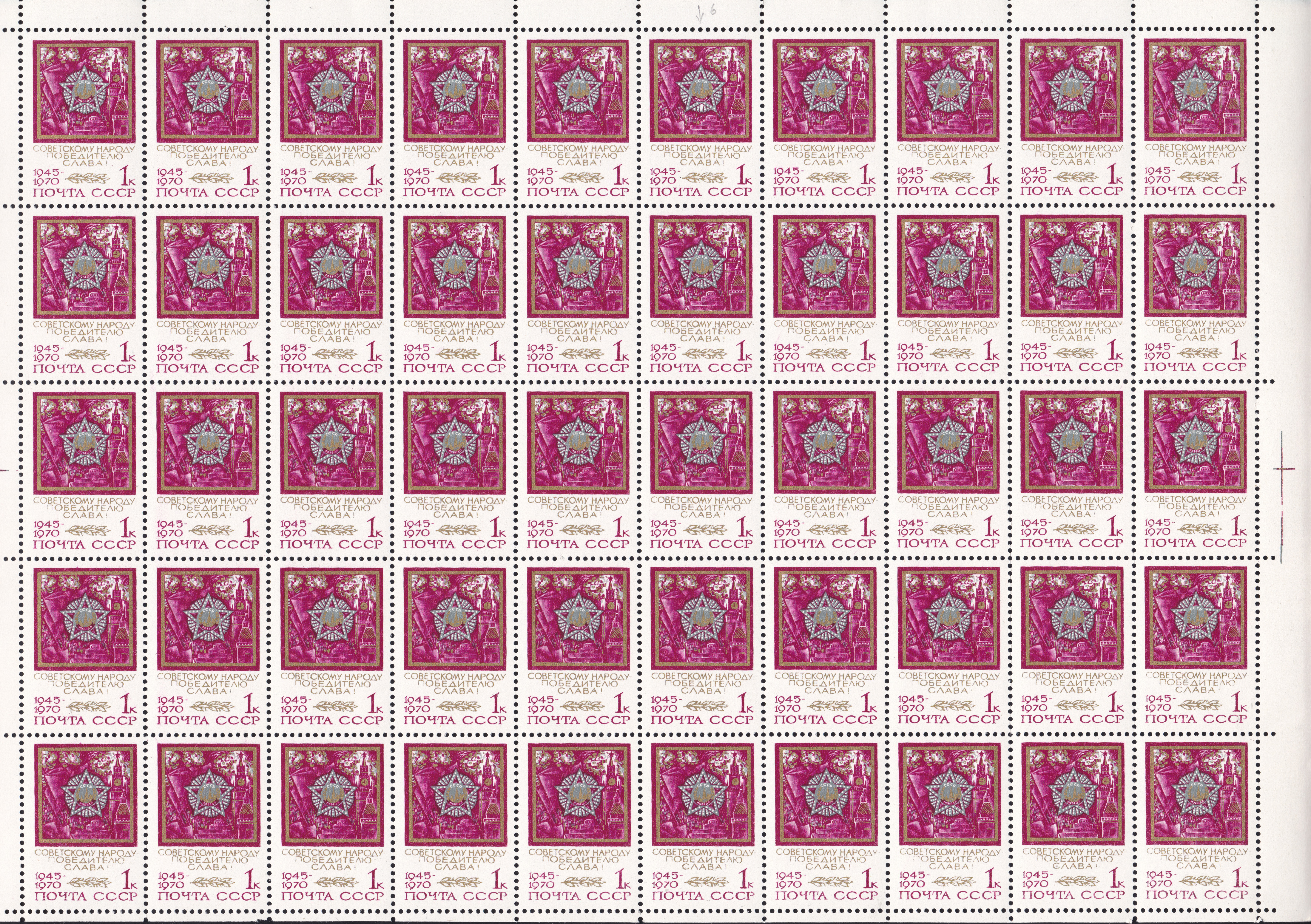
The “Order of Victory” stamp from the series “25 Years of Victory of the Soviet People in the Great Patriotic War” was issued on May 8, 1970. Print run: 5,000,000 copies. Artist: I. Kozlov.
The Order of Victory was the highest military order of the USSR, established by a decree of the Presidium of the Supreme Soviet of the USSR dated November 8, 1943, establishing the Order of Victory simultaneously with the soldiers’ Order of Glory. By a decree of the Presidium of the Supreme Soviet of the USSR dated August 18, 1944, the design and description of the ribbon of the Order of Victory, as well as the rules for wearing the ribbon bar, were approved. In total there were 20 awards and seventeen recipients (three were awarded twice; one was stripped of the award (posthumously)).
The order was proposed by Colonel N. S. Neelov, who served at the rear staff headquarters of the Soviet Army, around June 1943. The original name proposed by Colonel Neelov was the Order “For Loyalty to the Motherland”; however, it was given its current name around October of the same year.
On October 25, 1943, artist A. I. Kuznetsov, who had already designed many Soviet commissions, presented Stalin with his first sketch. The sketch of a round medallion with portraits of Lenin and Stalin was not approved by the Supreme Commander-in-Chief. Instead, Stalin wanted a design with the Spasskaya Tower in the center. Kuznetsov returned four days later with several new sketches, from which Stalin chose one titled “Victory.” He asked Kuznetsov to slightly modify the design, and on November 5 the prototype was finally approved. The order was officially adopted on November 8, 1943, and the first recipients were Georgy Zhukov, Alexander Vasilevsky, and Joseph Stalin.
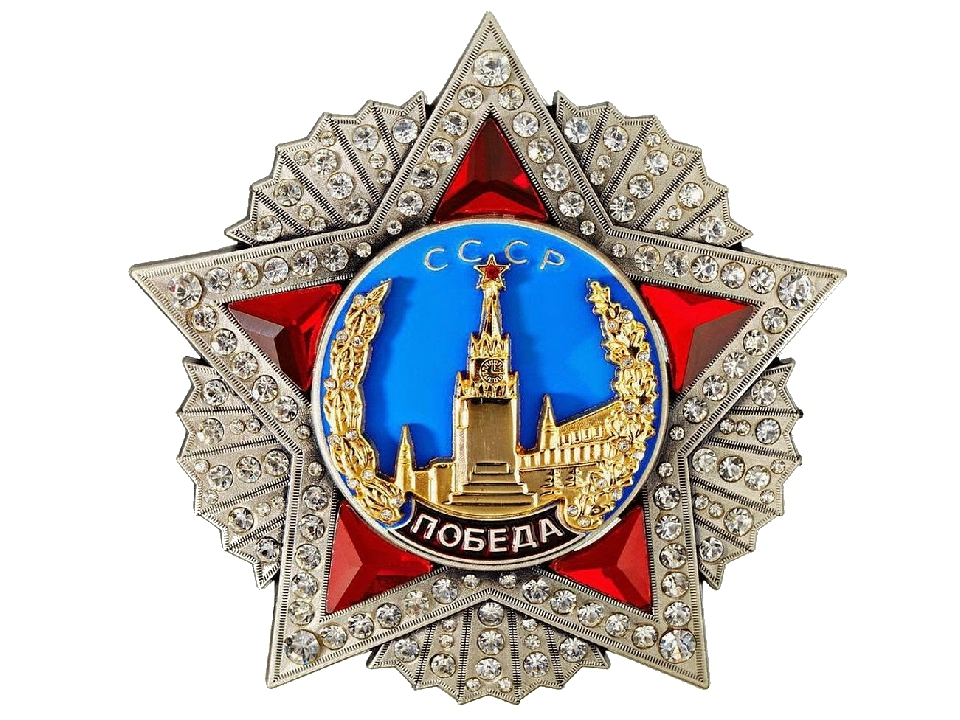
Unlike all other Soviet orders, the Order of Victory had no serial number; the number was mentioned only in the award certificate. After the death of a recipient of the Order of Victory, the award had to be returned to the state. Most of the awards are now kept in the Diamond Fund of the Moscow Kremlin. Notable exceptions are the Order of Victory of King Michael I of Romania, kept in the collection of the Romanian royal family; the Order of Victory of Dwight D. Eisenhower, displayed at the Dwight D. Eisenhower Presidential Library and Museum in Abilene, Kansas; the Order of Victory of Field Marshal Bernard Montgomery, displayed at the Imperial War Museum in London; and the Order of Victory of Josip Broz Tito, kept at the Museum of Yugoslav History in Belgrade.
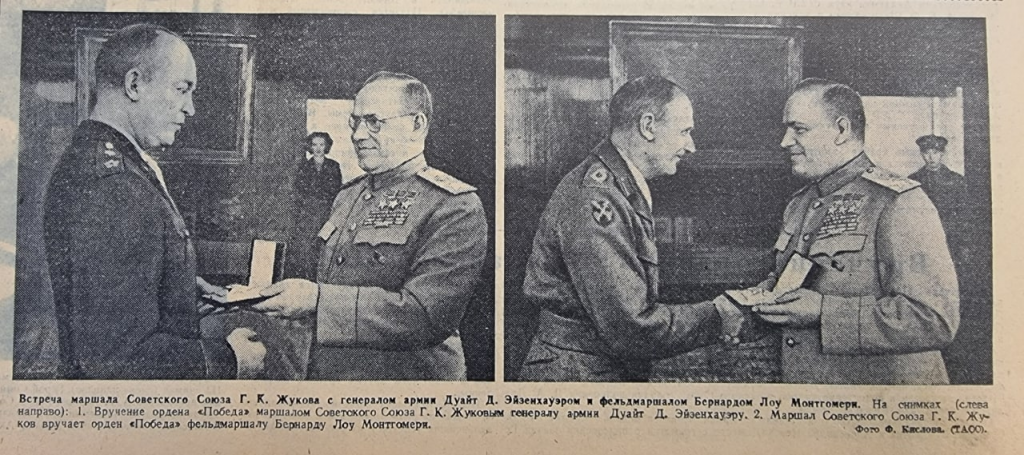
The order is made of platinum in the shape of a five-pointed star with small rays between larger ones, 72 mm in diameter. The star is set with 174 diamonds with a total weight of 16 carats (3.2 g), and the rays of the star are made of ruby. The rubies are synthetic because they had to be of uniform color, which could not be guaranteed with natural stones. In the center of the star is a silver medallion 31 mm in diameter depicting the wall of the Moscow Kremlin, the Spasskaya Tower, and Lenin’s Mausoleum, rendered in gold, surrounded by laurel and oak bands, also colored gold. The tower star is set with a natural ruby. The laurel and oak are tied with a red banner. The sky in the background is inlaid with blue enamel.
The letters “USSR” are applied in gold in the center of the upper part of the medallion, and the word “Victory” is shown in white on the red banner at the bottom, executed in enamel. The total weight of the order is 78 g, including 47 g of platinum, 2 g of gold, 19 g of silver, 25 carats of ruby, and 16 carats of diamond. The value of the award is estimated at 10 million dollars.
A prototype of the order was produced at the Moscow Jewelry and Watch Factory (the other awards were produced at the Mint) by master I. F. Kazyonnov, who had worked with the famous Faberge even before the revolution. He decorated the order with the first Soviet diamonds, which were mined in the Urals.
For 30 orders, 5,400 diamonds and 9 kg of pure platinum were allocated.