
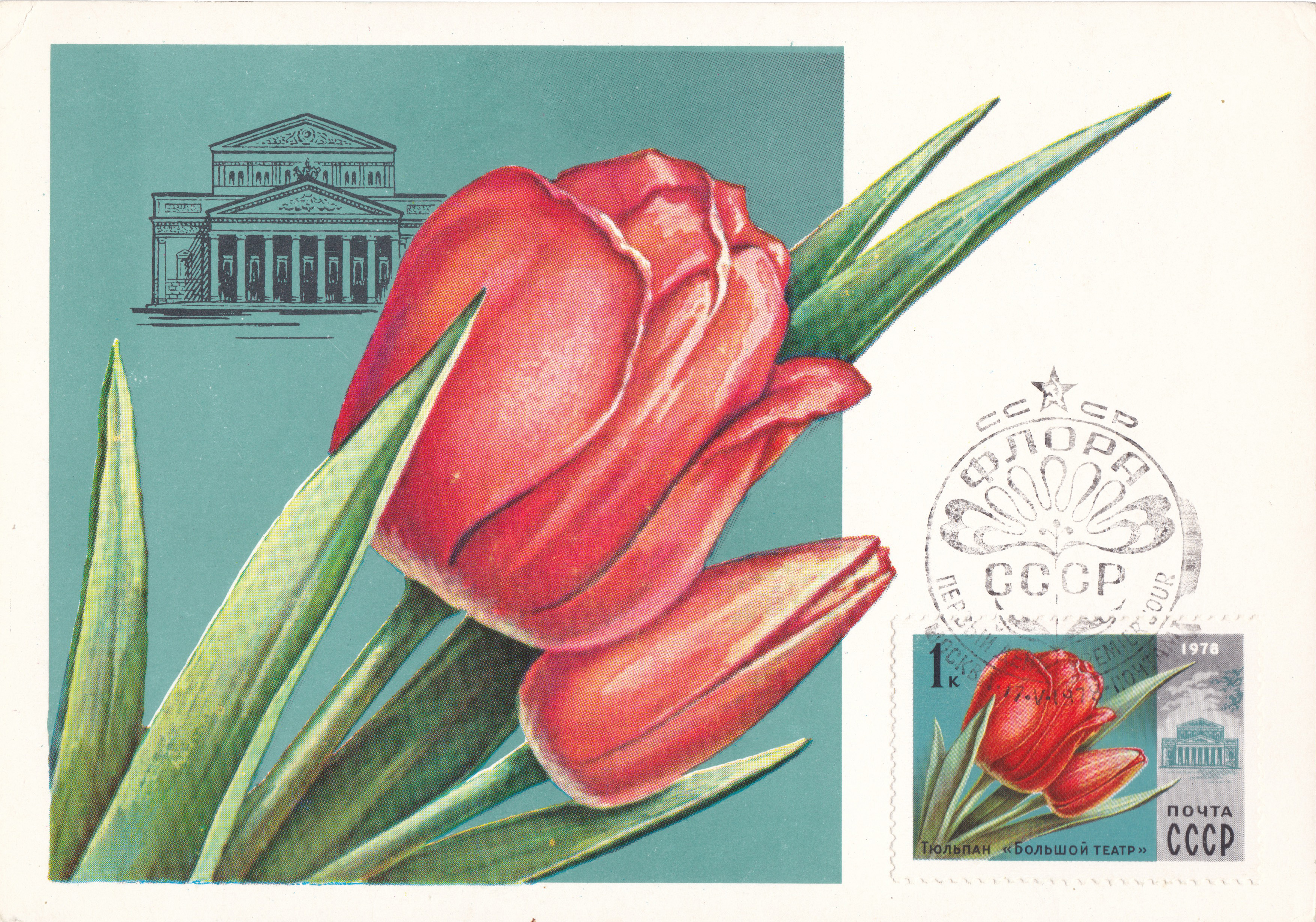
A first-day special-cancellation postcard with a stamp “Tulip ‘Bolshoi Theatre’” from the “Flowers of Moscow” series was issued on May 17, 1978. Print run: 8,500,000 copies. Artist: G. Pikunov.
“Bolshoi Theatre” is a tulip cultivar in the Darwin Hybrid class. It was bred by the renowned Dutch breeder Derek Willem Lefeber. “Bolshoi Theatre,” like the cultivar “Galina Ulanova,” was bred by Lefeber under the impression of a performance of the ballet “Swan Lake” at the Bolshoi Theatre, in which the leading role was danced by the famous Galina Ulanova. These two cultivars are planted every year in front of the State Academic Bolshoi Theatre of Russia.
A classic “Soviet” retro tulip. The cup is bright red. The base is hexagonal, black, well-defined, with a distinct yellow edging of medium width. The stamen filaments are black, with a small pale-yellow tip at the top; the base of the filaments is broad. The anthers are large, brownish-purple. The stigma is pale yellow; the style is greenish-yellow with a slight purple tint closer to the top.
Derek Willem Lefeber was born into a grower’s family and became interested in the profession from an early age. To study hybridization methods, he traveled to the United Kingdom, Germany, and France. As an eighteen-year-old in 1912, he left the Netherlands for Russia. He lived and worked near St. Petersburg. He witnessed the revolutionary events of February and October 1917 and, as a Dutch diplomatic courier, met with the Soviet People’s Commissar for Foreign Affairs, G. V. Chicherin. He told him about his main profession as a breeder-floriculturist and proposed organizing a tulip exhibition in Russia, but the young Soviet Republic had other priorities at the time.
After returning home in 1918, Derek Willem devoted himself wholeheartedly to his beloved work. In the late 1920s he visited our trade representative in The Hague and asked for assistance in acquiring bulbs of wild Russian tulips. The request was granted, and what was then an unusual cargo arrived from Moscow to the Netherlands. The breeder worked with these tulips for more than two decades—and not in vain.
In 1946, D. W. Lefeber visited Moscow and brought as a gift 30,000 red tulips, descendants of the “Russian settlers.”