
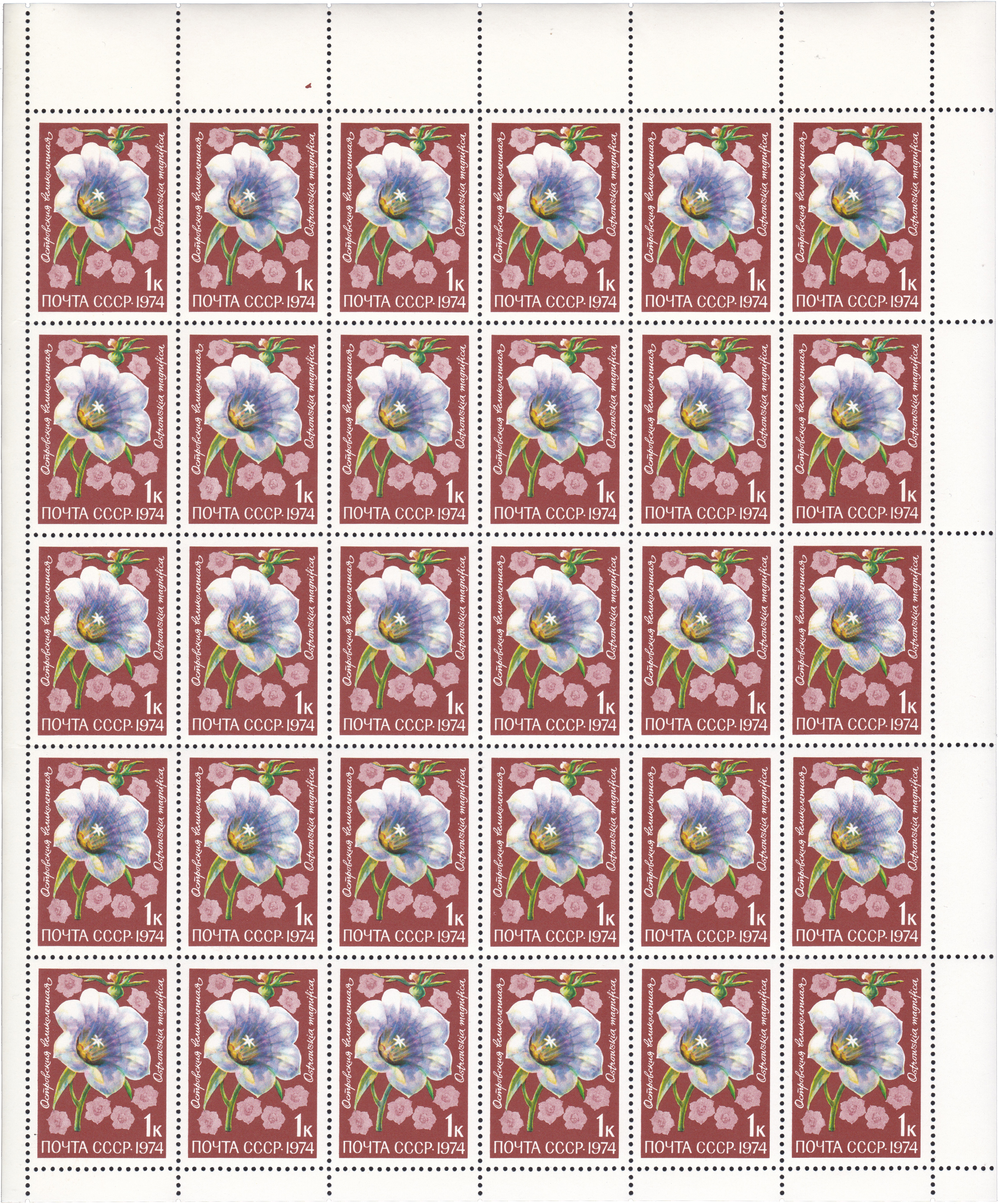
The stamp “Ostrowskia magnifica” from the series “Flowers of Alpine Meadows of Central Asia” was issued on November 20, 1974. Print run: 6,300,000 copies. Artist: V. Tikunov.
Ostrowskia magnifica is the only representative of the relict genus Ostrowskia. It is one of the most interesting plants of the bellflower family. It was discovered in the Darvaz Mountains (Tajikistan) in 1881 by Albert Regel, and in 1884 it was described by Eduard Regel and named in honor of Mikhail Nikolaevich Ostrovsky. Ostrowskia magnifica is endemic to the mountain regions of Central Asia and adjacent areas of northern Afghanistan. It inhabits walnut forests of the mid-mountain belt on clay-and-gravel soils among tall mixed herb vegetation, shrubs, and tree-like juniper.
Because of its high ornamental value, the plant has long been cultivated both in our country and abroad. The first to introduce it into cultivation was E. Regel, who sent several roots of the plant overseas. Ostrowskia was cultivated particularly successfully in Switzerland, where in 1898 B. A. Fedchenko saw splendid plantings of this species near Geneva at the garden of the then well-known horticulturist Marc Micheli. However, over time, for unknown reasons, Ostrowskia disappeared from cultivation. At present, the problem of cultivating Ostrowskia has become highly relevant due to the need to preserve this rare plant. In cultivation it is propagated by means of tuber-like underground organs, and sometimes by seeds.