
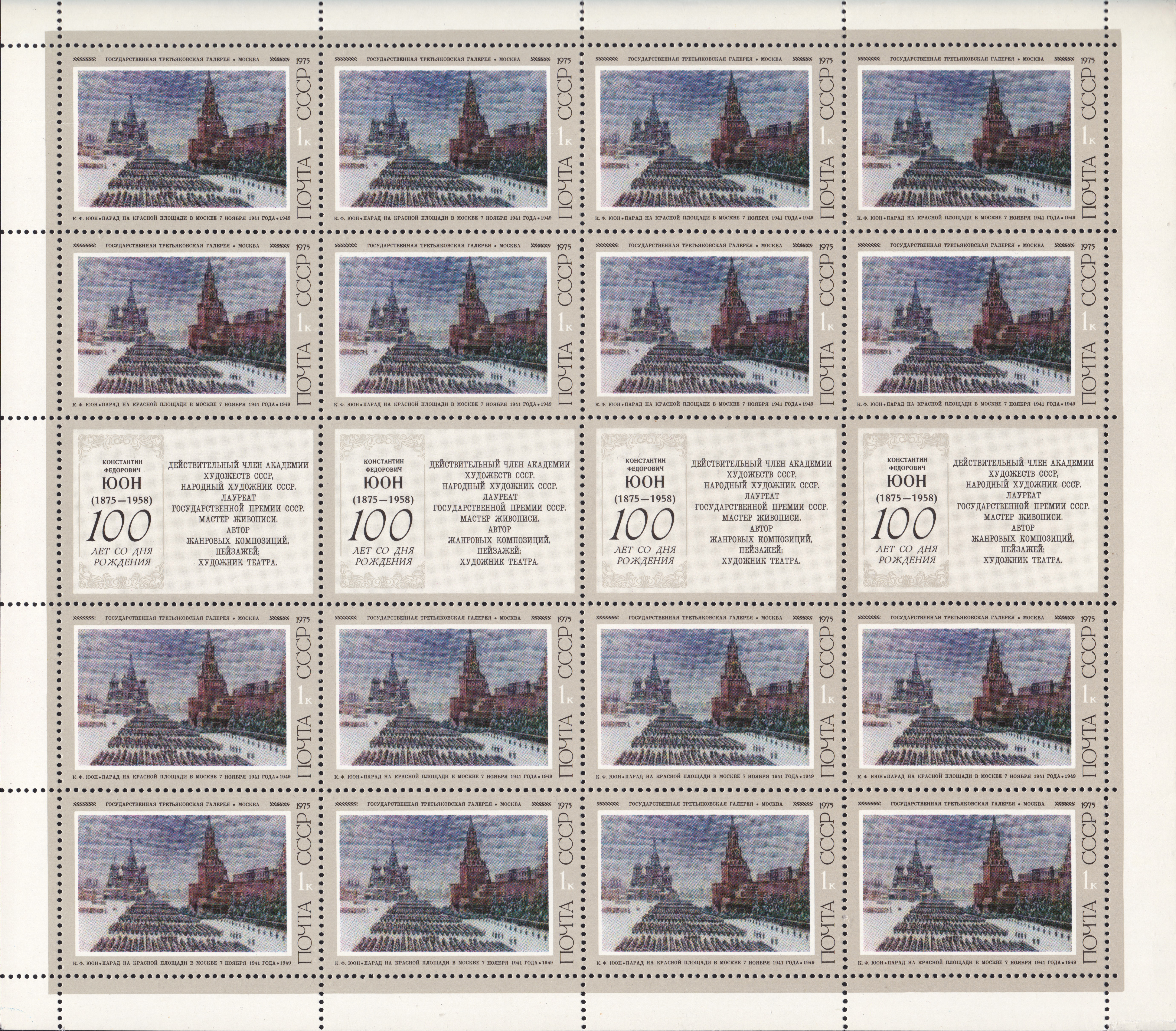
The stamp with a coupon “Parade on Red Square” from the “Soviet Painting” series was issued on July 22, 1975. Print run: 7,300,000 copies. Artist: I. Martynov.
The stamp shows a reproduction of the 1949 painting by Konstantin Fedorovich Yuon, “Parade on Red Square on November 7, ’41”.
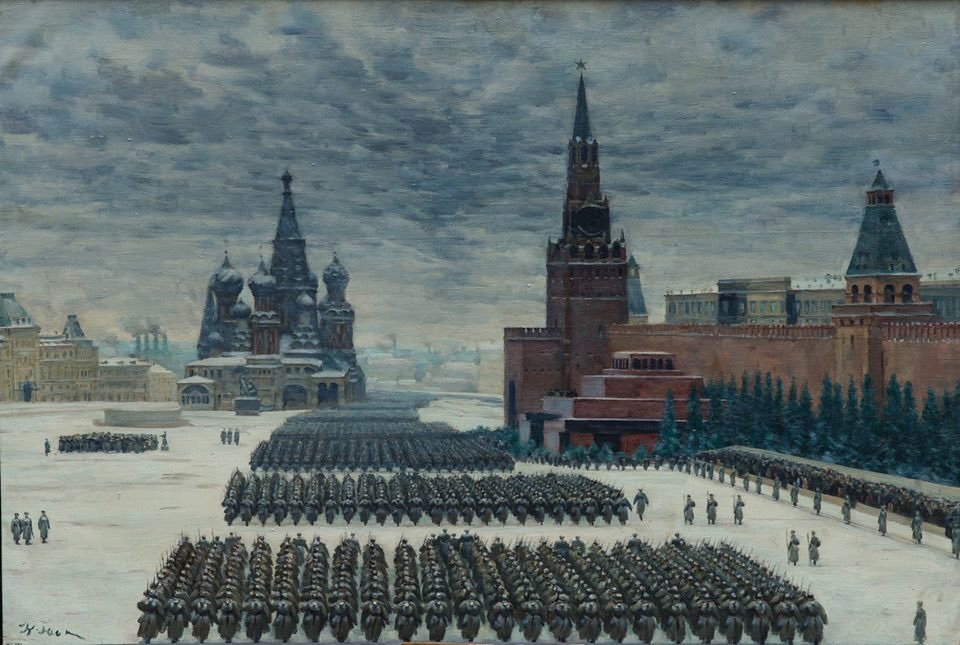
The military parade on Red Square on November 7 was a tradition and the main event of the celebration of the anniversary of the revolution. But in 1941, when Nazi German troops were rapidly advancing across the territory of the Soviet Union, it was hardly the time for a parade.
Late October to early November 1941 were, perhaps, the hardest days of the war for the capital. Industrial enterprises were being evacuated, bridges and factories were being mined, and the enemy was 70–100 kilometers from the city center.
The decision to hold the parade was made at a meeting on October 28 with members of the Politburo and military commanders. At first, when the idea of a military parade was proposed, everyone fell silent, but after a pause there was a unanimous: “Yes, of course, it will raise the morale of the troops and the home front!” Preparations for the ceremonial march began.
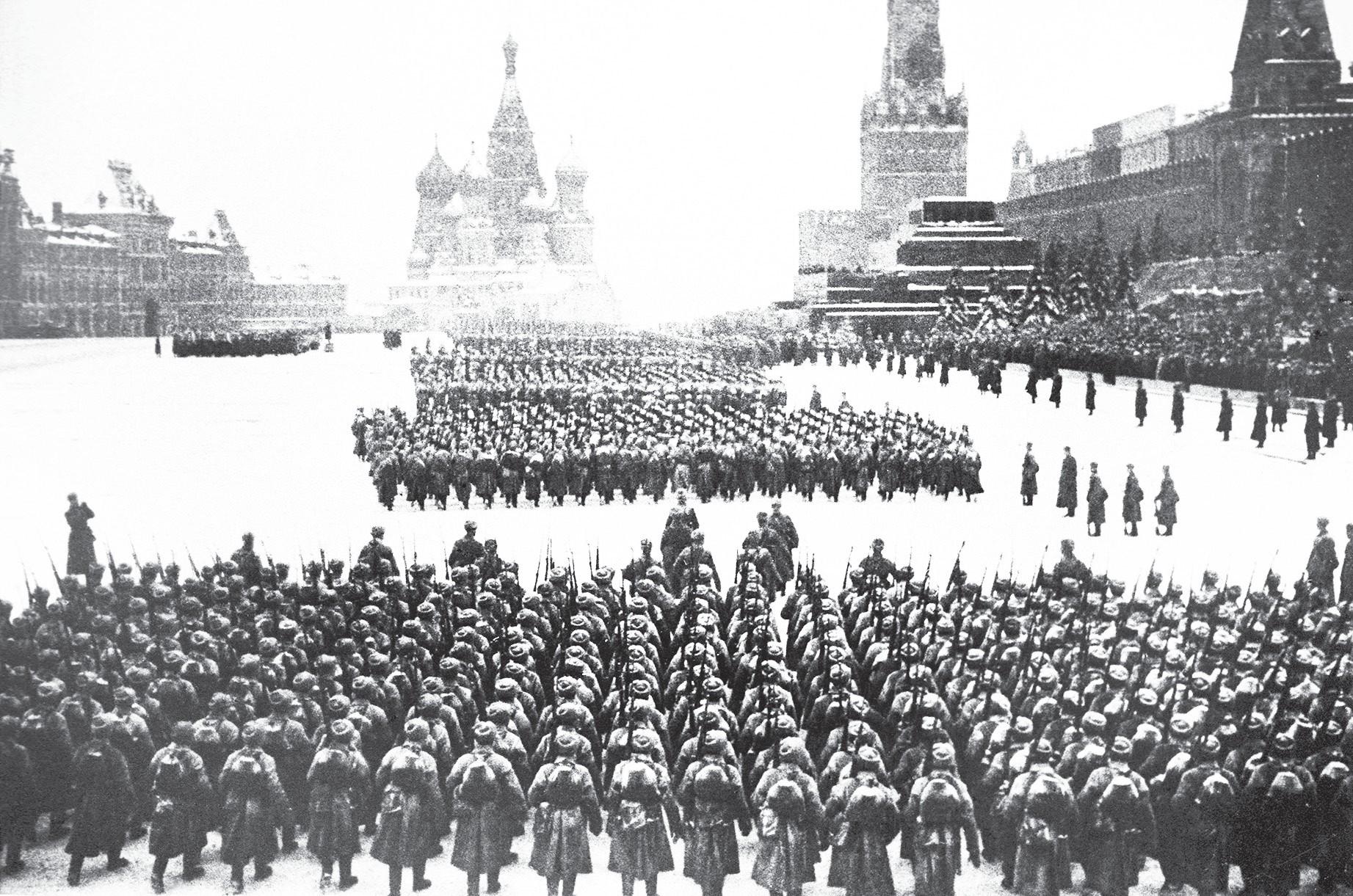
According to the military’s calculations, the parade was to last one hour, one minute, and 20 seconds.
By 08:00 (for safety reasons, it was decided to move the start an hour earlier), the entire area from the Moskvoretsky Bridge to the State Historical Museum building was filled with troops. A total of 28,467 people took part (infantrymen, cavalrymen, riflemen and machine gunners, artillerymen, tank crews, militia volunteers). The hardware on display included 296 machine guns, 18 mortars, 12 anti-aircraft machine guns, 12 small-caliber guns and 128 medium- and heavy-caliber artillery pieces, and 160 tanks (70 BT-7, 48 T-60, 40 T-34, two KV).
The participation of 300 aircraft was planned, but due to heavy snowfall and a blizzard the air segment had to be canceled.
Everyone was prepared for any turn of events. In case of a bombing of Red Square, 35 medical stations were on duty, with ambulances at their disposal, five repair-and-recovery teams, 15 fire engines and other special vehicles for work in the event of building destruction, damage to gas and power networks, and outbreaks of fire.
The parade was opened by cadets of the 1st Moscow Red Banner Artillery School named after L. B. Krasin, to the sounds of S. A. Chernetsky’s march “Parade”; the cavalry rode past to the tune “Cavalry Trot”.
The radio broadcast from Red Square was heard around the world; the commentary was delivered by the well-known Soviet radio announcer and journalist Vadim Sinyavsky.
Hitler turned on the radio and, according to historians, flew into an indescribable rage. He rushed to the telephone and demanded to be connected to the commander of the bomber wing closest to Moscow: “I give you an hour to atone for your guilt. The parade must be bombed no matter what. Take off immediately with your entire formation. Lead it yourself. Personally!”
Not a single bomber reached Moscow. As reported the next day, on the approaches to the city, forces of the 6th Fighter Corps and Moscow’s air-defense anti-aircraft units shot down 34 German aircraft.