
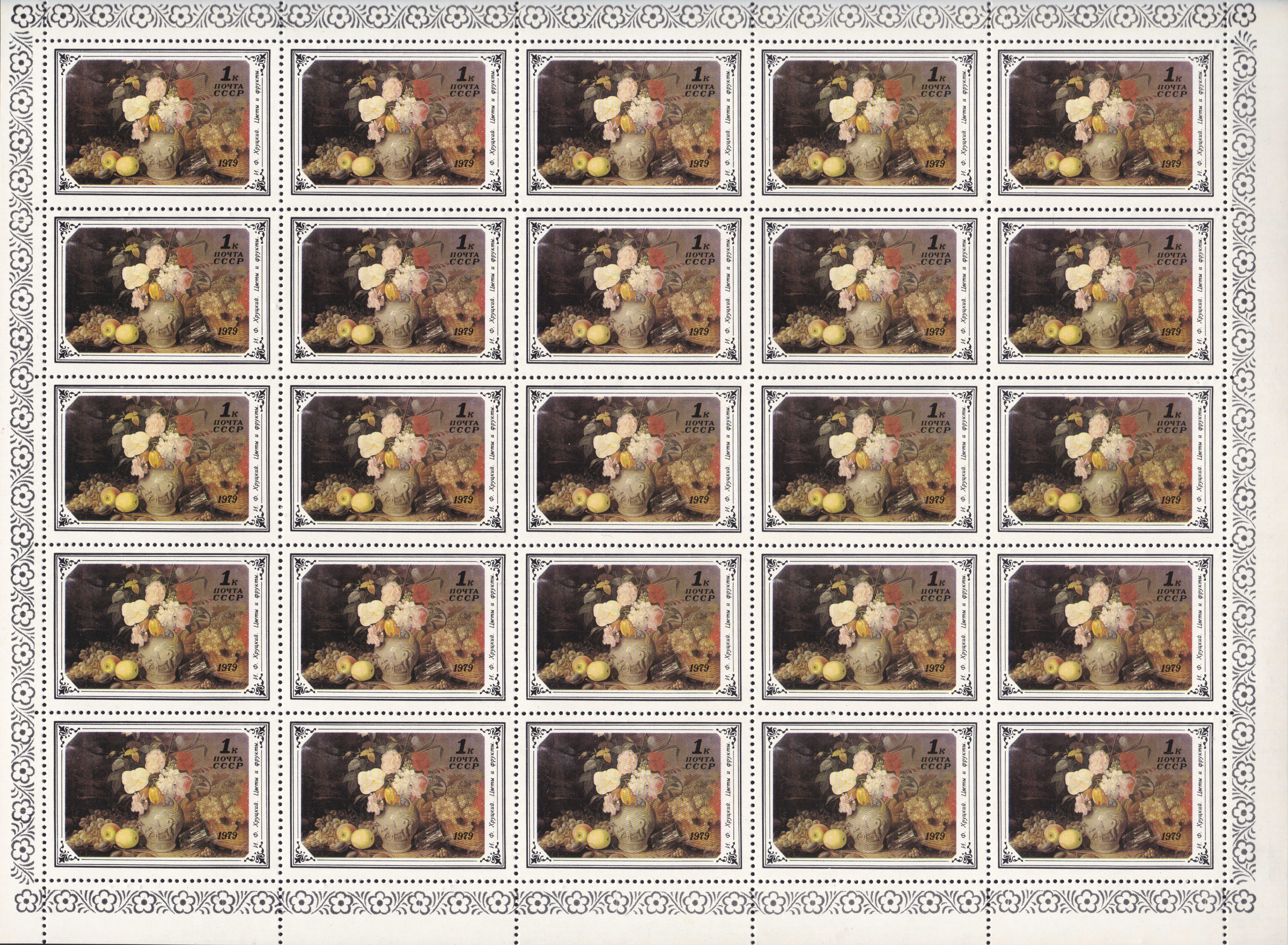
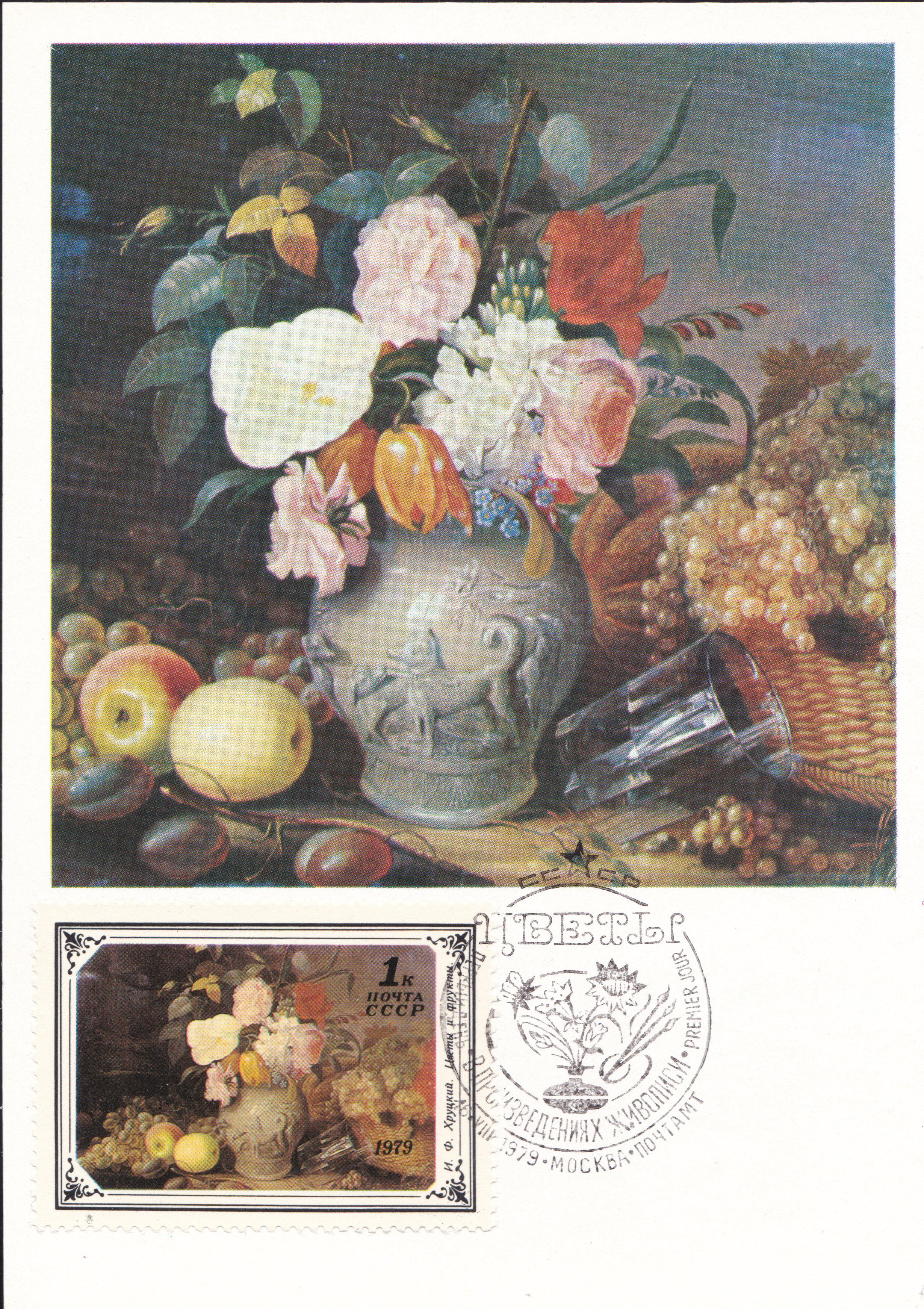
The “Flowers and Fruit” stamp from the “Flowers in Works of Russian and Soviet Painting” series was issued on August 16, 1979. Print run: 8,900,000 copies. Artists: I. Martynov, N. Cherkasov.
The stamp features a reproduction of the painting by the prominent Belarusian artist Ivan Fomich Khrutsky (1810–1855), “Flowers and Fruit” (1839, State Russian Museum).

This still life is arguably Khrutsky’s most famous work. There is a possibility that it was for this painting that the artist received the title of academician.
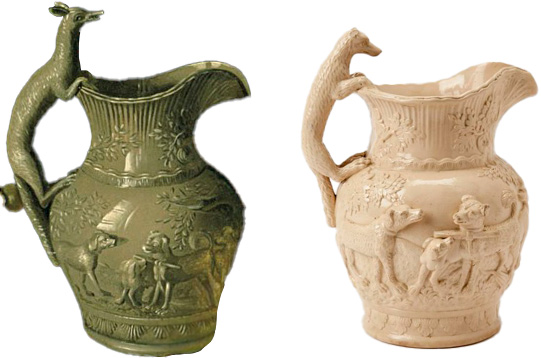
The faience jug is like Khrutsky’s signature: it appears in many of his still lifes. The popularity of inexpensive but striking English faience was high in Russia, and some factories in Russia copied it. A copy of a Minton jug with hunting hounds was produced by the Poskochin factory. But with one change: on the other side, instead of foxes, wolves were depicted. In the still life with a candle, only the side with the hounds is visible,
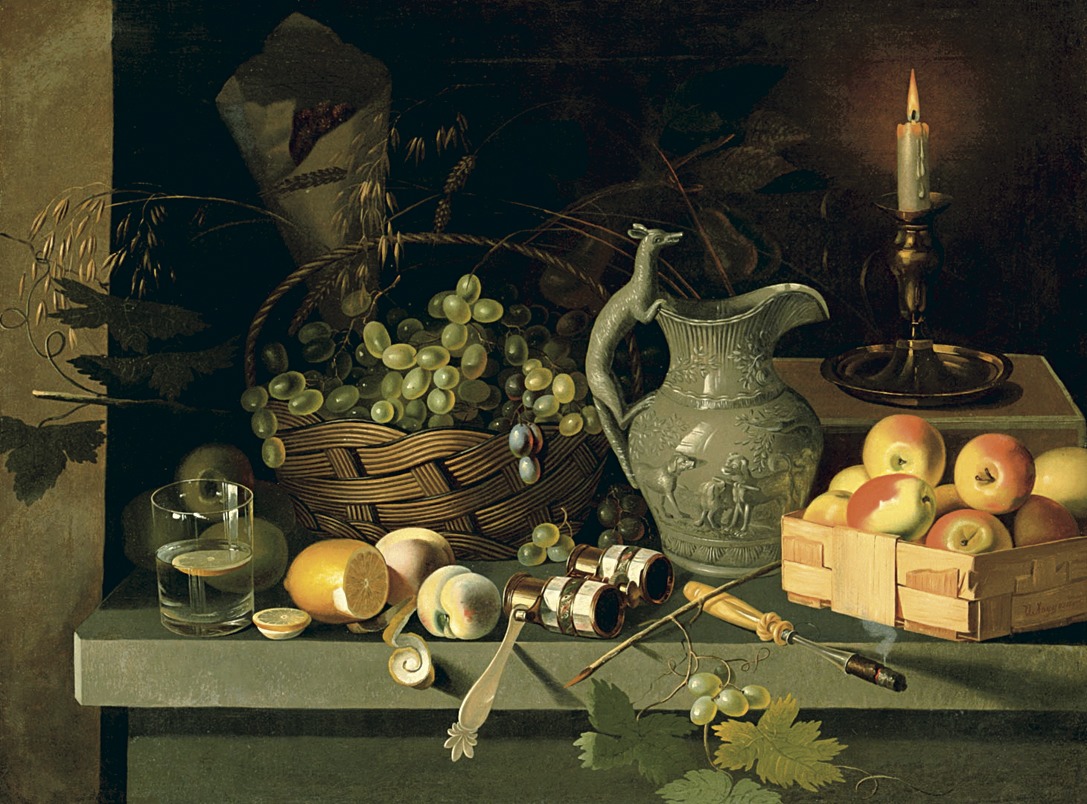
and in the “Flowers and Fruit” composition the jug is turned the other way, and there we see wolves!

Thus, it can be stated with complete certainty that the depicted jug was produced at the factory of Sergey Yakovlevich Poskochin in the village of Morye, Shlisselburg Governorate. The jug is inexpensive and entirely ordinary. But the flowers, fruit, and the painting’s ceremonial composition give it value and weight.

The Poskochin factory made an enormous contribution to the history of Russian faience. Its production facilities were located in the village of Morye. Poskochin bought an estate here and, along with it, the factory from Baron I. F. Fredericks, who had founded it himself 45 years earlier.
Until 1826 it produced glass and glassware, and later porcelain and faience. The main distinction, however, was that the Poskochin factory’s faience used bodies of different colors. The range included white, colored, black, marble-like bodies, and a “cream” color. This made it possible to create unique vases, elegant jugs, and plates with no equivalents. The items were made by hand; almost all production materials were domestic, and only the paints for decoration were imported from Denmark. Domestic raw materials helped keep prices moderate. The assortment of porcelain wares was very diverse and extensive. Luxurious vases, elegant jugs, rusks bowls, lavish serving dishes and plates, souvenir clocks, tea and coffee sets, flacons, small sculptural pieces, and much more were produced there.
In 1829, the first exhibition of domestic manufactures was held in Russia, to which items from the Poskochin porcelain factory were delivered. Experts rated the products very highly, assigned the factory first rank, and noted that the goods were distinguished by solidity and cleanliness of finish, had a beautiful form, and a moderate cost. The factory was Poskochin’s brainchild until 1842, after which he sold it to the wife of Colonel S. A. Golenishcheva-Kutuzova.
In 1851 the factory was sold to Baron Korf, who owned it until 1887. Throughout this period, Korf leased the factory to various people who, with frequent interruptions, produced porcelain and faience that, in their technological and artistic qualities, were inferior to Poskochin’s. In 1887 the factory was sold to the merchant F. Emelyanov, and from that time only porcelain was produced there, having nothing in common with the faience of the Poskochin factory.