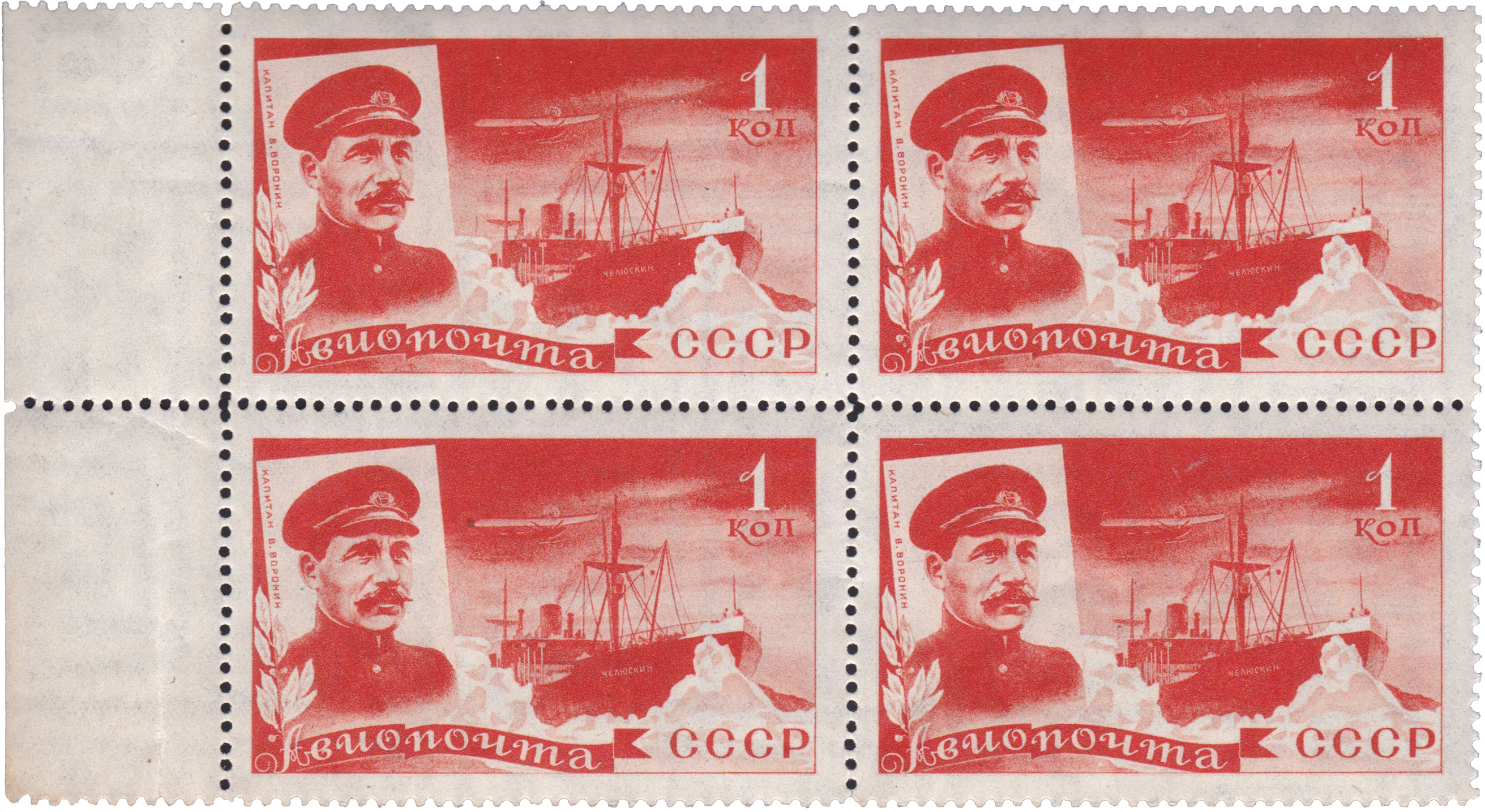
The stamp “Captain of the steamship ‘Chelyuskin’ V. I. Voronin” from the series “Rescue of the Chelyuskinites” was issued on January 25, 1935. Print run: 200,000 copies. Artist: V. Zavyalov.
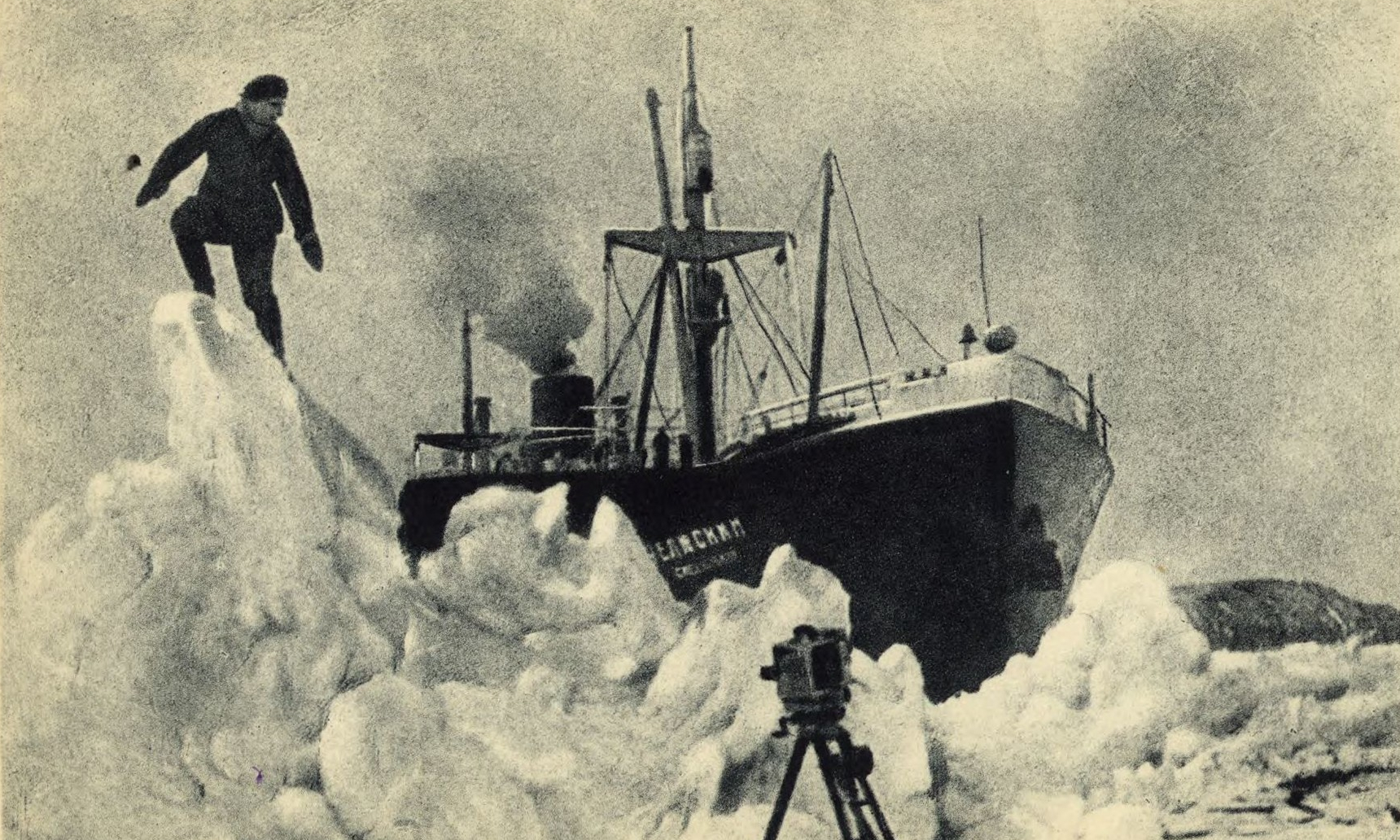
To ensure delivery of cargo to the far eastern areas of the coast via the Northern Sea Route, it was necessary to try to cover the entire route from Europe to Chukotka in a single short summer navigation season. The first to do so, in 1932, was the icebreaker “Sibiryakov.” But icebreakers had insufficient cargo capacity. For commercial freight transport matching the goals of developing the North, vessels were needed with a larger commercial payload, adapted for sailing in northern conditions. This led the Soviet leadership to the idea of using the steamship “Chelyuskin” to develop the Northern Sea Route. It was built in 1933 in Denmark at the shipyards of “Burmeister and Wain,” B&W, Copenhagen, commissioned by Soviet foreign-trade organizations.
“Chelyuskin” was launched on March 11, 1933. Displacement: 7,500 tons.
On August 2, 1933, with 112 people on board, the steamship departed Murmansk for Vladivostok, working out a scheme for delivering cargo along the Northern Sea Route in one summer navigation season. On the most difficult stretches, icebreakers were planned to assist in guiding “Chelyuskin.”
The first floes were encountered in the Kara Sea after leaving the Matochkin Shar Strait. With the help of an icebreaker, the ship broke through the continuous ice and then continued on its own. On September 1, Cape Chelyuskin was reached. In the Chukchi Sea, the steamship again encountered unbroken ice.
On September 9 and 10, “Chelyuskin” received dents on both the starboard and port sides. One of the frames cracked. The leak in the ship intensified.
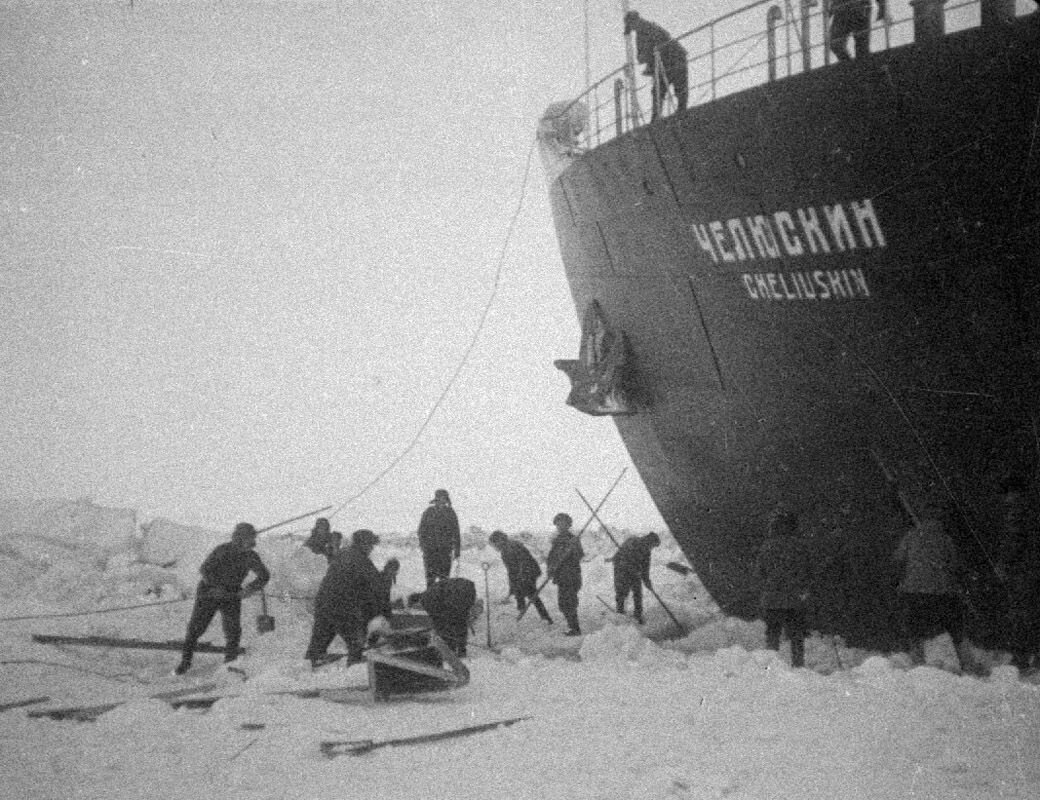
On September 23, it was completely blocked in the area of last year’s accident of the steamship “Aleksandr Sibiryakov.”
“Chelyuskin” drifted with its crew for almost five months.
On one of the autumn-winter September days (autumn by the calendar, winter by the cold), several dog sled teams arrived at “Chelyuskin.” It was a visit of courtesy and friendship from the Chukchi, whose settlement was 35 kilometers from the steamship. No one knew how long the ice captivity would last, and every extra person could become a serious problem. Eight Chelyuskinites—sick, weak, or simply unnecessary under drifting conditions—were sent away on foot... 105 people remained on the ship.
On November 4, 1933, thanks to a favorable drift with the ice, “Chelyuskin” entered the Bering Strait. Only a few miles remained to open water. However, the vessel was then carried back to the northwest. No efforts by the crew could save the situation. Movement south became impossible. In the strait, the ice began moving in the opposite direction, and “Chelyuskin” again ended up in the Chukchi Sea. The ship’s fate depended entirely on ice conditions. Squeezed by ice, the steamship could not move on its own.
On February 13, 1934, as a result of strong compression, “Chelyuskin” was crushed by the ice and sank within two hours. In advance, fearing such an outcome, the crew had prepared everything necessary to unload onto the surrounding ice. The last to leave “Chelyuskin” were Schmidt, Voronin, and the expedition’s supply manager, Boris Grigorievich Mogilevich. Bricks and boards, from which barracks were built, were managed to be moved onto the ice.
As a result of the disaster, 104 people ended up on the ice (8 people, for various reasons, had left the steamship earlier near Kolyuchin Island; in the Kara Sea, a daughter, Karina, was born to the family of surveyor Vasilyev, who had joined the expedition with his pregnant wife; one person—the supply manager B. G. Mogilevich—died during the sinking of the ship, crushed by a shifted deck cargo).
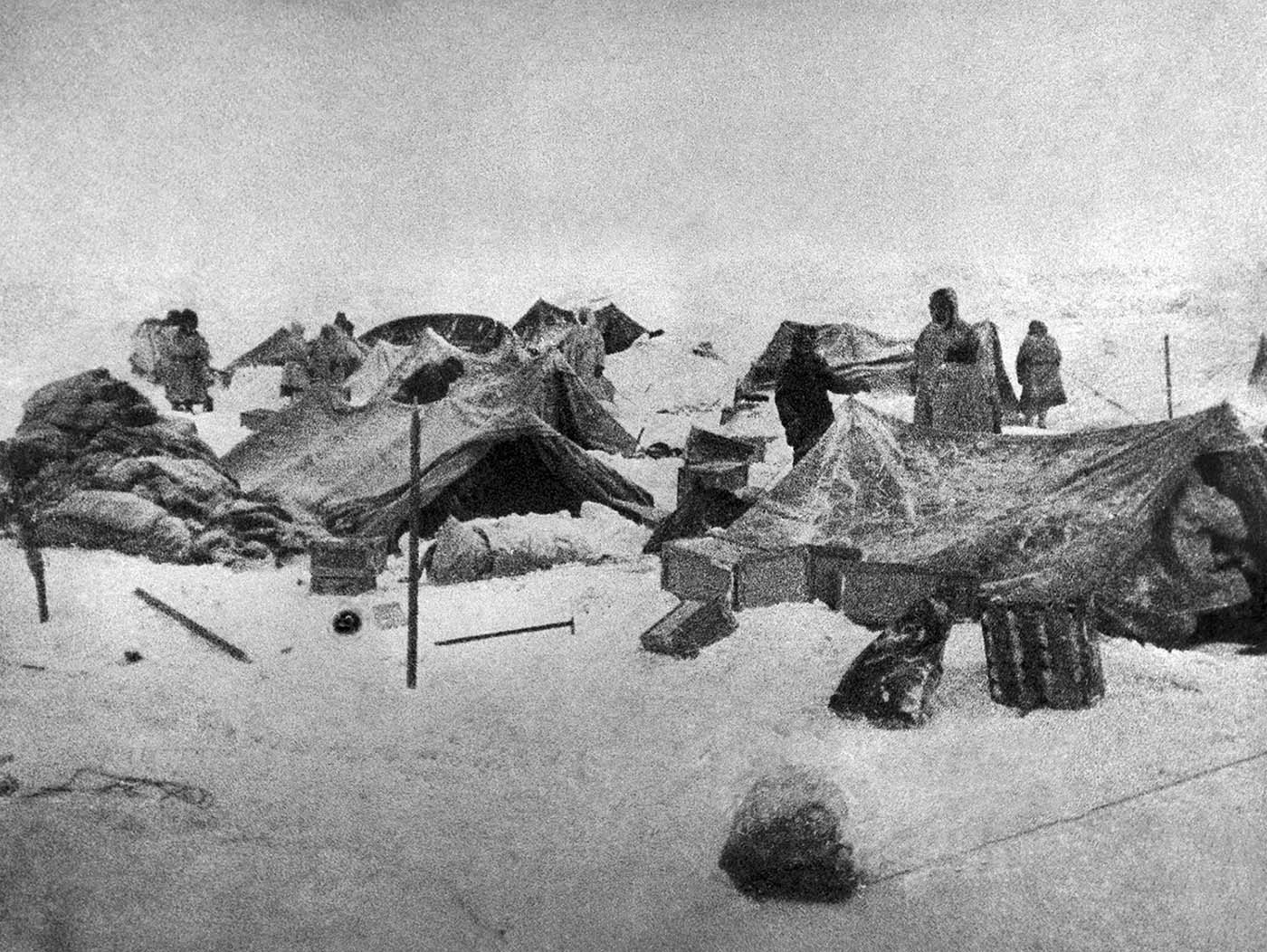
When the people found themselves on the ice, a government commission was formed to rescue the Chelyuskinites. Its actions were constantly reported in the press. Many specialists did not believe rescue was possible. Some Western newspapers wrote that the people on the ice were doomed, and that raising their hopes for rescue was inhumane—it would only intensify their suffering. At that time there were still no icebreakers capable of operating in winter conditions of the Arctic Ocean. The only hope was aviation. The government commission sent three groups of aircraft for the rescue. Note that apart from two “Fleisters” and one “Junkers,” the remaining aircraft were domestically produced.
The results of the crews’ work were as follows: Anatoly Lyapidevsky made one flight and evacuated 12 people; Vasily Molokov, over nine flights, 39 people; Kamanin, over nine flights, 34 people; Mikhail Vodopyanov made three flights and evacuated 10 people; Mavriky Slepnev, in one flight, five people; Ivan Doronin and Mikhail Babushkin made one flight each and evacuated two people each.
For two months, from February 13 to April 13, 1934, 104 people fought for their lives, carried out heroic work to establish an organized life on the ocean ice and to build an airfield that constantly broke apart, became covered with cracks and pressure ridges, and was buried by snow. Preserving a human community in such extreme conditions is a great feat. The history of Arctic exploration knows cases when, in such conditions, people not only lost the ability for collective struggle for life, but even committed grave crimes against their comrades for the sake of personal survival. The soul of the camp was Otto Yulievich Schmidt. There, on the ice floe, Schmidt published a wall newspaper and gave lectures on philosophy, which were reported daily in all central Soviet press. The entire world public, aviation specialists, and polar explorers gave the Chelyuskin epic the highest оценка.
In connection with the successful completion of the epic, the highest distinction was established—the title Hero of the Soviet Union. It was awarded to pilots A. Lyapidevsky, S. Levanevsky, M. Slepnev, V. Molokov, N. Kamanin, M. Vodopyanov, and I. Doronin. At the same time, all of them were awarded the Order of Lenin. Subsequently, Gold Star No. 1 was presented to Lyapidevsky. All flight mechanics were awarded, including two Americans. All participants of the expedition who had been on the ice floe, except for the children, were awarded the Order of the Red Star.
1 Kopeck 1935.
USSR.