
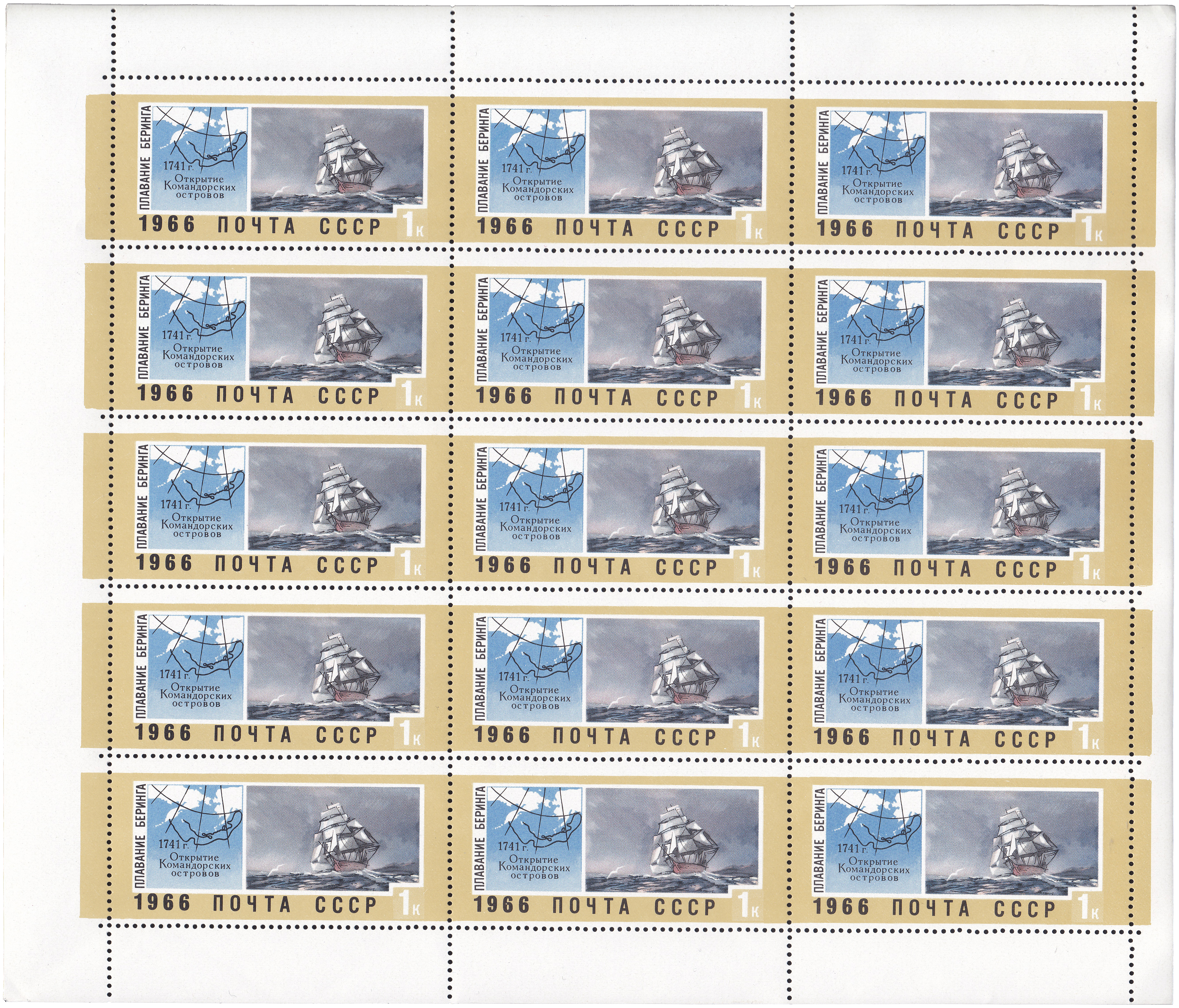
The “Bering’s Voyage” stamp from the “Soviet Far East” series was issued on December 25, 1966. Print run: 4,000,000 copies. Artist: L. Sharov.
One half of the stamp shows an outline map and marks the route taken by Vitus Bering’s Kamchatka Expedition (1733–1743); the other shows the packet boat “St. Peter” sailing toward the Commander Islands, which were first charted in 1741.
The detachment expedition led by Vitus Bering is often referred to simply as the “Second Kamchatka Expedition.” Its mission was to find a route to North America and to discover islands in the northern Pacific Ocean.
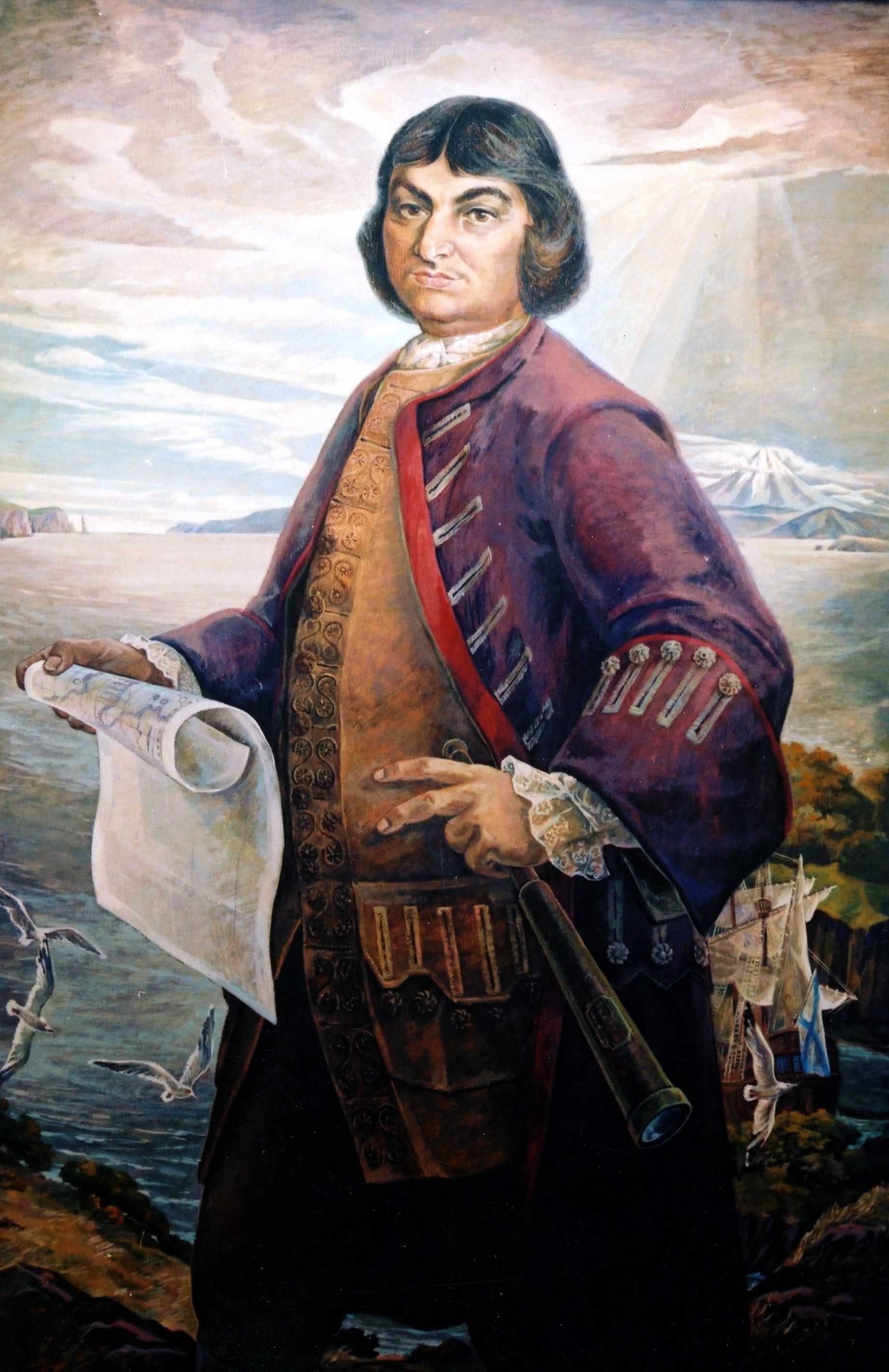
By the summer of 1740, in Okhotsk, under the supervision of shipwrights Kozmin and Rogachev, two packet boats (“St. Peter” and “St. Paul”) were built for the detachment. In September of the same year, the ships under the command of Bering (“St. Peter”) and Alexey Chirikov (“St. Paul”) crossed to the shores of Kamchatka, losing part of their provisions during a storm along the way. In Avacha Bay in Kamchatka, the detachment members founded a stockade that later grew into the city of Petropavlovsk-Kamchatsky.
On June 4, 1741, the packet boats “St. Peter” and “St. Paul” set course for the shores of North America. At the very beginning of the voyage, the ships lost sight of each other in heavy fog and proceeded separately.
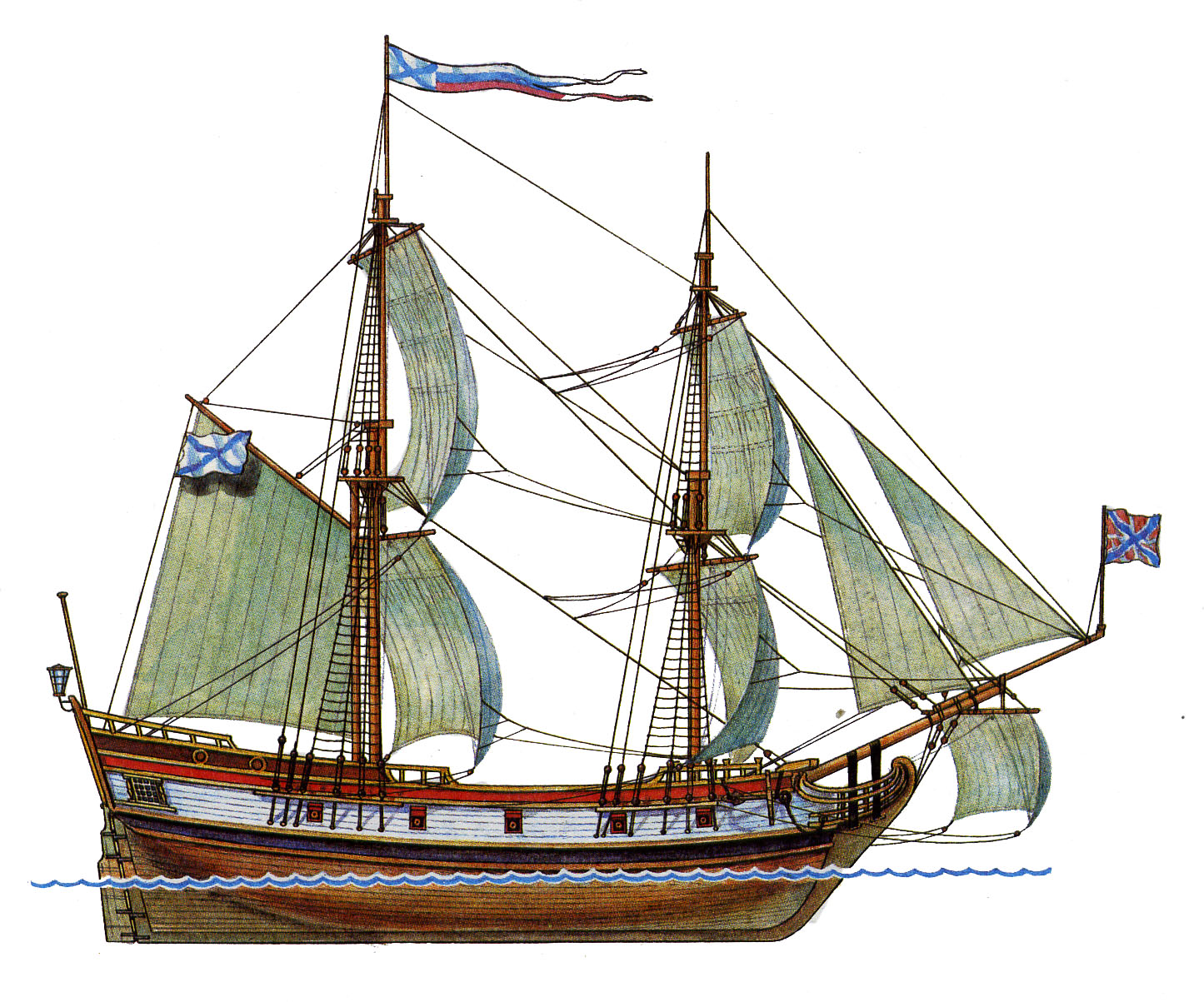
“St. Peter” reached the southern coast of Alaska on July 17 in the area of the St. Elias Range. By then Bering was already feeling unwell, so he did not even go ashore—after so many years of striving to reach it. Near Kayak Island the crew set foot on American soil, replenished their fresh-water supply, and the vessel began moving southwest, from time to time noting individual islands to the north (Montague, Kodiak, Foggy) and groups of islands. Progress against a headwind was very slow; sailors fell ill with scurvy one after another, and the ship suffered from a shortage of fresh water.
At the end of August, “St. Peter” approached one of the islands for the last time; the ship stayed there for a week, and the first encounter with local inhabitants—the Aleuts—took place. The first sailor of the expedition to die of scurvy, Nikita Shumagin, was buried on the island, and in his memory Bering named these islands after him.
On September 6, “St. Peter” headed due west across the open sea, along the chain of the Aleutian Islands. In stormy weather the packet boat was tossed about like a chip of wood. Bering was already too ill to command the ship. Finally, two months later, on November 4, high snow-covered mountains were sighted from the vessel. By that time the packet boat was virtually unmanageable and drifted “like a piece of dead wood.” The sailors hoped they had reached the shores of Kamchatka. In fact, it was only one of the islands of an archipelago that would later be called the Commander Islands. “St. Peter” dropped anchor not far from shore, but a wave удар tore the ship free and hurled it across the reefs into a deep bay near the coast, where the swell was not so strong. This was the first lucky chance of the entire voyage. Taking advantage of it, the crew managed to transport the sick, the remaining provisions, and equipment ashore.
Another major stroke of luck was the discovery, by Georg Steller (who was part of the expedition), of numerous herds of sea cows, whose meat helped many sailors survive the winter.
Adjacent to the bay was a valley surrounded by low mountains already covered with snow. A small river with crystal-clear water ran through the valley. They had to зимовать in dugouts covered with tarpaulins. Of the 75-man crew, thirty sailors died immediately after the shipwreck and during the winter. Captain-Commander Bering himself died on December 6, 1741. Later this island would be named in his honor.
The surviving sailors were led by Bering’s senior mate, the Swede Sven Waxell. Having endured winter storms and earthquakes, the crew managed to hold out until the summer of 1742. They were fortunate, too, that the western shore had a lot of Kamchatka timber washed up by the waves and wood debris that could be used as fuel. In addition, one could hunt Arctic foxes, sea otters, and sea cows on the island, and with the coming of spring—fur seals. Hunting these animals was very easy because they were not afraid of humans at all.
In the spring of 1742, construction began on a small single-masted vessel from the remains of the partially разрушенного “St. Peter.” And again the crew was lucky: despite the fact that all three ship’s carpenters had died of scurvy and there was no shipbuilding specialist among the naval officers, the shipwright team was led by the Cossack Savva Starodubtsev, a self-taught shipbuilder who, during the construction of the expedition packet boats in Okhotsk, worked as a common laborer and was later taken into the crew. By the end of summer, the new “St. Peter” was launched. It was much smaller: keel length 11 meters, width less than 4 meters.
The 46 survivors put to sea in dreadful cramped conditions in mid-August, and just four days later reached the coast of Kamchatka; nine days after that, on August 26, 1742, they arrived at Petropavlovsk.
For his, without exaggeration, heroic feat, Savva Starodubtsev was awarded the rank of “son of a boyar.” The new hooker “St. Peter” sailed for another 12 years, until 1755, and Starodubtsev himself, having mastered the shipbuilding trade, built several more ships.