
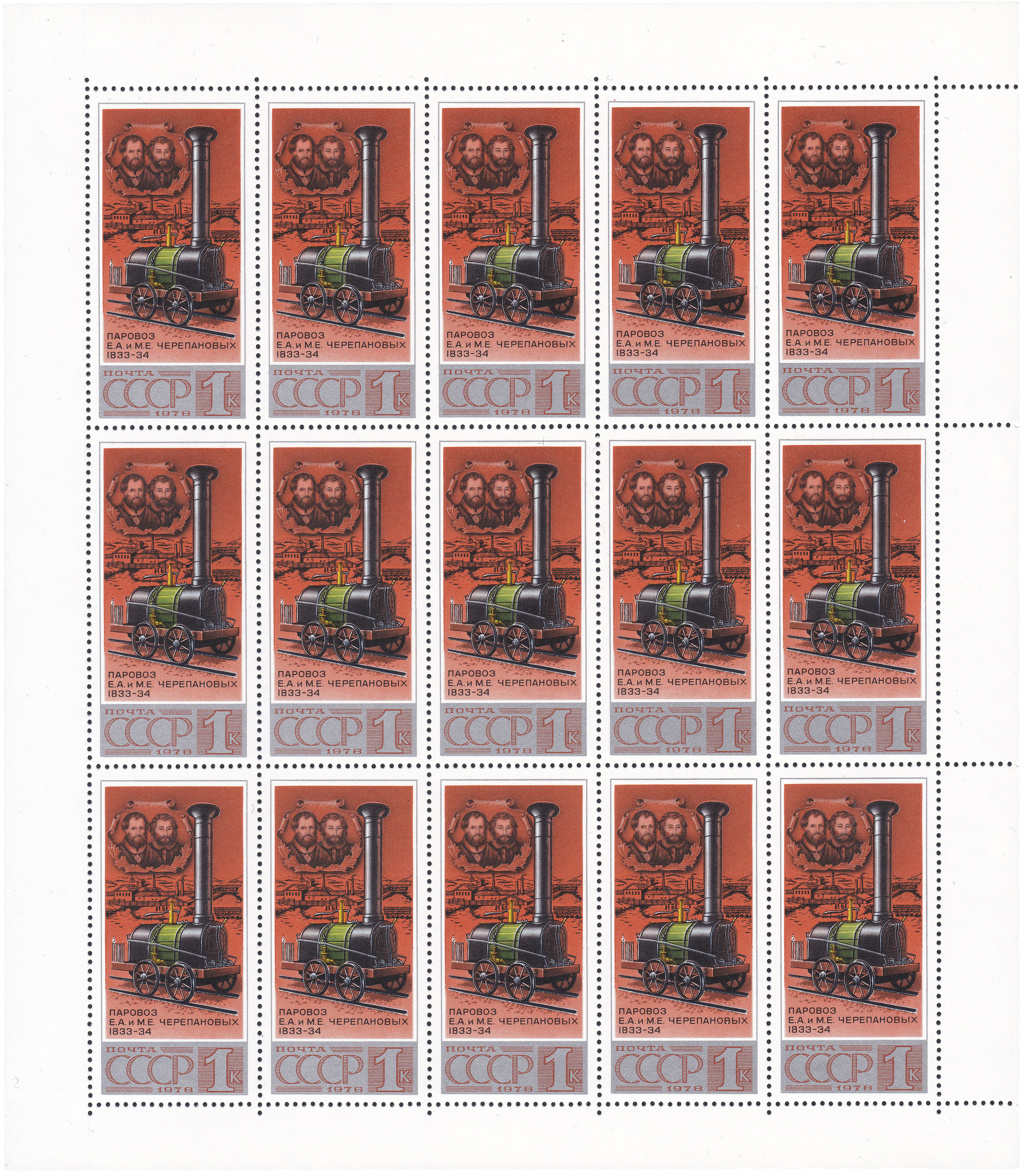
The stamp “The First Russian Steam Locomotive of E.A. and M.E. Cherepanov, 1833–34” from the series “History of Domestic Steam Locomotive Building” was issued in April 1978. Print run: 7,400,000 copies. Artist: I. Kolesnikov.
Self-taught inventors and serfs, Yefim Alekseyevich Cherepanov and his son Miron came from the registered peasants of the Vyisky Plant. Yefim Alekseyevich, as a dam master, in 1820 by his “skill and diligence” built the first steam engine, which drove a lathe and replaced the labor of two people. Among nearly 25 devices later designed by the Ural craftsman with the help of his son were lifting, dewatering, screw-cutting, planing, and gold-washing machines with power from 5 to 60 hp. In the Cherepanovs’ own words, all their lives they strove “unceasingly to set up machines for the benefit of the works and to ease the strength of those who labored.” Father and son were well acquainted with various technical innovations being introduced at that time at major enterprises in Russia, England, and Sweden.
Meanwhile, the management of the Nizhny Tagil Plant, and the owner N. Demidov himself, were very skeptical about building steam locomotives. They were far more concerned about why demand abroad for Ural iron had begun to fall. But none of them wanted to admit that the whole matter lay in the technical backwardness of domestic plants, which were unable to achieve high metal quality.
To establish the truth, Demidov sent the elder Cherepanov to England, considering him a sensible and technically competent specialist. However, as expected, the English did not receive the Russian mechanic very warmly, since they were not interested in passing their experience and metalmaking secrets to competitors.
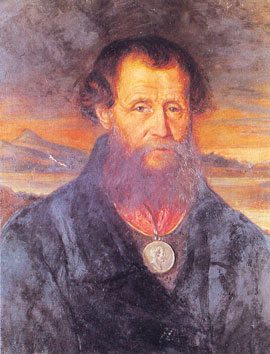
Judging by the surviving letters, Yefim managed only to view the marvels of overseas technology from the outside, since he was not allowed access to drawings and documents. Nevertheless, he coped with his main task. Cherepanov once again became convinced that, to improve the quality of metal produced in the Urals, it was necessary to mechanize workers’ labor. And most importantly, in England he saw for the first time in operation a rail road with steam traction connecting the Middleton coal mines with Leeds.
In 1825 — Demidov sent both Cherepanovs to Sweden to study mining and metallurgical production, and also “to inspect machines.”
In 1833 — Miron Cherepanov visited England, where he took an interest in the operation of rail transport.
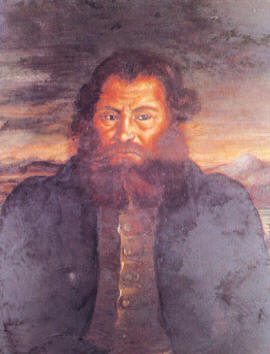
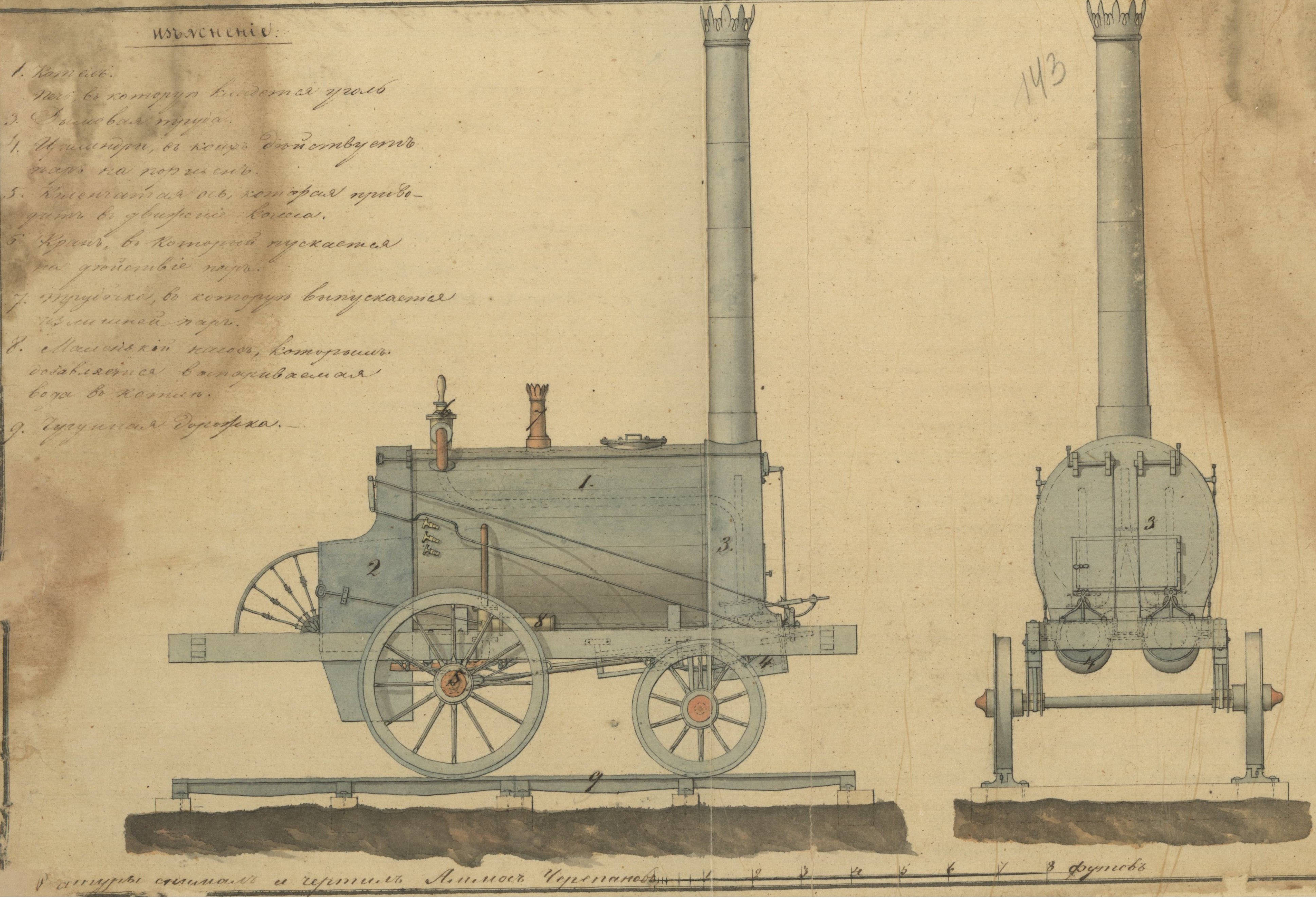
In 1834 — In Nizhny Tagil, father and son Cherepanov began construction of a “steam cart.” They built the locomotive for almost half a year, in their free time away from work — as a hobby. Despite an order from the management to “give the Cherepanovs a way to arrange steam carts for transporting heavy loads,” the Tagil clerks did not relieve the craftsmen of their many duties. Along the way, rails were laid along Podsaraynaya Street, which was soon renamed Parokhodnaya (it is still called that today). A shed was built for the “land stagecoach” — the first Russian depot...
In the first days of September 1834 — the main work was finished.
For building steam engines that “bring honor both to their builder, the simple practical plant servant Cherepanov, and to the Demidovs, who gave him the opportunity for greater self-improvement,” Yefim was awarded a silver medal “For Usefulness.” His Imperial Majesty was pleased to approve the award. Together with the medal, Yefim and his wife received their freedom. Three years later, Miron was freed from serf dependence. Fame and freedom came to the Cherepanovs.
Despite quite successful designs, the Cherepanovs’ locomotives did not become widespread. One of the reasons is considered to be opposition from horse-haulage contractors who did not want to lose their income. But besides this, there were also some objective reasons. Firewood was used as fuel in the Cherepanovs’ locomotives. The locomotive consumed it in such quantities that the problem of delivering it arose very soon. All the forest in the vicinity of the railway was cut down, and firewood had to be brought from far away. This also greatly affected the locomotive’s fate. For example, Stephenson’s first locomotives worked hauling coal from coal mines, which they also used as fuel.
In 1848 — Yefim Cherepanov burned out at work at the age of 68. Many times he asked to retire “due to advanced years.” The petition was considered for three years; no decision was ever made. Yefim Alekseyevich “died of an apoplectic stroke, having gone out on official business on the very eve of his death,” said a report of the plant administration. And six years later, “after an illness died the mechanic Miron Cherepanov, who served about 34 years at the works, who occupied himself with many arrangements in the mechanical part, and likewise rendered not insignificant services in the rebuilding of the plant dams, which were carried out under his observation and guidance.” He was 46.
Where the graves of father and son are is unknown.
In time, Russia became the second country in the world (after England) where its own steam locomotives were built. By the timing of introducing railways with steam traction, Russia held fourth place — after England, the USA, and France. The era of steam locomotives lasted until the 1950s, when their production was completely phased out.