

The stamp “Airship ‘Albatross’ 1910” from the “Airships” series was issued on July 18, 1991. Print run: 4,800,000 copies. Artist: R. Strelnikov.
The background illustration shows combat aircraft and a wagon near Przemysl (a combat zone during World War I).
“Albatross” was a soft (non-rigid) airship of the Russian Empire. It was built in 1913. It took part in World War I, carrying out several combat sorties. It crashed on October 13, 1914 during an emergency landing.
In 1911, construction of an airship with a volume of 9,600 m3 was laid down at the Izhora Plant.
Its construction was completed in the autumn of 1913. It was the most advanced airship of all those built at Russian factories. It was 77 m long, 22 m high, with a maximum diameter of 14.8 m, and could reach speeds of up to 68 km/h. The maximum ceiling reached 2,400 m, and endurance was 20 h. The powerplant consisted of two Clement-Bayard engines rated at 118 kW (150 hp) each, driving two propellers 4.75 m in diameter. The “Albatross” was designed by B. V. Golubov and D. S. Sukharzhevskiy. The lifting gas, hydrogen, was contained in two ballonets of 1,200 m3 each. The envelope was coated with aluminum, which reduced heating of the gas and also served as camouflage.
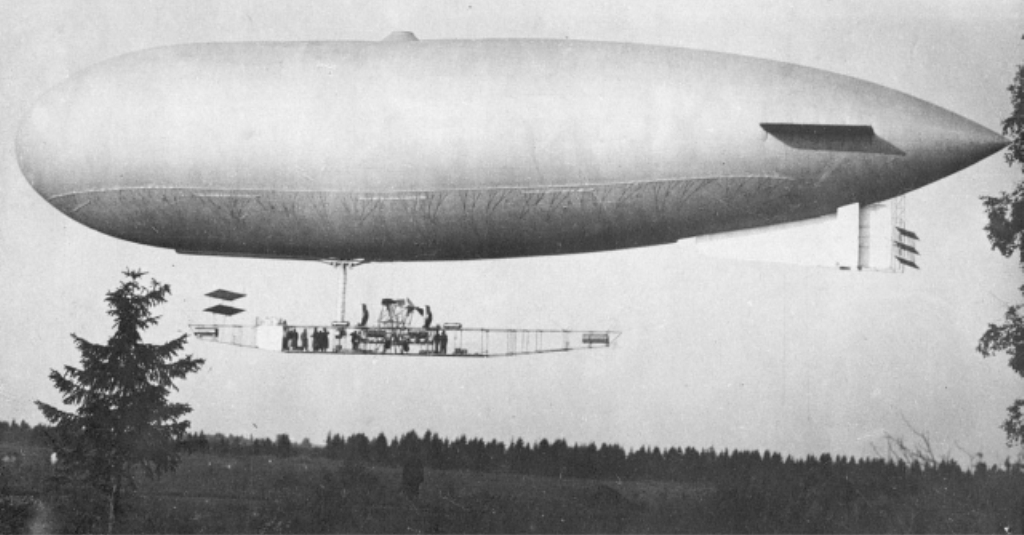
The airship’s armament, according to the 1912 technical requirements, consisted of three Maxim machine guns with an ammunition load of 3,000 rounds. In firing trials with Madsen machine guns, a good result was demonstrated: hits when firing from a distance of 600 meters amounted to 73.8%. The ship was also equipped with bomb racks.
Although the “Albatross” did not surpass French airships of its class, it was the most successful example of a powered dirigible among those created at Russian enterprises before 1914. The airship’s length was 77 m, height 22 m, envelope width 15.5 m, volume 1,000 m3. The airship was рассчитан on 7 passengers. By decision of the Aeronautics Committee of the Main Engineering Directorate, the craft was armed with two Maxim system machine guns with three thousand rounds for each.
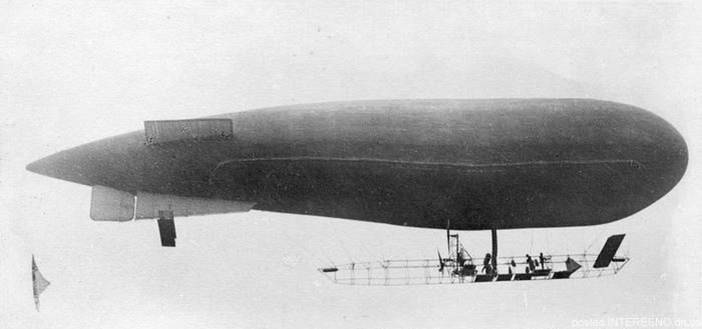
Despite bright prospects, the first “Albatross,” assembled in the autumn of 1912 in the village of Salizi, did not last long: after one of the test flights, the double rubberized envelope of the airship burst, and it had to be replaced with a triple one covered with a thin layer of aluminum. It was decided to give the updated airship a new name, “Albatross-2.” But specialists continued to call it “Albatross.” On June 12, 1913, the new “Albatross” made its first test flight. And on June 22 it already took part in an aviation festival in Gatchina. On the return from the festival to the hangar in Salizi, pilots in airplanes cheerfully greeted the airship and photographed it. The photographs were published. In August, equipment for a radiotelegraph station was tested on the airship. Communications with Revel were successful. Then the airship successfully passed speed trials. And on September 12, the “Albatross” carried out an important endurance-and-altitude flight: in 12 hours it covered 600 versts, while for 3 hours it remained at an altitude of 1,500 m, navigating in clouds by compass. Thus, on September 28, 1913, acceptance trials of the “Albatross” dirigible were completed by the military department. The Izhora Plant was awarded a prize “for the speed demonstrated by the aerostat, one meter above the contracted value.” Cadets of the Officers’ Aeronautics School began conducting training flights on the airship with live-fire practice.
In May 1914, the worn-out Clement-Bayard engines were replaced with more reliable ones of the Dansette-Gillet system. In the Far East, construction began on a hangar for the “Albatross.” However, with the start of hostilities, a decision was made to send the airship to the front. The ability to develop high speed (68 km/h), a sufficient service ceiling (1,600 m), powerful engines (280 hp), a large useful load (3,530 kg), and an aluminized envelope providing not only additional protection from sunlight but also camouflage in the sky—all this made it possible to use the craft as a reconnaissance aircraft and bomber. The ship’s commander, Lieutenant Colonel Golubov, was ordered to prepare the airship for a ferry flight first to Lida and then to the forward base in Bialystok. The craft arrived without incident, covering about 780 km in 12 hours. But the airship’s further fate was sad.
In the summer of 1914, while carrying out a night bombing of the approach routes to Osovets by order of the штаб of the Northwestern Front, the craft was mistakenly fired upon with small arms from its own positions. With numerous holes, it was decided to redeploy it to Brest-Litovsk. And although after the completion of repairs in mid-September 1914 the airship returned to Bialystok, it did not serve long: on October 13, during one of its sorties as a reconnaissance craft, 40 km from the front line, poor weather conditions triggered an emergency. Repairing the damage in field conditions proved impossible, and the craft had to be dismantled.