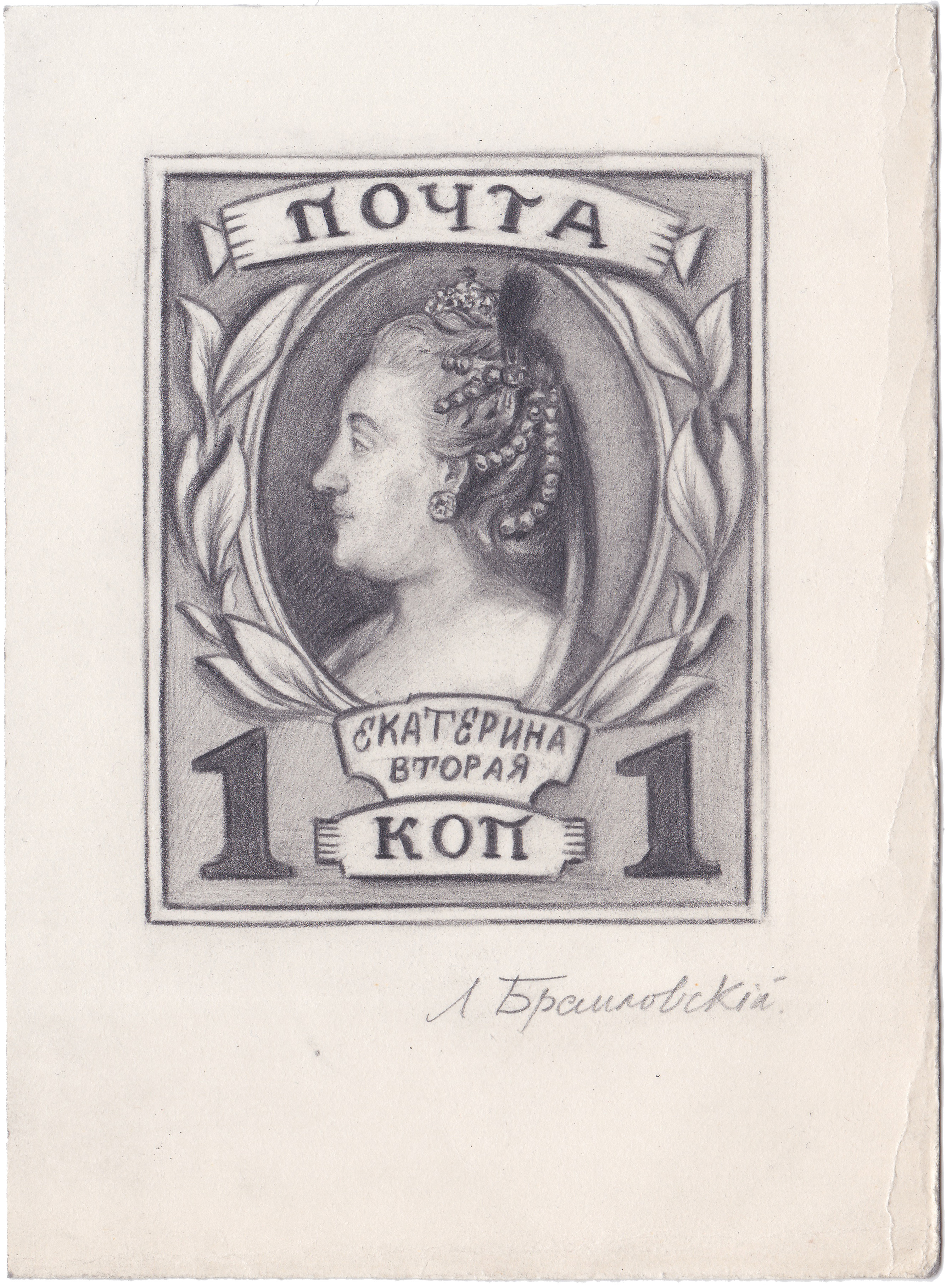
Artist Leonid Mikhailovich Brailovsky. An unapproved sketch for the “300 Years of the House of Romanov” series.
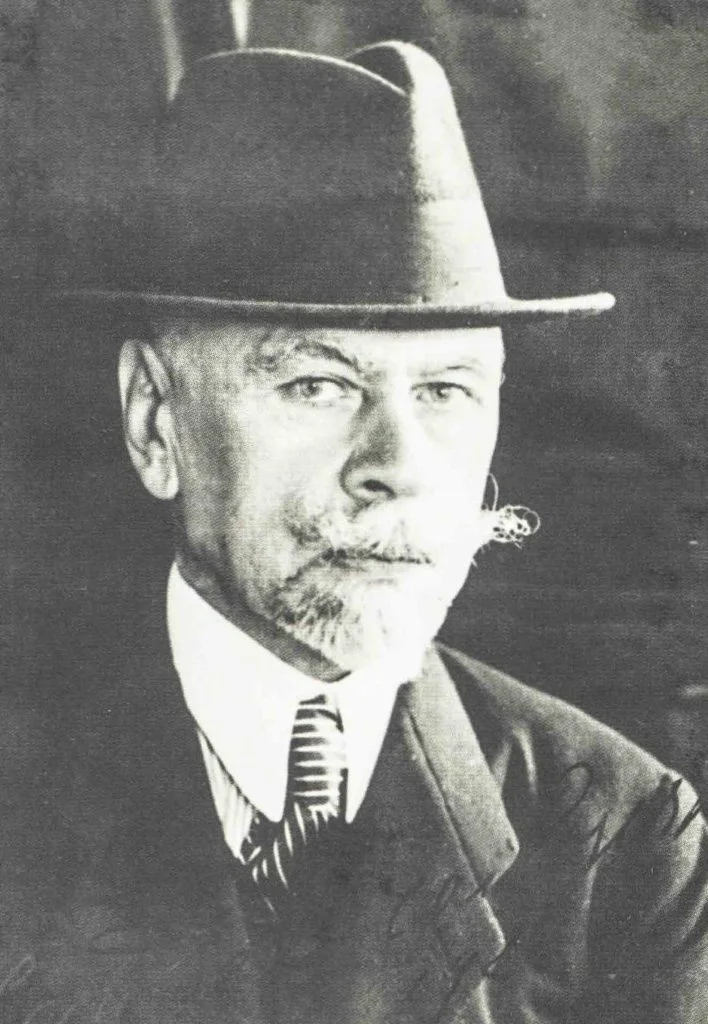
He was born in Kharkov in 1871 into an Orthodox noble family. His father, Mikhail Brailovsky, was the city mayor; his mother came from the Sedlyarevsky line of Little Russian nobility. After graduating from a classical gymnasium, he entered the Imperial Academy of Arts in Saint Petersburg. He studied painting and architecture, specializing in landscape painting. His mentor during those and subsequent years of study was the then still young A. N. Beketov, later a professor, academician, and leading teacher of an entire generation of Soviet architects.
During his studies he was repeatedly awarded for academic success: in 1890 a Small Silver Medal, in 1892 a Large Silver Medal, and in 1893 a Small Gold Medal. For a project of the Imperial stables he was awarded a Gold Medal.
In 1894 he successfully graduated from the Imperial Academy of Arts in Saint Petersburg in the architecture class. In view of his excellent performance, he became an Academy pensioner, and was granted the honorary right to travel at state expense in 1895–1897 on a foreign tour—to Italy, Greece, Egypt, and Spain, highly exotic countries where he found new subjects. In a sense, they were what made him famous.
Brailovsky also visited France, Germany, Austria, and England, where he again made architectural sketches and measurements that entered his creative report on the two-year voyage. Some of his architectural watercolors, sent as a report on the foreign trip, were acquired by the Museum of the Academy of Arts, the Institute of Civil Engineers, and the Russian Museum. Some of his works even entered the Byzantine Museum at the Sorbonne, which testifies to the maturity of his painting as well as to undeniable commercial success.
Abroad, Brailovsky attended the studios of R. Bompiani in Rome and the Academie R. Julien in Paris. This gave him certain acquaintances and familiarity with some methods of Western European art.
After returning to his homeland, L. M. Brailovsky received a professorial post at the Moscow School of Painting and Architecture and at the same time began teaching at the Stroganov School. He also carried out stage work for the Imperial Bolshoi Theatre.
In Crimea, the Brailovskys became closely acquainted with A. P. Chekhov’s sister, Maria Pavlovna Chekhova, who not far from them, also in Miskhor, likewise bought herself a small dacha in order to be closer to the writer’s own White Dacha, which was located in Yalta.
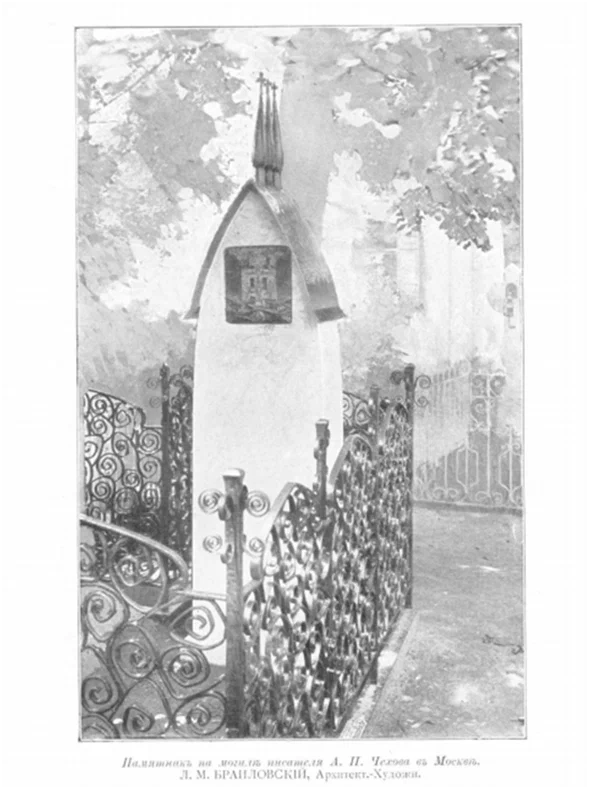
After the writer’s death, in Moscow, an original golbets-style monument designed by Brailovsky—with three small domes and a cast cross with enamel and a crucifix—was made and installed on the classic author’s grave. In Soviet times, by decision of the Ministry of Culture, the monument and the fence, also made from Brailovsky’s sketches, were restored and brought into proper condition. It should be said that the grave itself had to be moved from one place to another.
At that time, the Academy of Arts commissioned Brailovsky to copy the frescoes of the Novgorod Church of the Savior on Nereditsa. His work was used by the well-known Byzantinist Millet in his book published at the Sorbonne.
In 1916 Leonid Mikhailovich Brailovsky was awarded the title of Academician of the Academy of Arts. He became the last person to receive this title during the imperial period of Russian history.
As a first step toward building a creative career no longer tied to apprenticeship, the Academy’s top leadership proposed that he move to Moscow to fulfill a major commission: creating watercolor images of the interiors of the Yusupov Palace. In a few months, L. M. Brailovsky painted 12 watercolors of high artistic quality, depicting in the finest detail all the luxury of the recently restored rooms of the ancient Russian residence. Striking in their refined precision of detail, these watercolor albums could already then, without any exaggeration, stand in the same rank as similar works by his predecessors depicting the interiors of Russian palaces and mansions.
After the October Revolution, in 1919, together with his wife, the artist Rimma Nikitichna Brailovskaya (nee Schmidt), he emigrated first to Latvia; later he lived in Constantinople. Through Constantinople he arrived in Serbia, where for three years Brailovsky held the post of chief artist of the Royal Theatres in Belgrade.
In 1925 he moved to Rome. Under the influence of priests A. Sipyagin and M. Nedotochin, Brailovsky reunited with the Catholic Church. In 1932 an exhibition of 40 paintings by the Brailovskys was organized, depicting monuments of Russian religious art. This collection was presented to Pius XI. It became the basis of a collection of 100 paintings and 20 plans depicting monuments of church painting and architecture of Kiev, Novgorod, Moscow, Rostov, Suzdal, and so on. The Brailovskys’ apartment in Rome became a kind of center of Russian life. The home regularly hosted gatherings for compatriots, tea parties were arranged, and endless интеллигент-style conversations took place.
He exhibited in many cities and, together with his wife, held two solo exhibitions in Paris and the Vatican. With the participation of Princess M. Radziwill, an illustrated catalog of the exhibited paintings was published and three small albums of corresponding postcards were issued.
He died in 1937 in Rome.
Sketch of a stamp for the Tercentenary of the House of Romanov 1 Kopeck 1913.
Russian Empire.