
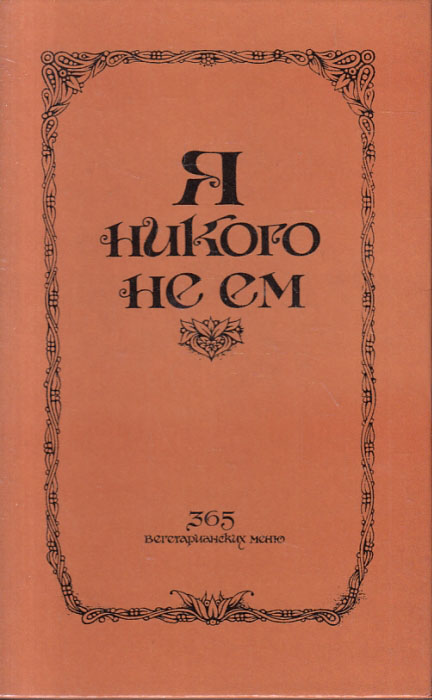
On December 1, 1901, the first vegetarian society in Russia was formed in St. Petersburg; jokingly, it was called “Neither Fish nor Meat.” The society was headed by Alexander Petrovich Zelenkov, a physician and surgeon. In 1913, his wife published the first vegetarian cookbook titled “I Eat No One.” The book contained three hundred sixty-five menu options. In 1904, the society began publishing a printed journal, “Vegetarian Herald.”
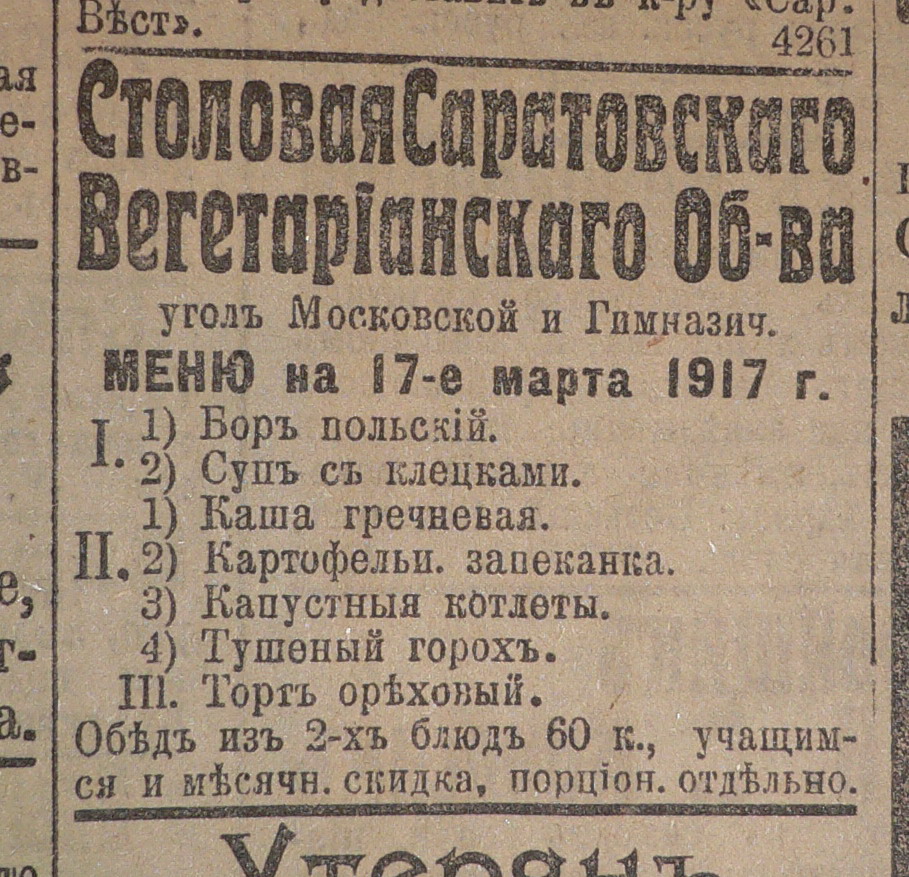
Later, cafeterias appeared as well, in 24 cities of the empire: Moscow had 6, St. Petersburg had 5, and Kyiv had 7.
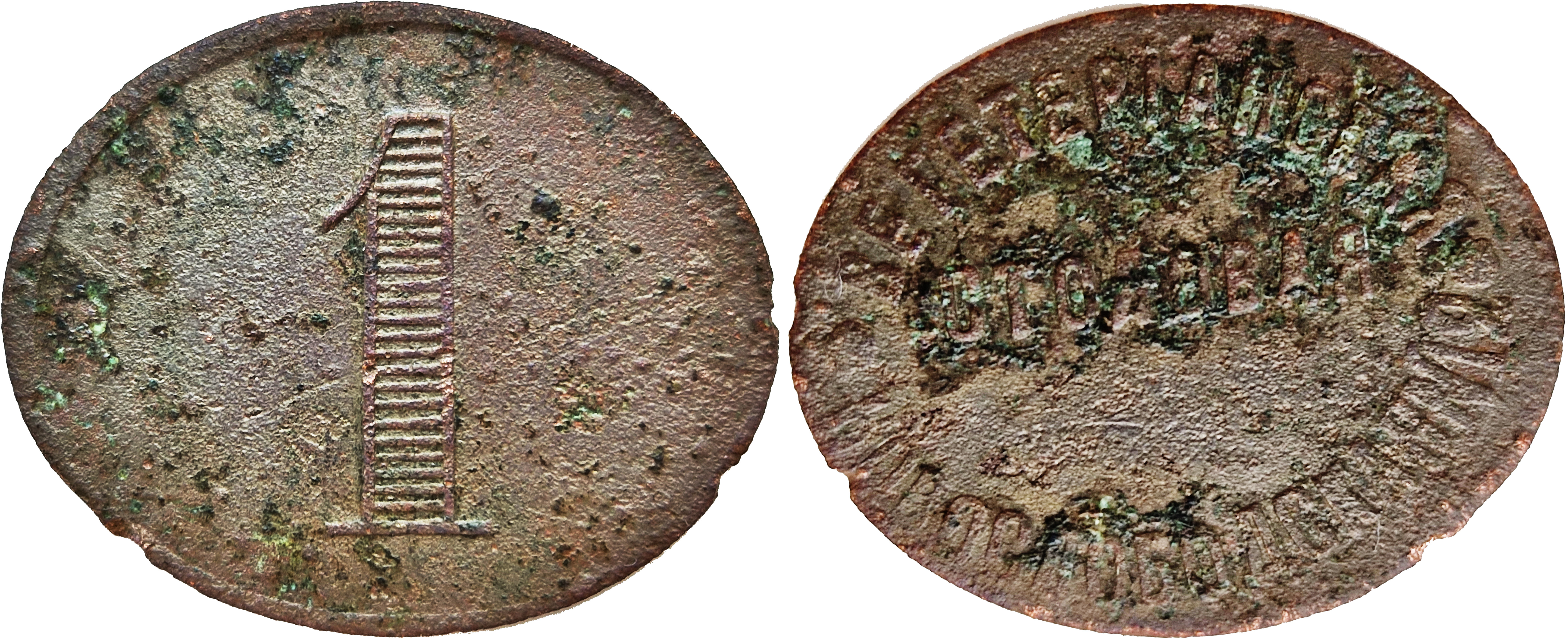
Korney Ivanovich Chukovsky described how Ilya Repin led him into such an exotic place: “There you had to stand in line for a long time—for bread, for dishes, and for some kind of tin tokens… The main draws at this vegetarian canteen were pea cutlets, cabbage, and potatoes. A two-course lunch cost thirty kopecks.”
Repin himself, of course, was absolutely delighted: “The canteen is run impeccably; in the entryway, the cloakroom attendants are not allowed to take any payment. And this has serious meaning, given the special influx here of underfunded students… The walls of all the rooms are covered with photographic portraits of Leo Tolstoy, of different sizes and in different angles and poses. And at the very end of the rooms, on the right—in the reading room—hangs an enormous life-size portrait of L. N. Tolstoy on a gray, dappled horse, riding through the Yasnaya Polyana forest… The selection of dishes is quite sufficient, but that is not the main thing; the main thing is that whatever dish you take is so tasty, fresh, and nourishing that the words slip out of your mouth: why, this is a feast!”
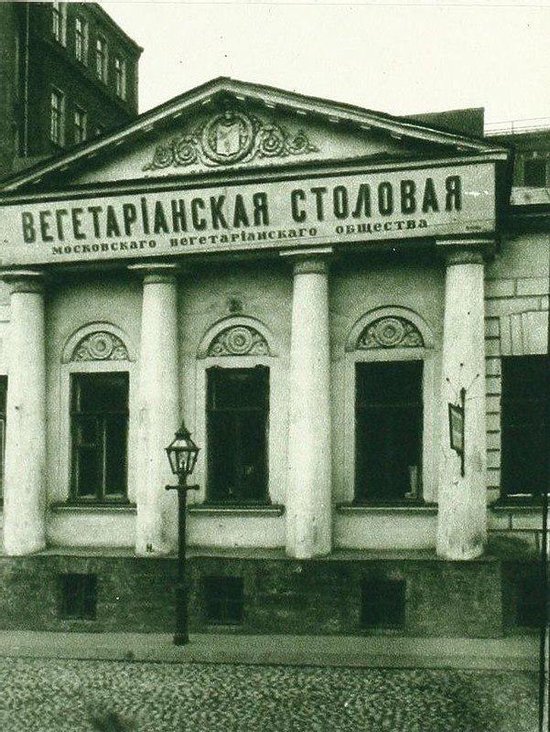
Moscow became the center of vegetarianism in 1909, when the “Moscow Vegetarian Society” was founded; it lasted until 1929.
In the first post-revolutionary years, vegetarianism remained popular. The old cafeterias kept operating, and one new one even opened—in a mansion on Petrovka Street. It was called “Take a Break from Meat.” This was exactly the place frequented by the newlyweds Kalachev, characters in Ilf and Petrov’s novel “The Twelve Chairs.”
But gradually, vegetarians began to be viewed with suspicion. No wonder: suspicion was aroused by anything that stood out, even slightly, from the plain, mainstream trends. The canteens began to be renamed “dietetic” (that is how the word was spelled at the time), and then they were closed altogether or squeezed out by rent. Societies were dissolved, and their activists were arrested. Later, vegetarianism was banned as harmful food unsuitable for the Soviet person.
In 1951, in Volume 7 of the second edition of the Great Soviet Encyclopedia, “Varioloid – Vibrator,” it was officially stated: “Vegetarianism, based on false hypotheses and ideas, has no adherents in the Soviet Union.”