
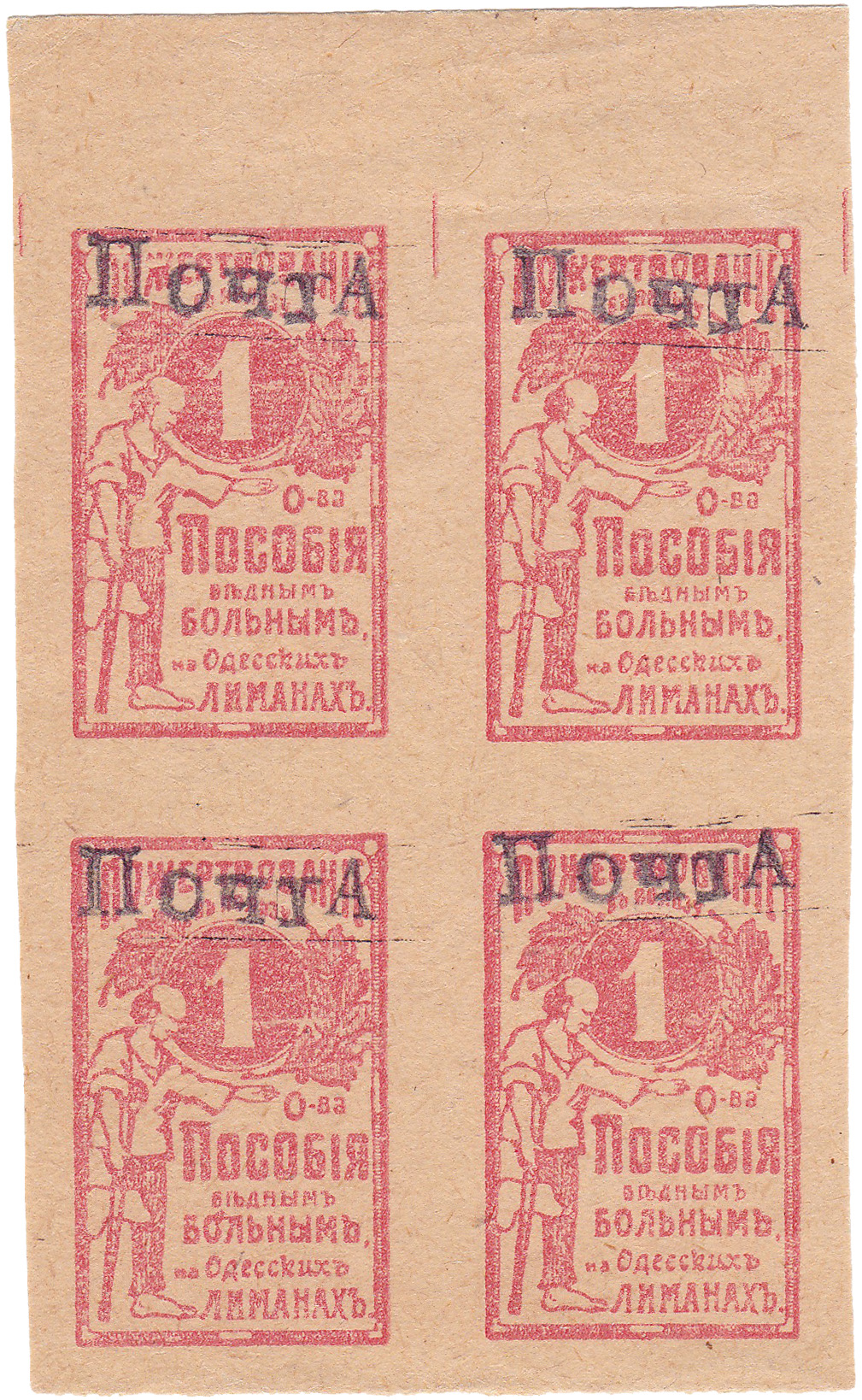
Overprint: Post.
The history of the world-famous Kuyalnik resort began with this handwritten document, preserved to this day: “Statement. Odessa. On the 9th day of June 1833. I, the undersigned, retired Major General Prince Ivan Semenovich, son of Zhevakhov, agree to the proposal of the local authorities here and cede to the city, from my own land by the liman, an area of 6 desyatinas 135 square sazhen, for the establishment of bathing facilities on this site. Zhevakhov”
Further events unfolded as follows. On June 12, 1833, the office of the Bessarabian Governor-General M.S. Vorontsov sent a letter to the Odessa city governor A.I. Levshin, stating that such bathing facilities were to be “constructed according to the specified plans and estimates, by хозяйственным образом, as soon as possible.”
Soon A.I. Levshin received a report from the architect Koshelev: “By assignment of the Building Committee, entrusted to me by directive of the 14th of this June under No. 2024 regarding the construction of two bathing facilities at the Kulnitsky liman, I immediately began carrying out the works. On the 27th day of June 1833. Koshelev.” And two months later Koshelev reported to the Odessa Building Committee: “By assignment of the committee regarding the establishment of two bathing facilities at the Kuyalnik liman, all construction works are now completed. Architect Koshelev. On the 29th day of August 1833.”
On July 26, 1833, the first notice was printed in the newspaper “Odessa Herald” about the creation of the first лечебница at the Kuyalnik liman. “Having become convinced of the healing properties of the waters of the Odessa Kuyalnik liman, the authorities issued orders to establish an institution right by the shore, where those wishing could use the liman baths and find all the conveniences they might need. This institution, consisting of hot-houses for warm mud and sand baths and a tent for cold bathing, has now been brought to completion and handed over for the supervision of Doctor Andrievsky.
Kuyalnik liman. Daily, ladies may use the bathing tent from 10 o’clock in the morning until 6 in the evening, and the other morning and evening hours are allotted to men; sand and mud baths are taken from 10 to 2 o’clock in the afternoon.”
Memoirs have survived describing what the Kuyalnik “Infirmary of sand and mud baths” looked like. “One wall of the warm hot-house (a wooden barrack) and half the roof were glazed. In cauldrons over a hearth, liman water was heated for the baths. In the sun, the mud was warmed to the required temperature; after heating, it was used to fill wooden troughs in the ‘hot-house.’ The treatment itself was just as simple. The patient was laid in the mud up to the neck for an hour, and sometimes longer, until the patient began to feel unpleasant symptoms—speaking in medical terms, on the verge of heat stroke. The patient was immediately taken out of the mud and washed in a warmed bath with the liman brine.
Cold bathing facilities were built over the water at a distance of 20 sazhen from the shore. The facility was arranged like a tent on piles driven into the bottom. For access, a small footbridge was placed from the shore. Under these conditions, E.S. Andrievsky began actively providing real help to sick people. He tried to make maximum use of the summer season, organizing treatment for as many patients as possible, and observed recovery outcomes. Taking notes, he analyzed which diseases the liman suited and in which cases it could even be harmful.”
At the beginning of the 20th century, for a good room rented for the entire season (from May 15 to September 1), one had to pay at least 100 rubles. For half a season, 50–60 rubles, and per month a room cost 40–50 rubles.
In addition, the prices for procedures had to be considered, and they were not small either. For a first-class mud bath they charged 2 rubles, second class 1.5 rubles; for a first-class bath with brine 75 kopecks, second class 50 kopecks. For bathing in the city baths, first class, 15 kopecks per person per day. To this one should add meals and travel, if the patient arrived from the city every day. So treatment in those years was far from affordable for all segments of the population.
In this regard, in Odessa, which was famous for its traditions of charity, a project was proposed to organize assistance for indigent patients at the Kuyalnik liman. In the draft charter of the Society, published in 1896, mention was made in particular of the lack of premises for poor patients to live in. “Every year at the Kuyalnik liman a mass of poor people undergo treatment, suffering extreme hardship, since accommodation here is generally exorbitantly expensive and there are no public dining rooms at all. Patients from the poorest class live in terrible overcrowding, often going hungry.” The paragraphs of the future society stated that its members would “arrange inexpensive living quarters, dining rooms and tea rooms for the poor, providing them with free use of baths, supplying medicines, etc.”