
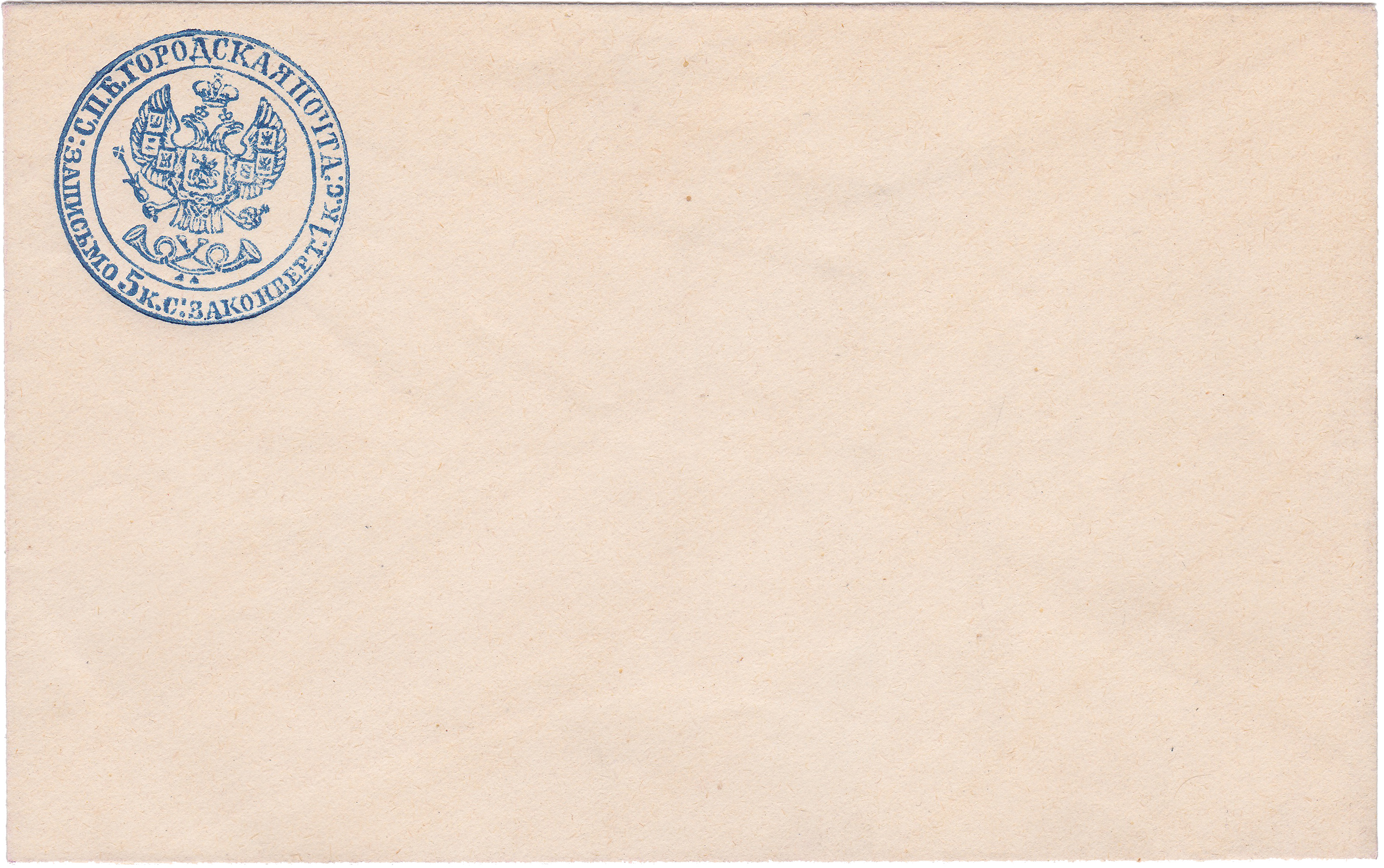
3rd issue.
The first postal stationery items of Russia were issued for the St. Petersburg city post, which began operations on January 17, 1833 (the right to organize a city post in St. Petersburg was granted by a State Council decision of October 27, 1830). Before that time, the St. Petersburg Post Office and city postal branches accepted only out-of-town correspondence, while letters within the city were delivered by special messengers or through servants. The cost of forwarding correspondence by the city post was set at 5 silver kopecks per letter and 1 kopeck per envelope.
On November 15, 1845, the Postal Department, headed by General of Infantry V. F. Adlerberg (1791–1884), issued Circular Order No. 11825 introducing stamped envelopes for the St. Petersburg city post; the sale of stamped city-post envelopes was carried out at the two city-post offices that existed by that time. The rate for sending correspondence in stamped envelopes was set at 6 kopecks (5 kopecks for the letter and 1 kopeck for the envelope). At the same time, correspondence sent in an ordinary envelope was paid in cash at the existing rate of 10 kopecks per lot. Letters for the city post were also accepted at small retail shops and in stores on the city’s main streets. From 1846, the operation of the city post was extended to nearby summer cottage areas during the “dacha season” from May 1 to October 1, while maintaining the usual rate for ordinary private out-of-town correspondence at other times. City-post letters were not permitted to be dropped into boxes for out-of-town correspondence; city letters that ended up in such boxes (green in color) remained undelivered. St. Petersburg city-post stamped envelopes were later also accepted by the city posts of Moscow and Kazan, where in 1869 they were replaced by nationwide-standard city-post stamped envelopes, and also in Warsaw, where in December 1858 they were replaced by a temporary provisional issue of the Main Postal Treasury of the Kingdom of Poland.
The envelopes were made of grayish-white or yellowish, thick paper without a watermark; the flap had no gum. The envelopes were folded by hand, so the actual dimensions may differ by 1–3 mm. The stamp imprint was applied using a hand press. The imprint, consisting of the state coat of arms with postal horns below, 28.5 mm in diameter, in dark blue or blue, was struck on the folded envelope, which resulted in various positions of the imprint relative to the flap. Envelopes are known on which, in addition to the colored imprint, there are also colorless impressions of the same stamp, slightly shifted relative to the main one. In total, three issues of stamped envelopes for the St. Petersburg city post were produced.