
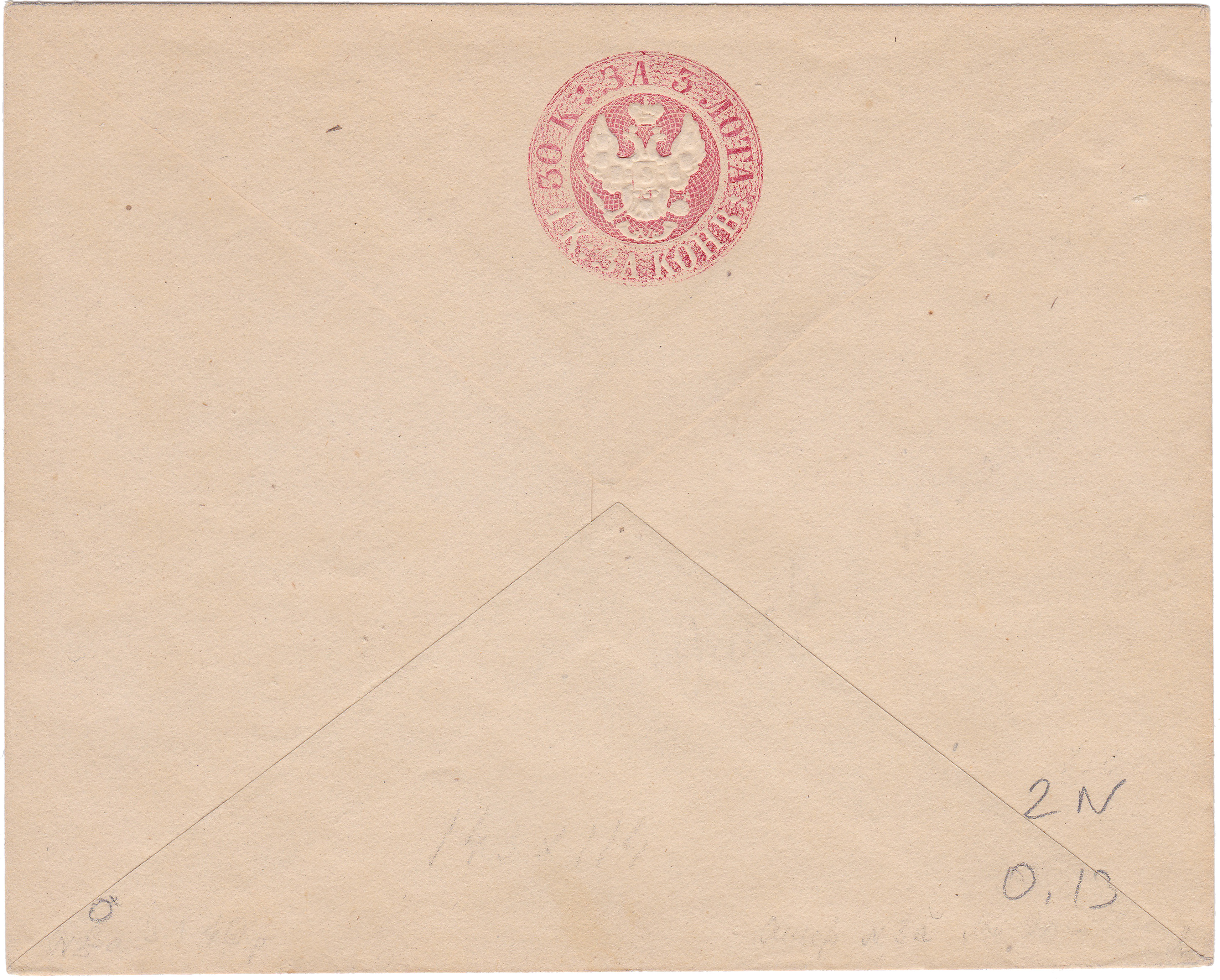
On November 15, 1845, the Postal Department, headed by General of Infantry V. F. Adlerberg (1791–1884), issued Circular Order No. 11825 introducing stamped envelopes for the St. Petersburg city post; the sale of stamped envelopes for the city post was carried out at the two city-post offices that existed by that time. The rate for sending correspondence in stamped envelopes was set at 6 kopecks (5 kopecks for the letter and 1 kopeck for the envelope). At the same time, correspondence sent in an ordinary envelope was paid in cash according to the existing rate of 10 kopecks per lot. Letters for the city post were also accepted at small retail shops and in stores on the city’s main streets.
From 1846, the activity of the city post was extended to nearby summer cottage areas during the “dacha season,” from May 1 to October 1, while during the rest of the year the usual rate for ordinary private out-of-town correspondence was maintained. City-post letters were not allowed to be dropped into boxes for out-of-town correspondence; city letters that ended up in such boxes (green in color) remained unsent. St. Petersburg city-post stamped envelopes were later also accepted by the city posts of Moscow and Kazan, where in 1869 they were replaced by stamped envelopes of a nationwide standard, and also in Warsaw, where in December 1858 they were replaced by a temporary provisional issue of the Main Postal Treasury of the Kingdom of Poland.
The envelopes were made of grayish-white or yellowish thick paper without a watermark; the flap had no gum. The envelopes were folded by hand, so the actual dimensions may differ by 1–3 mm. The stamp was applied using a hand press. The stamp, consisting of the state coat of arms with postal horns below, 28.5 mm in diameter, in black-blue or blue, was applied to the folded envelope, which led to various placement variants in relation to the flap. Envelopes are known that, in addition to the colored stamp, also have colorless impressions of the stamp, slightly shifted relative to the main one. In total, three issues of stamped envelopes for the St. Petersburg city post were produced.
St. Petersburg envelopes had a blue stamp; for Moscow, the stamps were printed in red ink. Today, “stamped envelopes” are quite a rarity. Especially rare are the Moscow city-post envelopes issued in 1846 in a print run of 6,000 copies. They were stamped on a hand-operated device with a 29.5 mm diameter stamp. In the center was the emblem of the postal administration. The circular inscription read: “Moscow City Post. For the letter 5 k. s. (silver); for the envelope 1 k. s. (silver).”
The first example of an envelope with a red stamp was discovered abroad only in 1877. Collectors long doubted the authenticity of the find. Even the leading experts in Russian philately for a long time did not recognize the “red stamped envelope” and considered it a forgery. It took considerable time and effort by Russian philatelists not only to prove the authenticity of the unusual discovery but also to establish the reasons for its rarity. It turned out that the authorities rather quickly withdrew the envelope from circulation. At the end of 1846, the entire stock held at the Moscow Post Office was destroyed. In its place, St. Petersburg stamped envelopes were introduced; they remained in use until 1851, when Moscow envelopes of the second printing began to be used. The second issue of envelopes for the Moscow city post was produced in 1851–1856.
Stamped envelopes greatly облегчened the work of the city post. Cash settlements with shopkeepers were eliminated. Keeping postal registers became simpler, accounting was reduced to a minimum, and efficiency increased.
The population and business circles duly appreciated the new way of sending correspondence. The popularity of “stamped envelopes” was so great that in 1848 envelopes for out-of-town correspondence were issued. The Postal Department introduced them in accordance with the postal tariffs of 1843. One envelope with a black stamp was for letters weighing 1 lot (10 kopecks silver plus 1 kopeck for the envelope). The second, with a blue stamp, was for letters of 2 lots (20 kopecks silver for delivery plus 1 kopeck for the envelope). And the third, with a red stamp, was for letters weighing 3 lots (30 kopecks for delivery plus 1 kopeck for the envelope).
The rapid spread of envelopes led to improvements in ways of sending correspondence. Now there was no need to go to the post office with each letter or to turn to a shopkeeper. In 1848, first in St. Petersburg and then in Moscow, post boxes appeared. Unlike city-post boxes, they were installed directly on the streets.
The issuance of stamped envelopes for the nationwide post began in December 1848. On envelopes of the first period of issue (1848–1863), the round stamp, 28 mm in diameter, was placed on the upper flap. The envelopes were manufactured at the printing house of the Postal Department. Paper of various grades was used, both white and in various shades (grayish, yellowish, grayish, etc.). The paper pulp could contain fairly large particles of varying thickness, shape, and size.