
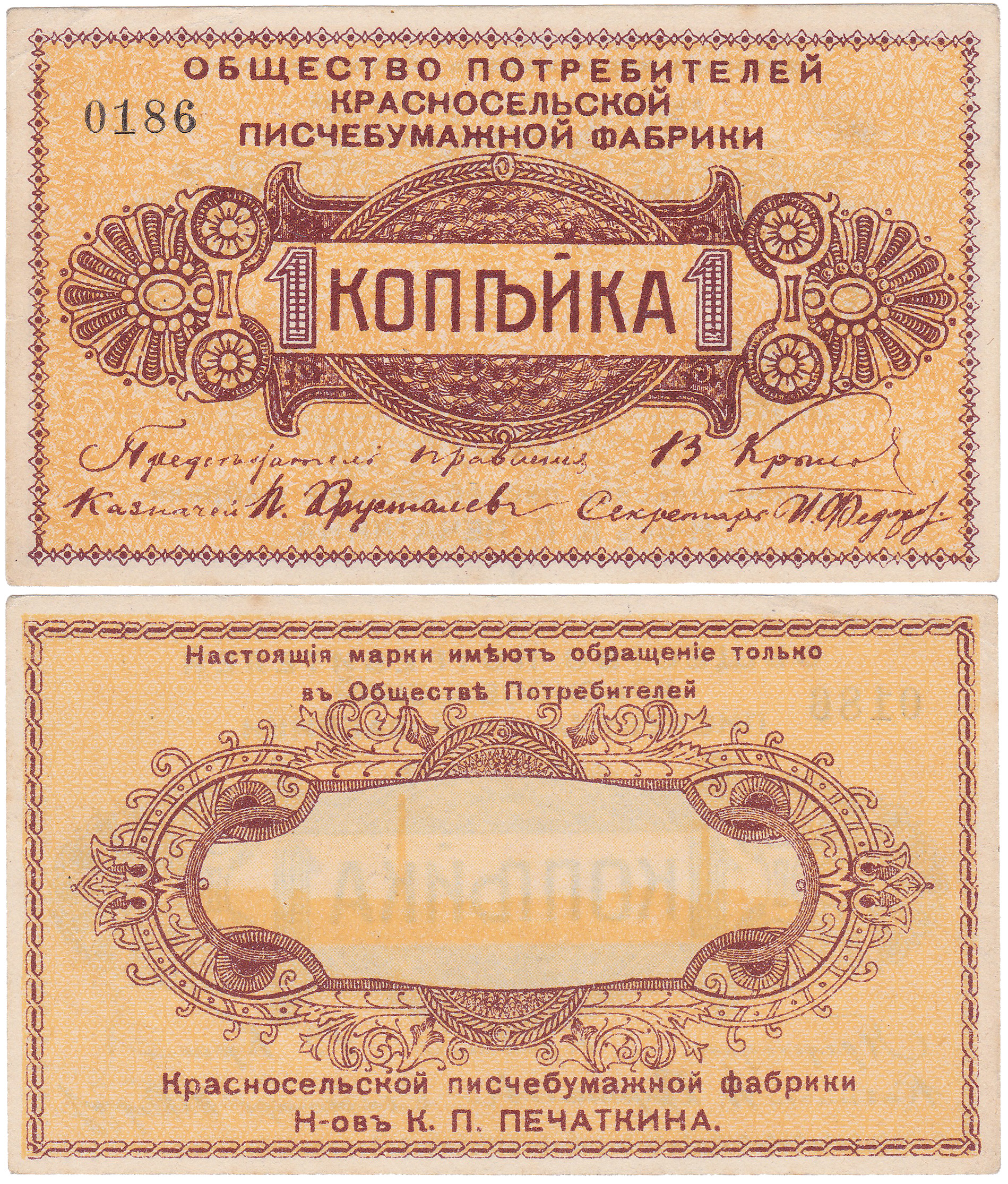
The Krasnoye Selo writing-paper mill is Russia’s oldest industrial enterprise. Krasnoye Selo is near St. Petersburg: by decree of Peter I, a mill was founded there as a state-owned enterprise staffed by attached serf laborers, producing paper for writing and drawing; under Catherine II, from 1769 to 1785, it also produced paper for Russian assignation banknotes.
In 1753, the state mill was purchased by Baron Sievers, with an obligation to supply paper to government institutions at a discount. As a private enterprise, the mill changed hands repeatedly, providing, as early as the beginning of the 19th century, a highly curious example of workers’ access to participation in production management. Between the owner of the Krasnoye Selo mill and its workers, the following contractual relations were legally formalized: for work stoppages caused by the administration, workers received monetary compensation; the length of the working day and the price of the paper sold had to be agreed by the manufacturer with the mill’s workers; 20% of revenue was allocated to workers’ wages and distributed among them at their discretion, while the workers undertook, at their own expense, to carry out routine repairs of buildings and equipment.
In 1838 the mill was acquired by Pyotr Pechatkin, and in 1860 its owner became his son, Konstantin Pechatkin. In 1896 the mill was reorganized as a joint-stock company and took the name “The Partnership of the Krasnoye Selo Writing-Paper Mill named after K. P. Pechatkin.” During the Partnership’s operation, there was not a single labor strike; the mill had its own nursery, its own kindergarten, and its own school, and the mill’s Consumers’ Society had its own money. The Pechatkin heirs called their surrogate money—circulating only within the Consumers’ Society—“marks.”
In total, over 22 years of the Partnership’s work, 12 denominations of marks were issued: 1 kopeck, 2 kopecks, 3 kopecks, 5 kopecks, 10 kopecks, 15 kopecks, 20 kopecks, 50 kopecks, 1 ruble, 3 rubles, 5 rubles, 10 rubles. As with real money of the Russian Empire, the size of the marks increased with their denomination: 79 mm x 46 mm for denominations up to 5 kopecks, 103 mm x 62 mm for denominations up to 50 kopecks, and 123 mm x 70 mm for ruble denominations. In the summer of 1918, the Partnership was nationalized: the Pechatkins’ legacy passed to Soviet authority.