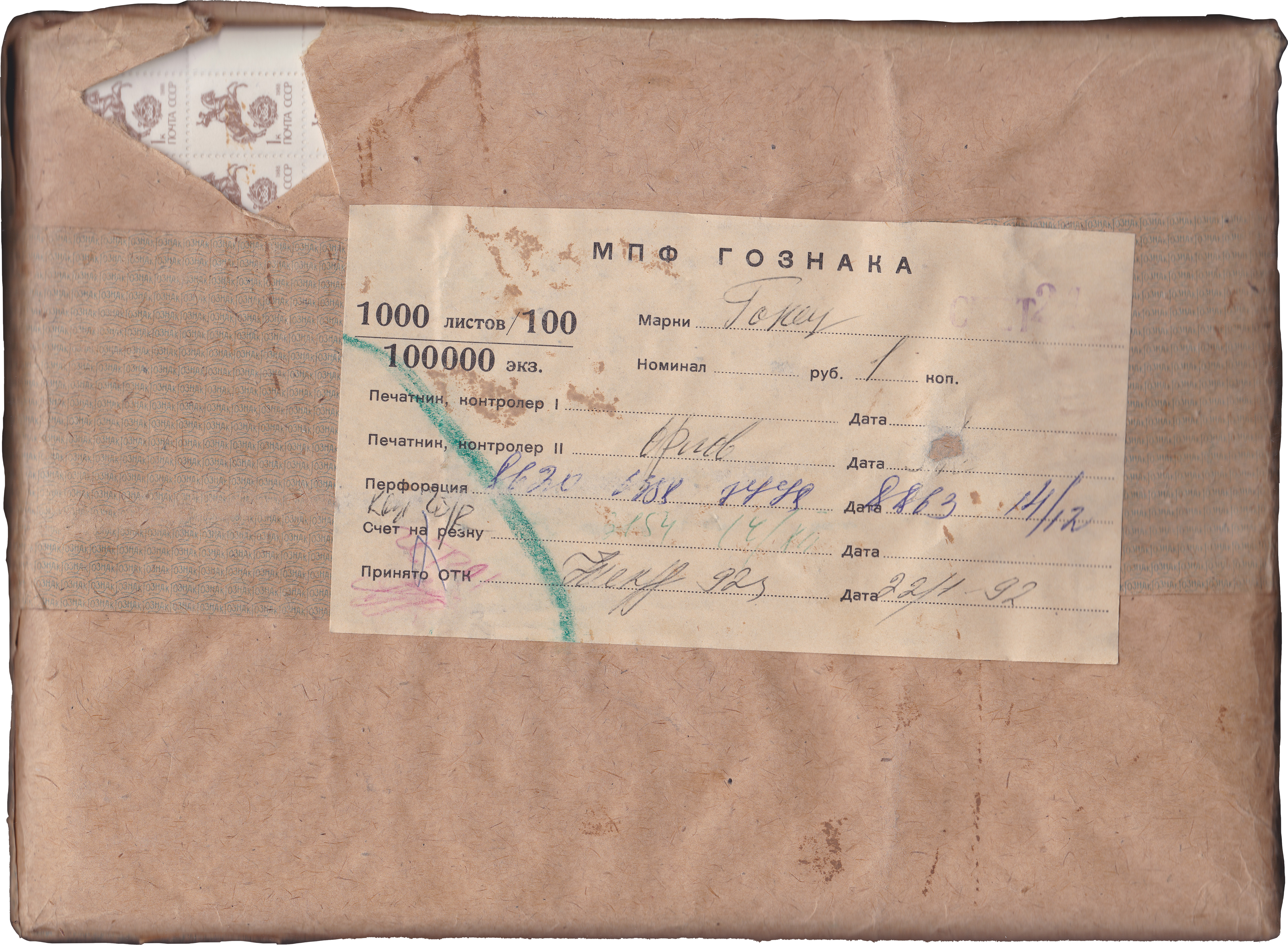
22 December — 13th issue of standard postage stamps. Postal courier. Symbol of the postal service. Print run: 8,000,000 copies.
Artist: Vladislav Koval.
The history of the Moscow Printing Factory began with the evacuation of the Expedition for the Procurement of State Papers from Petrograd in 1918.
On 26 February 1918, a meeting of the Council of People’s Commissars discussed evacuating the government from Petrograd to Moscow due to the February advance of German troops. At this meeting, Lenin sketched a draft resolution on the evacuation of the government, in which he stated: “...At all costs and immediately remove the State Bank, the gold, and the Expedition for the Procurement of State Papers...”. The final decision to move the capital to Moscow was made in March 1918.
On 2 March 1918, the government decree “On the organization of a special board for the fastest and more successful evacuation of the Expedition” was signed.
The printing and plate-making (stereotype workshop) equipment evacuated to Moscow was placed in the premises of the former Vtorov plant. By order of the government, the remaining printing and plate-making/art departments of the Expedition were urgently evacuated from Petrograd to Moscow together with all the workshops included in them: typefounding, engraving, stereotype, electrotyping, and photomechanical. After combining them into the plate-making department, they were initially housed on the grounds of the Vtorov plant, where the previously evacuated printing equipment was already located. Thus, the First Goznak Printing Factory in Moscow was formed. Paper production remained in Petrograd. The Expedition’s facilities also operated in Penza, Perm, and Rostov-on-Don. As a result, paper and printing production were effectively separated.
In June 1920, the Directorate of Factories for the Procurement of State Signs received part of the premises of the former Brocard perfume factory to house its production. The plate-making/art department was transferred there from the former Vtorov plant.
On 31 March 1921, the Council of People’s Commissars decided to transfer all the premises of the Brocard factory to Goznak. Here, Goznak was able to install all the equipment received from Penza. Thus, the Second Moscow Goznak Printing Factory was established. All production of printing plates was centralized here, and the manufacture of originals and dies was concentrated here.
At the end of 1923, the First and Second printing factories were merged into a single operation—the Moscow Goznak Printing Factory—on the grounds of the former Brocard perfume factory on Mytnaya Street.
In early 1948, the Moscow Goznak Printing Factory underwent a reconstruction aimed at specializing the factory in the production of three main types of products: paper banknotes, government documentation subject to strict accounting, and postage stamps. A significant part of the equipment was renewed, mainly with machines of domestic manufacture.
From that time on, USSR postage stamps, as well as stamps for foreign customers, were printed only at the Moscow Goznak Printing Factory.
In 1964, a new workshop for the production of postage stamps was commissioned at the Moscow Printing Factory, where a new four-color press was installed, combining intaglio printing and gravure doctor-blade printing, as well as a device for stamp perforation.
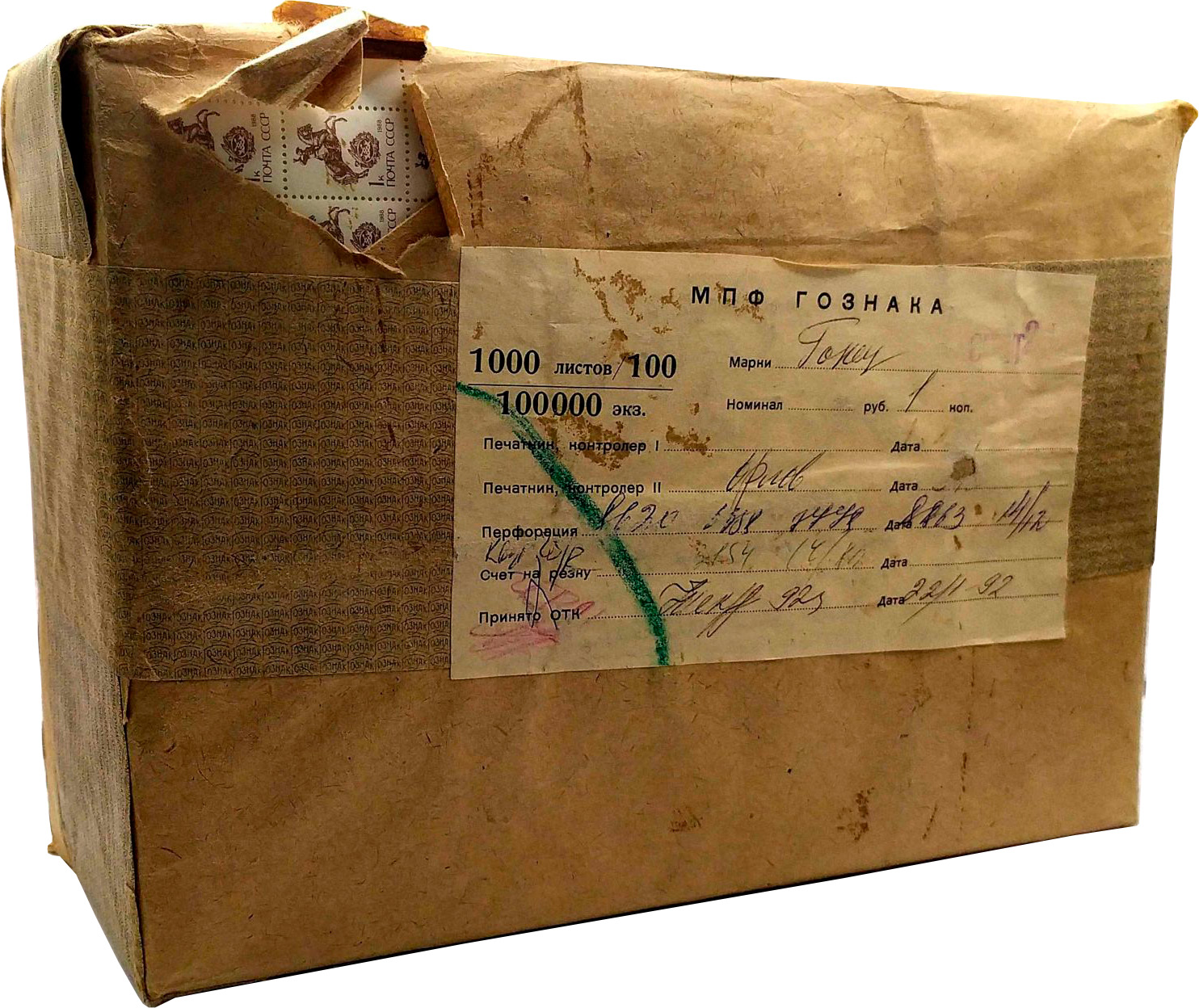
Packaging of 1000 sheets. Qty 100,000 stamps 1 Kopeck 1988.
13th Issue of the USSR, Moscow Printing Factory of Goznak.