
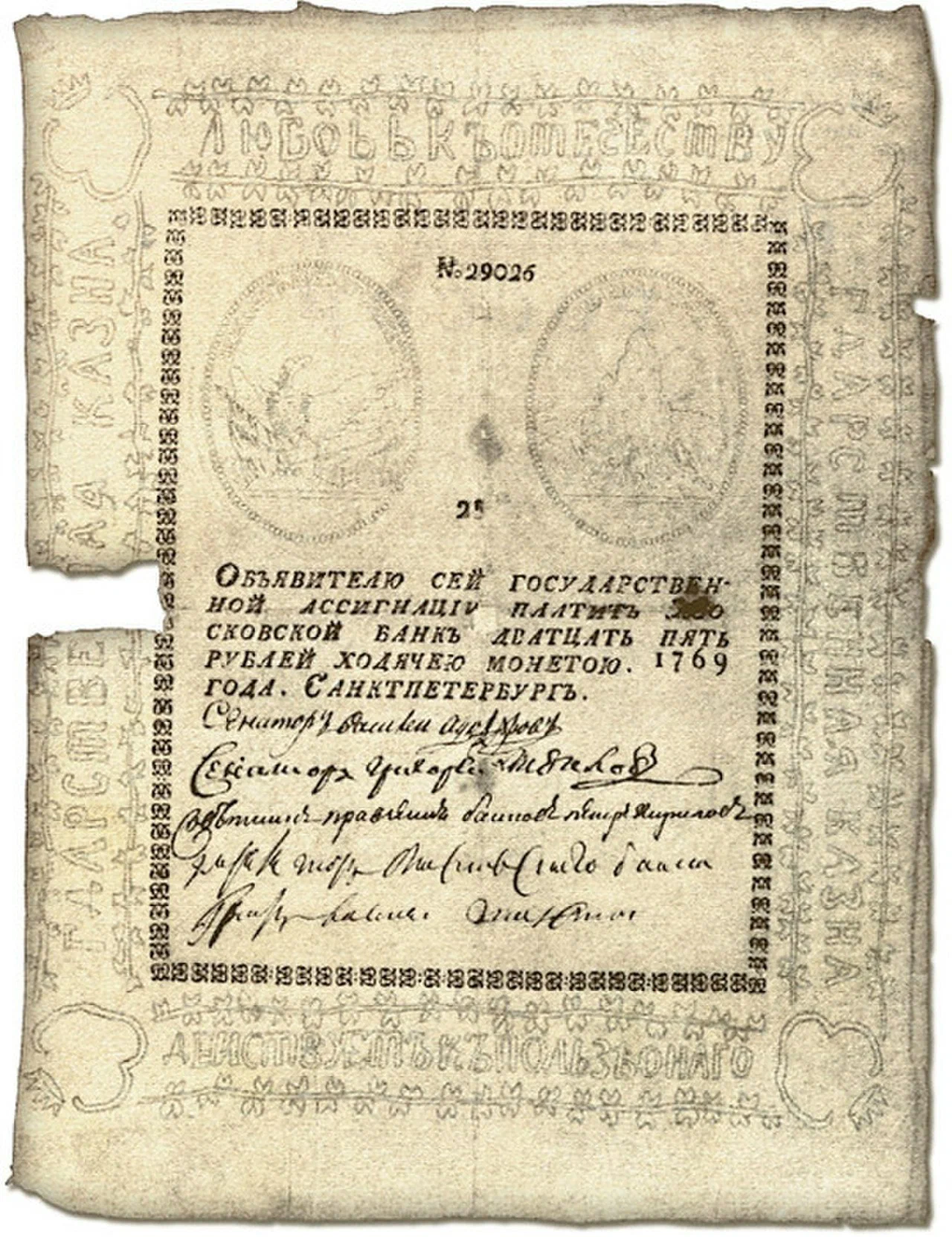
January 9 — the first paper money was introduced in Russia: Catherine II signed a manifesto introducing banknotes with denominations of 25, 50, 75, and 100 rubles. The very first Russian banknotes, the practical Catherine ordered to be made from old palace tablecloths and napkins, which in this unusual way found a second life in a new, noble form. The banknotes resembled a book’s title page: a vertical format, elegant typefaces, single-color printing, handmade white paper with a filigree watermark—ornamental watermarks.
At the center stood a double-headed eagle with outstretched wings and the chain of the Order of St. Andrew the First-Called, but without a crown. On the left, in a semicircle, ran an inscription referring to the eagle: “It gives rest and protects.” At the top was the inscription “Love for the Fatherland,” at the bottom—“It acts for its benefit.” On the right was depicted an impregnable rock; beneath it—a raging sea and the heads of monsters. Above all this was written “Unharmed.” All banknotes were issued in the same size and color and differed only by the denomination numeral.
By mid-1771, 75-ruble banknotes stopped being printed—because counterfeiters had learned to alter 25-ruble banknotes into 75-ruble ones. To further intimidate counterfeiters, the death penalty for forging money was introduced.