28 January 1827 — the first Decembrists were delivered to the Chita stockade.
During the Revolution of 1905–1907, Chita drew the attention of the entire country. For two months — from 22 November 1905 to 22 January 1906 — power in the city in fact belonged to the socialist Soviet of Soldiers’ and Cossack Deputies, although legally it remained with the military governor. The socialists’ authority in the newly proclaimed Chita Republic was ensured by armed squads, whose core consisted of workers from the Chita railway workshops and depot. An 8-hour working day was introduced; political prisoners were released from prisons; the post and telegraph were seized; and the possibility of expropriating the railway in favor of the workers was considered. For the first time, the newspaper “Zabaykalsky Rabochy” began to be published — the official printed organ of the Chita Committee of the RSDLP.
In January 1906 the uprising was crushed by the tsarist punitive expeditions of Generals Meller-Zakomelsky and Rennenkampf. On 2 March, on the slope of Titovskaya Sopka, the leaders and activists of the Chita Republic were shot: the chairman of the Council of Workers’ Squads Kostyushko-Grigorovich, and the railwaymen Weinstein, Tsupsman, and Stolyarov. A little earlier, at Slyudyanka station, the revolutionary Ivan Babushkin was shot. Viktor Kurnatovsky, the first editor of “Zabaykalsky Rabochy,” was also sentenced to execution, but later his sentence was commuted to hard labor, from which he escaped to Paris later that same year.
After Nicholas II abdicated the throne on 3 March 1917, at an emergency meeting the Chita City Duma created the COB — the Committee of Public Safety, and city Soviets of Workers’ and Soldiers’ Deputies appeared. Military Governor Mustafin and several other key representatives of tsarist power were arrested. The Transbaikal Cossacks and the diocese also recognized the authority of the Provisional Government; as early as 10 March, Chita celebrated the victory of the revolution en masse.
Throughout 1917, both the domestic political and administrative crisis in Transbaikalia intensified. The Transbaikal Soviets did not recognize the Bolsheviks’ victory in the October Revolution. By the end of 1917 the COB fell apart, giving way to the People’s Council, which in January 1918 was supported by Cossacks of the 1st Chita Regiment returning from the front. On 16 February, with their help, Soviet power was established in Chita; it lasted until August, when units of the Provisional Siberian Government entered the city from the west, and from the south came troops of the Imperial Japanese Army and Ataman Semyonov’s Special Manchurian Detachment.
From 6 September 1918 until the end of July 1920, Chita was occupied by troops of the Japanese expeditionary corps. Under the pretext of supporting the White regime, the Japanese sought to detach part of Russia by creating a puppet government in Eastern Siberia and the Far East. Legally, full authority in Transbaikalia belonged to Lieutenant General, Ataman Grigory Semyonov. During this time, Chita was the political and military center of Transbaikal White statehood.
In April 1920, the Central Committee of the RCP(b) created the Far Eastern Republic (FER) as a buffer between Soviet Russia and Japan. The formation of the People’s Revolutionary Army immediately began; its most important task was the liberation of Chita. In April–May, fierce battles took place on the northwestern outskirts of Chita between the PRA and Japanese troops. The FER’s army did not take the city, but forced the Japanese into negotiations at the end of May. In July, the interventionists left the city, leaving Ataman Semyonov without support. He left Chita in October 1920; at the same time, the forces of the FER’s PRA entered the city in fighting.
Chita residents welcome the FER government arriving in the city, October 1920
In October 1920, Chita became the capital of the FER, with a territory stretching from the eastern shore of Lake Baikal to the Pacific Ocean. After the Constituent Assembly in the spring of 1921, the republic began a process of recovery — a Constitution and a flag were adopted; its own currency was introduced; and the army was strengthened. In 1921, the Ministry of Education opened Chita’s first higher education institution — the State Institute of Public Education, transformed in 1923 into the Far Eastern University. On 8 September of that same year, the university was transferred to Vladivostok, where it continues to operate successfully to this day.
From November 1921 to May 1922, the Lenkov gang operated in and around Chita — several dozen of its members robbed townspeople, homes, and shops, distinguished by their cruelty. The liquidation of the gang began in March. In May, near Chita, the bandits killed Anokhin, secretary of the Far Eastern Bureau of the Central Committee of the RCP(b), and Krylov, the administrative manager.
In April–May, after a series of operations, the gang was eliminated and its leader Lenkov was killed. During the operations, the head of the Chita criminal investigation department, Fomenko, and several militiamen were killed.
13 November 1922 — liquidation of the FER. The entire territory of the republic became part of the RSFSR.
1923–1926 — Chita is the center of the Transbaikal Governorate.
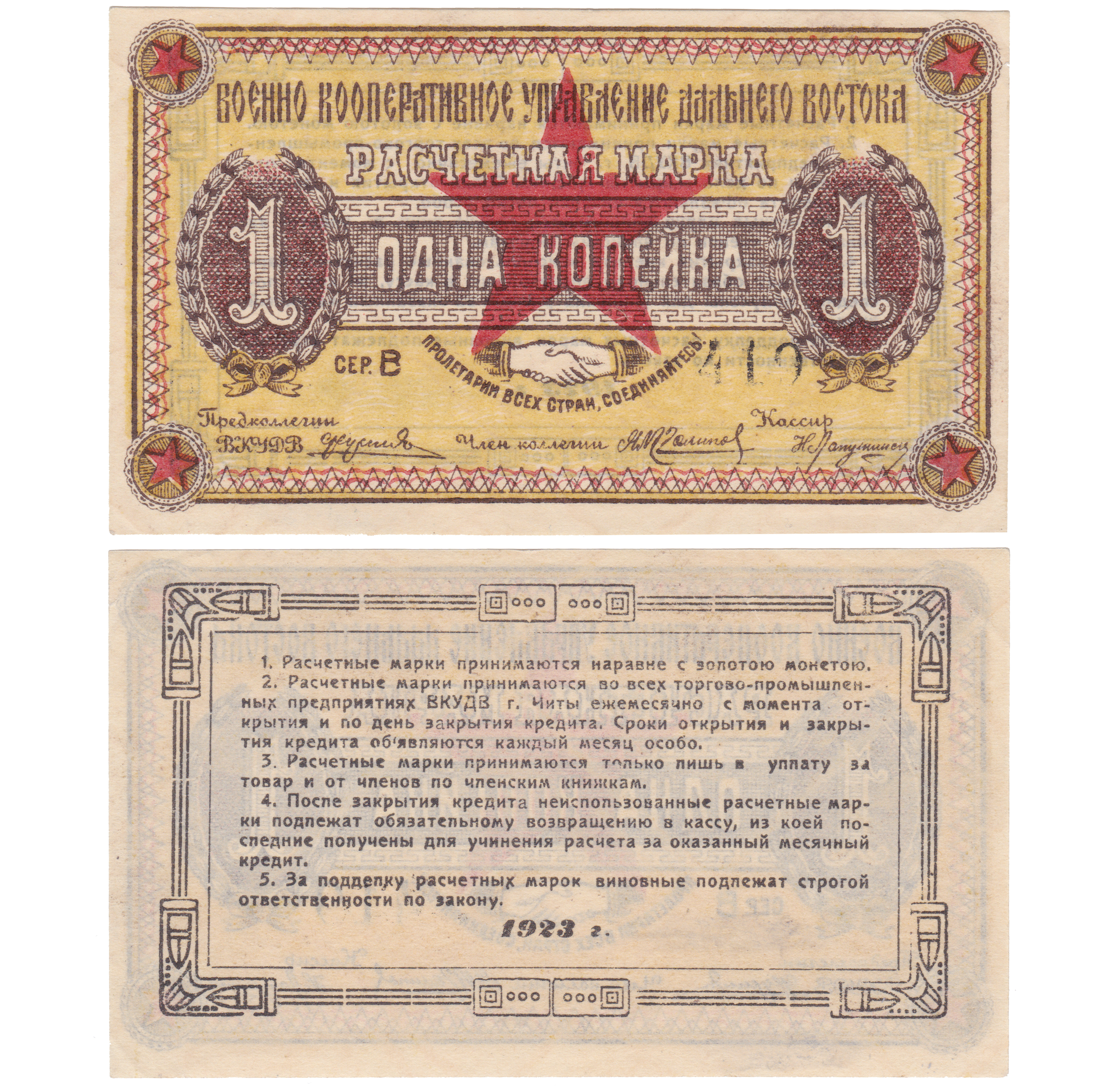
Settlement stamp 1 Kopeck gold 1923.
Far Eastern Military Cooperative Administration, Chita, Transbaikal Region.