
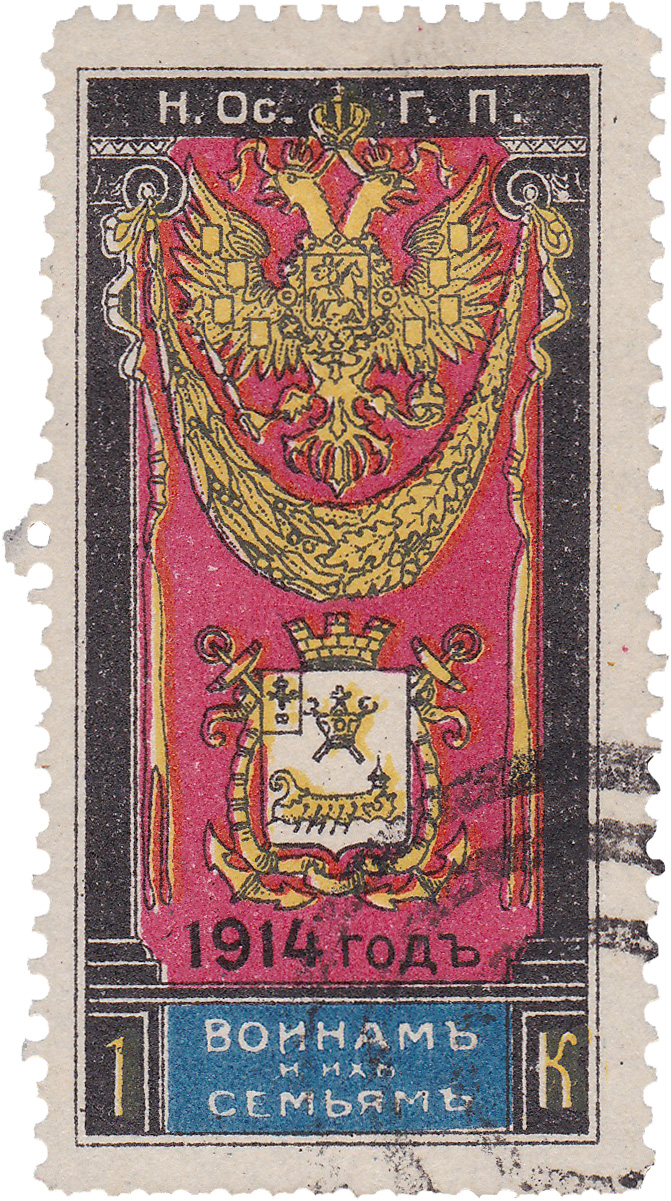
At the beginning of World War I, many semi-postal charity stamps were issued, with the proceeds transferred to a fund to assist the wounded and the families of fallen soldiers.
On August 18 (31), 1914, Nicholas II signed a supreme decree renaming Saint Petersburg to Petrograd. Contemporaries attributed the initiative to the Minister of Land Management and Agriculture, A.V. Krivoshein. Arguing for the need to abandon the city’s old name, he appealed to the authority of F.I. Tyutchev and his ideas of Slavic unity under the aegis of the Russian tsar, as well as to A.S. Pushkin, who in the poem "The Bronze Horseman" referred to Petersburg as Petrograd. According to the recollections of I.I. Tkhorzhevsky, former head of the Chancellery of the Ministry, the emperor—and military circles as well—regarded the renaming as a kind of wartime measure. In this connection, the memoirist cites a story told by one of the courtiers: "His Majesty is holding up bravely. Many attack him over Petrograd. They say Rukhlov remarked: What are you doing, Your Majesty—correcting Peter the Great! And do you know how the Sovereign replied? He did not get angry, but joked: 'Well then! Tsar Peter demanded reports from his generals about victories, and I would be glad of news of triumphs. A Russian sound is dearer to the heart...'"
Municipal public administration in pre-revolutionary Russia was a city executive body subordinate to the governor and composed of representatives of the wealthiest estates of the city. Among other things, this body oversaw collections and donations from citizens, and one may assume that organizing aid for the soldiers of the newly erupted world war was seen as a display of patriotism and considered at the highest level.
Helping one’s neighbor in Russia had long been a fairly popular cause: by the start of the 20th century the Empire had about 7,500 charitable organizations, and in 1902 as many as 11,040 were registered. So all manner of charity events, concerts, as well as "collection-cup" donations in Russian cities of that time were not uncommon. People chipped in for everything—relief for the starving, equipping public almshouses, support for war invalids and their family members, and so on.
But it was precisely with the outbreak first of the Russo-Japanese War and then World War I that charity ceased to be a purely personal matter and became a "civic duty." To evade it was considered dreadful bad form, while demonstrating one’s participation, on the contrary, took on the character of a kind of competition. This gave rise to many charity badges, postcards, and other distinguishing marks. At first they were needed so that collectors would not ask the same townspeople for a contribution twice. Later, however, they began to play a particularly important role—emphasizing the high level of civic engagement of their bearer. These tokens were something people wanted not only to wear, but also to be able to show to their correspondents. That is how non-postal charity stamps came into being: now the recipient of a letter, seeing them on the back of the envelope, could be assured of the sender’s strong civic consciousness and patriotism.