

In the Russian Empire, excise stamp bands were issued by the Ministry of Finance and printed at the EZGB.
In 1861–1863, the tax-farming system had to be replaced by the excise system, which remained fully in force until the introduction of the state sale of wine, or the liquor monopoly, established by the laws of June 8, 1893 and June 6, 1894.
Under the statute on the state sale of alcoholic beverages, the wholesale and retail sale of spirit, grain wine, and vodka products constituted the exclusive right of the state treasury and was carried out from establishments, warehouses, and wine shops belonging to the treasury.
All wine offered for sale had to be prepared from rectified spirit, subjected to cold purification through charcoal, and have a strength of at least 40 degrees.
The sale of wine and spirit from state points of sale was carried out exclusively for takeaway, in glass containers sealed with the state seal, with a capacity from 1/200 (61.6 ml) of a vedro and above, at prices set annually by the Minister of Finance within limits established by law; the price of a fraction of a vedro had to be proportional to the price of a full vedro. Vodka products were produced at private factories from rectified spirit purchased from the state and released for sale under an excise stamp, the price of which was set at 2 rubles per vedro of products.
D. I. Mendeleev and many of his colleagues warmly supported the idea of a liquor monopoly.
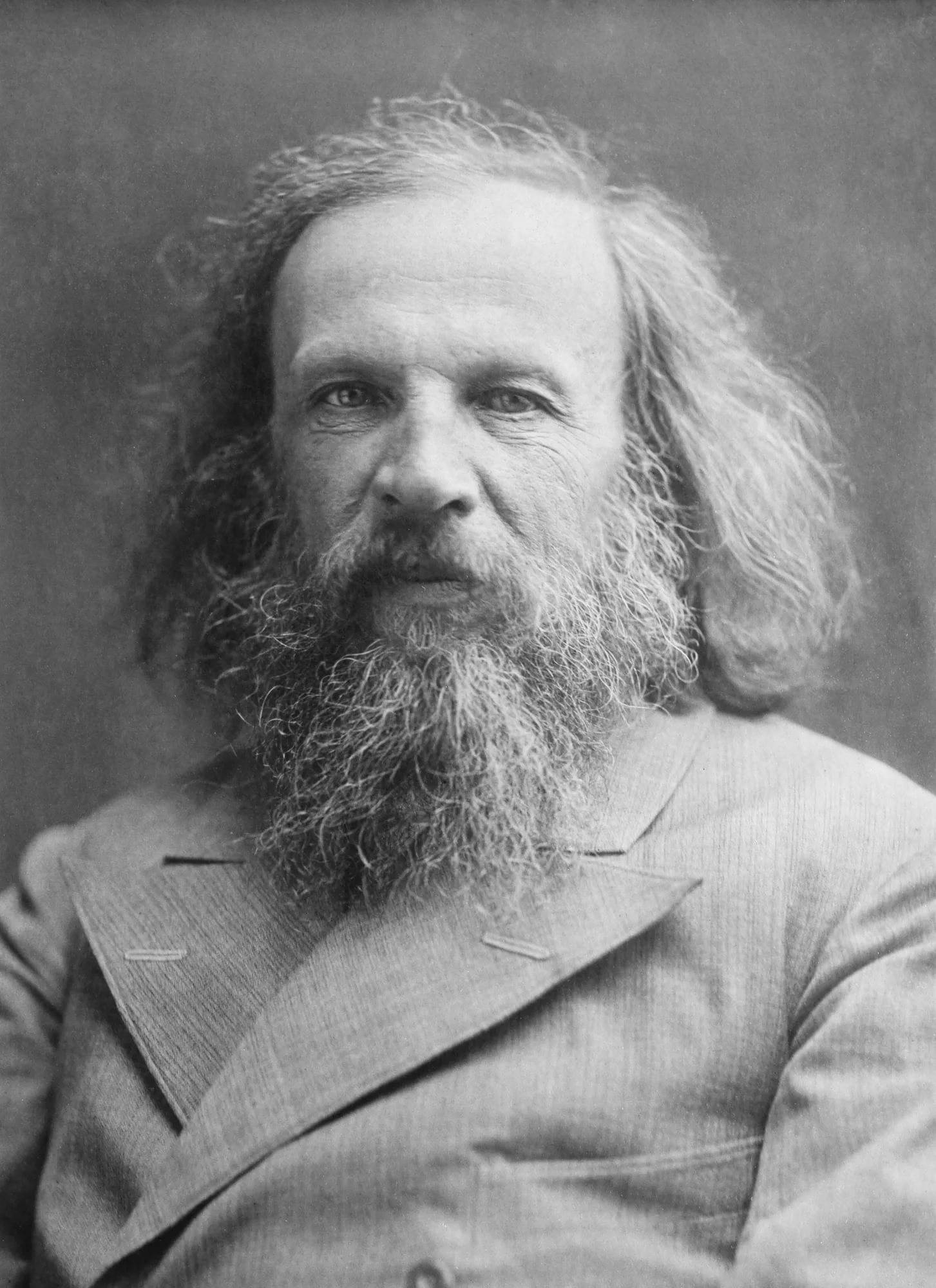
From 1893, a large group of scholars led by Mendeleev, a number of statesmen sympathetic to Witte, and leading jurists headed by A. F. Koni undertook a comprehensive development of the liquor monopoly. For effective state quality control, a vodka standard had to exist. It was proposed to use a water-alcohol mixture containing 40 parts by weight of ethyl alcohol, passed through a charcoal filter and containing minimal (stipulated) concentrations of fusel oils. Moreover, the spirit had to be made обязательно from rye malt. For vodka production it was recommended to use spirit at 60–80 degrees, diluting it with water to vodka strength. The water had to be very soft, containing few salts, and “alive,” not boiled. As a result, the reference vodka was presented as a clear colorless liquid with a light characteristic мягкий спиртовой aroma and taste. The choice of a strength standard of 40 degrees (40 parts by weight) was not accidental. Back in 1864, D. I. Mendeleev defended his doctoral dissertation on the topic “Reflections on the Combination of Alcohol with Water.”
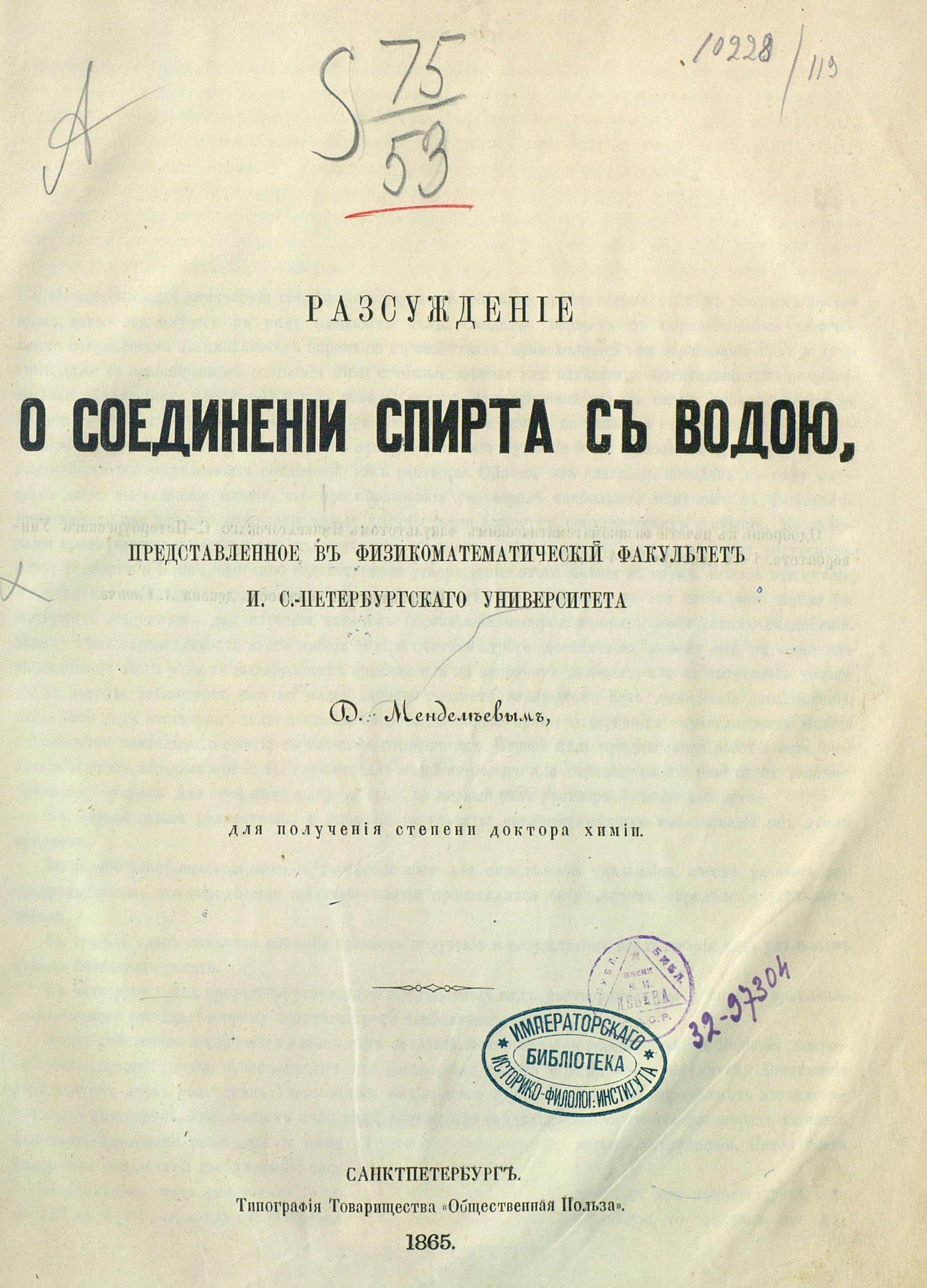
In this work, he suggested that in a water-alcohol solution, alcohol, depending on concentration, could exist in the form of three hydrates—an alcohol molecule with one, three, and twelve water molecules. In a report to the Russian Physico-Chemical Society in 1887, based on his own experiments and the data of other researchers, he asserted this viewpoint. These studies formed the basis of the strength standard. If you dilute 40-degree vodka just a little with water, it instantly becomes watery; try fortifying it slightly with спирт, and it immediately becomes very strong. These characteristics depend on the viscosity of the alcohol mixture. At an alcohol concentration below 40 degrees, hydrates with 12 water molecules prevail, hence the low viscosity and the sensation of dilution. If the mixture is above 40 degrees, there are more hydrates with one water molecule; we get high viscosity and a sensation of unpleasant harsh strength and dryness. Only forty parts спирт by weight produce in solution a balanced mixture of hydrates, the main share of which have three water molecules. Such viscosity is the only one that makes vodka neither watery nor harsh, but ideally drinkable. However, introducing a 40-degree strength was not something new. Even before the liquor monopoly, the commercial strength of “higher drinks” fluctuated within 38–40 degrees. In addition, in distilling there existed a conventional measure for output: a vedro of spirit at 40 degrees. Therefore, D. I. Mendeleev’s заслуга is limited only to the approval of 40 degrees in monopoly wine and to the theoretical justification of why it was done. The commission headed by D. I. Mendeleev did not develop a vodka standard, but approved its fundamental production scheme, based on centuries of Russian distilling experience. It was developed exclusively for state quality control and contained nothing fundamentally new. In 1998, vodka “Russian Standard” appeared. In the booklet dedicated to this vodka, it is written that “D. I. Mendeleev created not only the periodic table of elements, but also the standard of high-quality Russian vodka.” In addition, Mendeleev, it turns out, was “a great connoisseur and appreciator of vodka.” The vodka developed by him turned out to be “not only completely safe for health, but even beneficial in moderate quantities.” We believe that vodka “Russian Standard” is presented as a Russian standard not of the Fourth liquor monopoly, but of our modern standard of Russian life, where irresponsibility prevails not only in deeds, but also in words.
In essence, the introduction of a vodka standard in 1895 became a turning point in the modern understanding of Russian vodka in general. In the entire history of vodka production in Russia up to the end of the 19th century, “vodka” meant infusions as such—colored, with herbs and berries—and distilled, flavored, clear ones. If sugar or other sweet substances were added to vodka (an infusion), it was called ratafia; if vodka (an infusion) was distilled several times and a strong (about 60 degrees) drink was obtained, it was called yerofeich. In Russia, people tried not to drink a simple aqueous solution of alcohol, whether at 40 parts by weight, or 38, or 56. V. V. Pokhlebkin writes about the 18th–early 19th centuries: “It was considered prestigious to have vodkas with flavorings for every letter of the alphabet, and sometimes two or three vodkas for each letter. They made such vodkas as anise, birch, cherry, pear, melon, blackberry.” In the collection of V. I. Dal, a proverb about vodka is given: “An infusion on St. John’s wort and other innocent herbs.” The old Russian alcohol term “bitter wine” means vodka distilled with slightly bitter herbs (wormwood, birch buds, oak, willow, alder). In Siberia in the 17th–19th centuries, people drank anise, wormwood, orange, lemon, St. John’s wort, pepper, fir bitter, cedar, honey, star anise, and many others infused on Siberian herbs and southern spices that were brought from China together with tea caravans through Siberia to Europe. The Kamensky distillery (early 17th century—1850) near Yeniseysk supplied ordinary and sweet vodka with its own spices to Yakutsk, Nerchinsk, Irkutsk, Berezov, Surgut, Narym, Mangazeya, Turukhansk, Krasnoyarsk, Kansk, and Tobolsk. The best vodka in Russia and in Siberia was always, as professionals would say today, colored vodka—an infusion—and clear vodka—a distilled infusion, stronger. Of course, this does not mean that people drank exclusively vodkas enhanced with flavoring or aromatic substances. They also drank simple vodkas made from spirit and water, but these were the cheapest ones, “unworthy” of a person who respected himself.
The modern concept of Russian vodka as a clear aqueous solution of alcohol with a “characteristic vodka smell and vodka taste” does not have roots deeper than the Fourth liquor monopoly (1895). This concept became entrenched among the people due to the broad coverage of all preparatory work carried out by the government in preparation for the liquor reform. Everyone believed that the proposals of the government, the scholars, and the Tsar-Father would be the best of everything there had been. And as soon as the reform began to operate, it immediately became obvious that one should consume an aqueous solution of alcohol without any additional additives, that this is the real Russian vodka. In confirmation of this, after 1895 all private firms where the reform had not yet begun shifted their ассортимент to the monopoly one. This last circumstance also played its role in закрепление of the “monopoly” image of Russian vodka among the people. The Soviet authorities supported the standard of an ordinary спирт solution passed through birch charcoal and filtered repeatedly; Western firms adopted it.
Ethanol is the basis of all alcoholic beverages. The recipes for cider, beer, and wine подразумевают that it is produced naturally. This method is suitable only for low-alcohol drinks, since yeast cannot reproduce if the ethyl alcohol content exceeds 13–17% (depending on the strain). But when it comes to strong alcohol, things get most interesting. The basis of spirits is alcohol obtained by distillation. It comes in two types: distillation and rectification. Accordingly, depending on origin, the спирт is called rectified spirit or distillate. The chemical formula is unchanged, but the taste differs.