
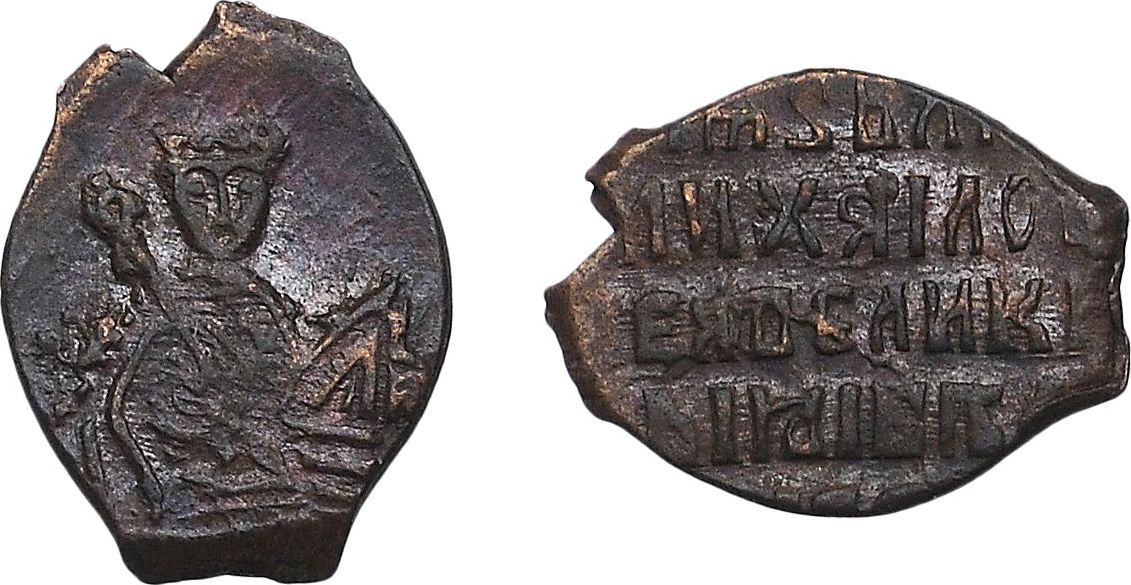
By decree of 15 March, copper money was abolished and the former monetary system was restored. After that, the government began paying the troops in Little Russia in silver, and in Russia itself it forbade private individuals not only to make payments in copper money, but even to keep it in their possession. At the same time, it was made possible, within a specified period, to exchange copper money for silver through the treasury at a ratio of 1 to 20 of the original rate.
22 August — Tsar Alexei Mikhailovich issued a decree on the “exile to Siberia for eternal residence, with wives and children, of counterfeiters of coins.”
October — November — the last major operation of the Polish–Russian War began: a campaign by the Polish army led by King Jan Casimir, joined with detachments of Crimean Tatars and Right-Bank Cossacks, against Left-Bank Little Russia. In the course of hard fighting, advancing north along the Desna River, Polish units captured a number of small towns. The king’s army bypassed major fortresses with numerous Russian garrisons (Kyiv, Pereiaslav, Chernihiv, Nizhyn). However, near the fortress walls of Hadiach and Hlukhiv, the forces of the Crown army ran out of steam. To repel the offensive under winter conditions, Moscow had to mobilize troops that had been sent home.
By the end of the year, Little Russia had de facto split into two parts: the hetman of Right-Bank (Polish) Little Russia became the Pereiaslav colonel P. I. Teteria (1663–1665), who was succeeded by the general esaul P. D. Doroshenko (1663–1676), while the hetman of Left-Bank Little Russia was elected the Kosh Ataman I. M. Briukhovetsky (1663–1668), who was later succeeded by the Chernihiv colonel D. I. Mnohohrishny (1668–1672). At the same time, the entire hetman elite and regimental officer class not only fought one another, but also conducted active combat operations on the Polish, Crimean, and Russian “fronts.”
6 February — in England, the minting of a gold coin from gold brought from Guinea began; it received the unofficial name “guinea.”
27 March — a proclamation by King Charles II granted the coin the status of the kingdom’s principal gold coin. The guinea was set equal to 21 shillings (one pound sterling plus one more shilling).
It was the first English gold coin struck by machine. The guinea’s weight varied within 8.3–8.5 g (gold content exceeded 90%), diameter 25–27 mm. Overall, for nearly a century and a half (1663–1813), the quality of the coins remained fairly stable.
12 December — for the first time in Russian history, a Bible came off the printing press in Moscow.
The Penza fortress was founded.
The reflecting telescope was invented.