

The building of the Irbit Zemstvo Board was constructed in 1879.
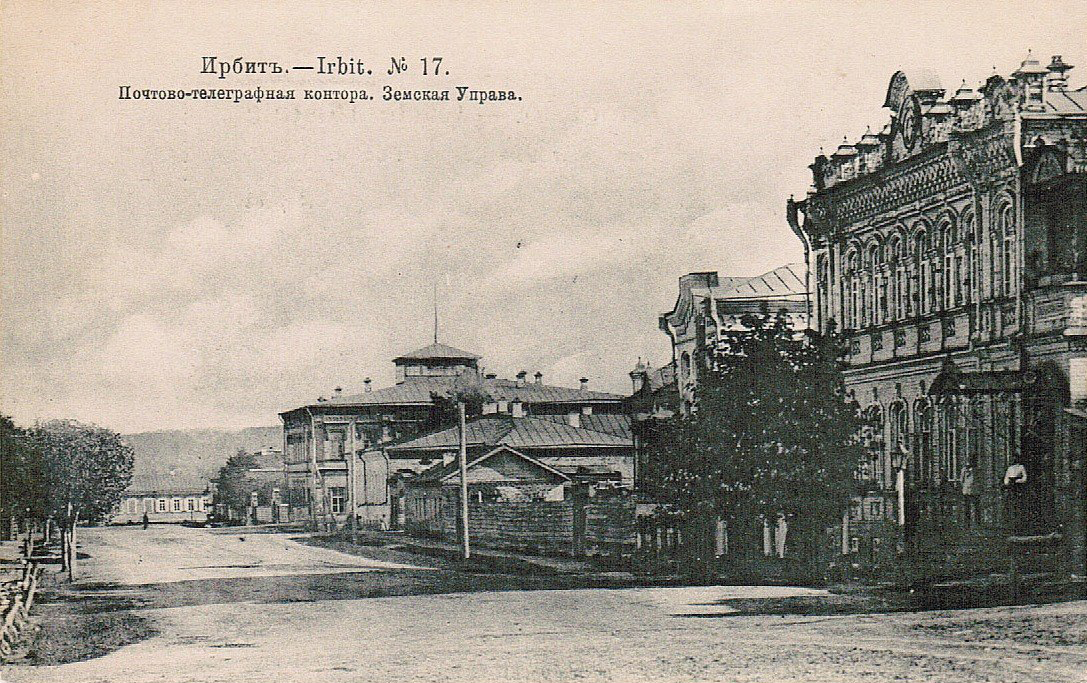
The district zemstvo building housed a public library, a book repository, a temperance committee, a board of trustees for children's shelters, a Red Cross branch, a central telegraph station—twelve institutions in total.
Today, the building houses the Department of Agriculture and Food.
This two-story stone building is located in the historic city center, within a block of loosely spaced manor-type development. In its western part, a volume containing the stairwell stands out; above the roof rises a lantern with continuous glazing, which is a fairly rare feature for buildings in pre-revolutionary Irbit.
The composition of the main facade is asymmetrical: its central axis is not emphasized, although the number of openings is odd. The design is planar; the volume of architectural decor increases only in the crowning part. The articulation features pilaster strips and a compact group of five window openings on the first and second floors, with narrow piers between them.
Horizontal divisions are expressed by a simply patterned interstory band, a scalloped frieze, and a multi-profile cornice. The first-floor windows are framed with linear relief, while those on the second floor have surrounds with geometric ornament.
Above the main entrance, with two paneled doors, there is a canopy on wrought-iron brackets. The grille between the canopy slopes and the brackets features a pattern of large scrolls.
The side facade facing K. Liebknecht Street has a central-axis scheme of articulation; its center is accentuated by a group of five window openings on the first and second floors, flanked by pilaster strips. The decorative details are similar to those of the main facade.
The courtyard facades are finished more modestly: the window openings have no surrounds; only the corner pilaster strips and the interstory band are preserved.
Over time, the building underwent some changes. In particular, one of the window openings on the main facade was bricked up, an extension was built on the courtyard side, and the interiors were partially reconfigured.
Overall, the building is an example of a late-19th-century public building erected in the "brick" style.