
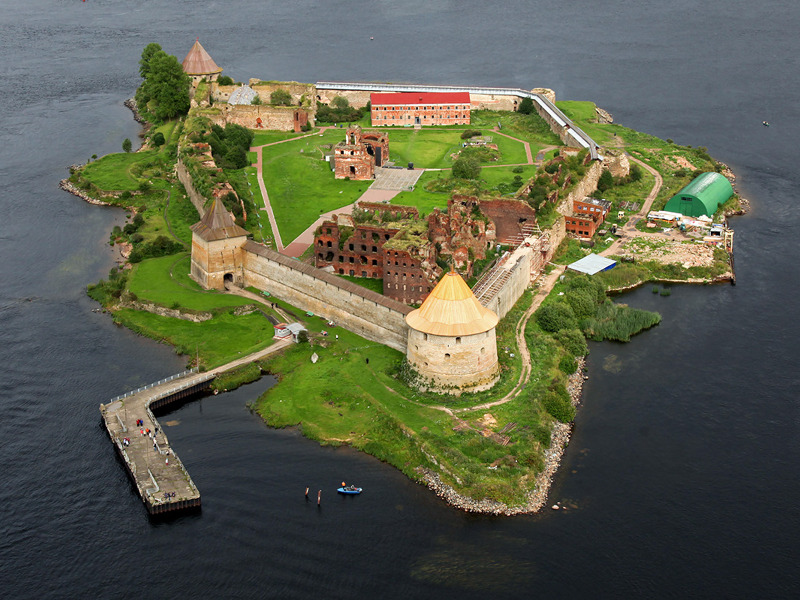
October 11 — Russian troops captured the Swedish fortress of Noteburg. The Shlisselburg Fortress (Oreshek Fortress) is located at the very source of the Neva River as it flows out of Lake Ladoga, on Orekhovy Island (which gave the fortress its name), opposite the town of Shlisselburg. Orekhovy Island splits the Neva into two wide channels, with such a strong current that the water does not freeze here even in winter, even in the harshest frosts. The fortress, occupying the entire island, has the shape of an irregular triangle in plan, stretched from east to west. Founded in 1323 by the Novgorodians, it belonged to the Swedes from 1612 to 1702.
During the Great Northern War (1700–1721), the capture of the Noteburg fortress was Peter I’s top priority.
By that time the fortress had not lost its combat capability, but its island position implied the need for a fleet to take it—something Peter I did not have. Preparing for the assault on Noteburg, Peter I ordered thirteen ships to be built in Arkhangelsk, two of which—the “Holy Spirit” and the “Courier”—were dragged overland through swamps and taiga by local men from the White Sea to Lake Onega, where they were launched, and then, via the Svir River and Lake Ladoga, the ships reached the headwaters of the Neva.
The first Russian detachments led by Peter I appeared near Noteburg on October 7; the next day the siege began. After the Swedes refused the offer to “surrender the fortress under terms,” and following many days of bombardment, the Russians launched the assault.
On October 22, 1702, after a bloody assault that lasted, with breaks, for 13 hours, Noteburg once again became a Russian fortress, and the official handover took place on October 25.
Regarding the capture of the fortress, Peter I wrote: “It is true that this nut was exceedingly hard, yet, thanks be to God, it has been happily cracked.” Noteburg Fortress was renamed by Peter to Shlisselburg, which in German means “Key City”; the settlement town on the left bank of the Neva also came to be called by the same name.
A key to the fortress was mounted on the Sovereign’s Tower, symbolizing that the taking of Oreshek was the key that opened the way to further victories in the Great Northern War and to the Baltic Sea.