
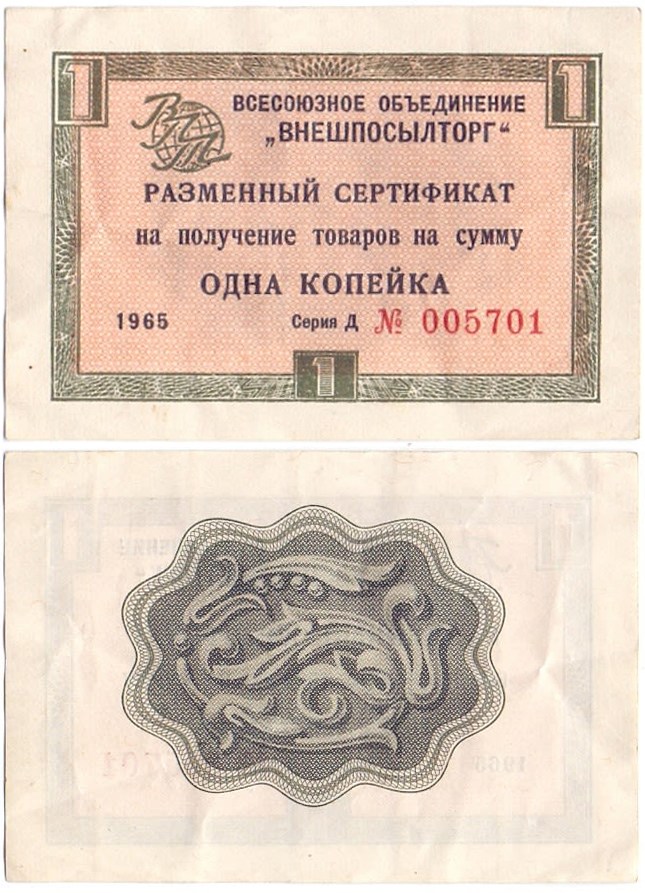
Vneshposyltorg checks (formerly "certificates" and "bons") were a kind of "parallel currency" that existed in the USSR from 1964 to 1988. They were used to pay wages to Soviet citizens working abroad: mainly specialists employed on USSR construction contracts, as well as specialists (for example, teachers, doctors, and military advisers) working under contracts with foreign state and private institutions (hospitals, universities, etc.), rank-and-file embassy staff, and other persons within the USSR who received fees or remittances in foreign currency.
The main purpose of introducing certificates, and later VPT checks, was the Soviet state's desire to limit foreign-currency wage spending on citizens working abroad (especially in capitalist countries, where otherwise employees would withdraw their entire salary in foreign currency and spend it locally), and also to reduce the inflow into the country of private consumer-goods imports from uncontrolled sources. While abroad, part of the foreign-currency salary of overseas employees was voluntarily (but no more than 60%) transferred to an account at Vnesheconombank, from which, on the spot (usually through the economic adviser at the USSR Embassy) or upon returning to the USSR, one could receive a pre-ordered amount in the form of certificates (later, checks). Some categories of overseas employees of foreign-trade organizations and diplomats could also bring into the USSR a limited amount of foreign currency, which they were required to convert into certificates (checks) no later than the установленный deadline; otherwise, their possession of currency was also considered illegal.
Certificates existed in three types: "blue-stripe certificates"—paid to citizens working in CMEA countries (account crediting ratio 1:1); "yellow-stripe certificates"—paid to overseas employees working in countries with non-convertible currency, that is, in the Third World, for example India, African countries, etc. (ratio 4.6:1); and "stripe-less certificates"—paid to those working in countries with freely convertible currency (ratio 4.6:1). Thus, the "yellow-stripe" and "stripe-less" certificates unofficially were the physical analogue of the notional accounting foreign-currency "gold" ruble, performing a quasi-function of "Soviet chervonets."
Certificates and bons (later checks) could legally be spent only in a network of special stores—"Beryozka" shops; in addition, they could be paid in as a contribution to a housing-construction cooperative, but only at a 1:1 rate to the ordinary ruble, which was also an additional source of state revenue. The essence of the certificate system was that overseas employees in different countries, with formally comparable salary levels (close to the USSR average), in reality received wages that differed greatly in purchasing power. For example, the salary of a Soviet interpreter in India, условно set at 200 rubles, in fact amounted to 920 rubles in "yellow-stripe certificates," while the salary of an interpreter, for example in Hungary, equal to 400 rubles in "blue-stripe certificates," amounted to the same 400 rubles. In "Beryozka," for blue- and yellow-stripe certificates they sold not only clothing, carpets, crystal, and other mass-produced consumer goods from CMEA production, but also automobiles.
For "stripe-less certificates," high-quality imported consumer goods were also sold, including Western audio and video equipment and scarce food products. The difference in the purchasing power of the certificates was especially clear using passenger cars as an example:
"Volga" GAZ-21 cost 5,500 rubles in "blue-stripe" and only about 1,200 rubles in "stripe-less" and "yellow-stripe";
"Moskvich" AZLK-408 cost 4,500 rubles in "blue-stripe" and only about 980 rubles in "stripe-less" and "yellow-stripe";
"Zaporozhets" ZAZ-966 cost 3,500 rubles in "blue-stripe" and only about 760 rubles in "stripe-less" and "yellow-stripe".