
June 5 — an American scientist from the Centers for Disease Control, M. Gottlieb, first described a new disease marked by profound damage to the immune system. Careful analysis led U.S. researchers to conclude that a previously unknown syndrome existed, which in 1982 received the name Acquired Immune Deficiency Syndrome (AIDS).
The AIDS era began in the early 1980s. The first warning most physicians would receive came from a single case report. Case reports typically focus on odd and remarkable cases—cases with unexpected twists—but with limited practical teaching value. That is why clinical case reports sit at the bottom of the hierarchy when it comes to levels of research evidence. However, this one was entirely different.
The Morbidity and Mortality Weekly Report (MMWR) has been published weekly by the Centers for Disease Control and Prevention (CDC) since 1950. Each week it provides information on public health, possible exposures, outbreaks, and other health risks that medical professionals need to know about. One single-case report stands out especially from their entire back catalog. It was written by several physicians from the University of California, Los Angeles, and Cedars-Mt Sinai Hospital in Los Angeles. It was published on June 5, 1981:
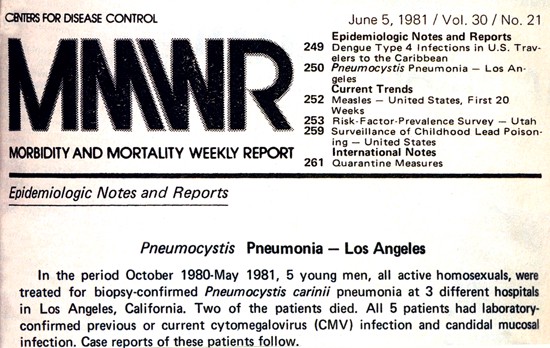
Pneumocystis pneumonia (PCP) is a rare form of pneumonia caused by the yeast-like fungus Pneumocystis jiroveci. The fungus can live in the lungs of healthy people without causing any problems, so it was strange to see it in five healthy young men (the oldest was 36).
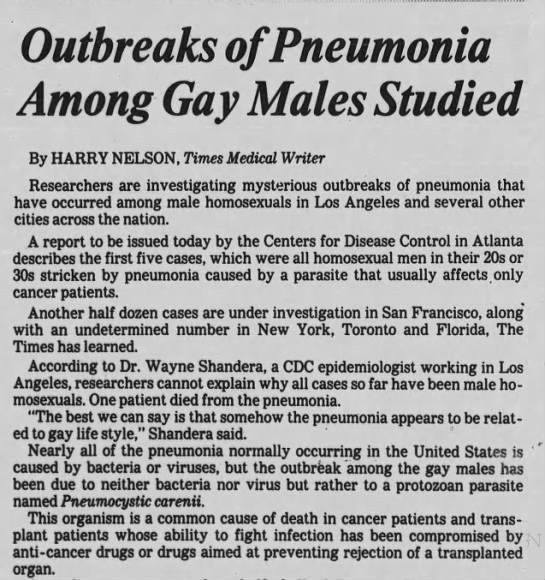
While the June 5, 1981 MMWR was the first clinical publication to mention this new disease, three weeks earlier a newspaper had published an article about this rare pneumonia. The New York Native was a biweekly LGBT newspaper founded in December 1980. On May 18, 1981, their medical reporter Dr. Lawrence D. Mass wrote a short piece titled “Rumors of Disease Largely Unfounded.” After discussions with Dr. Steve Phillips of the New York City Department of Health, Mass concluded that there was not yet enough evidence that PCP predominantly affected homosexual men or that a homosexual lifestyle was associated with the disease.
On the same day the CDC published the MMWR, the Los Angeles Times became the first national newspaper to report on the emerging illness. Their article was titled “Pneumonia Outbreaks Among Gays Studied.”
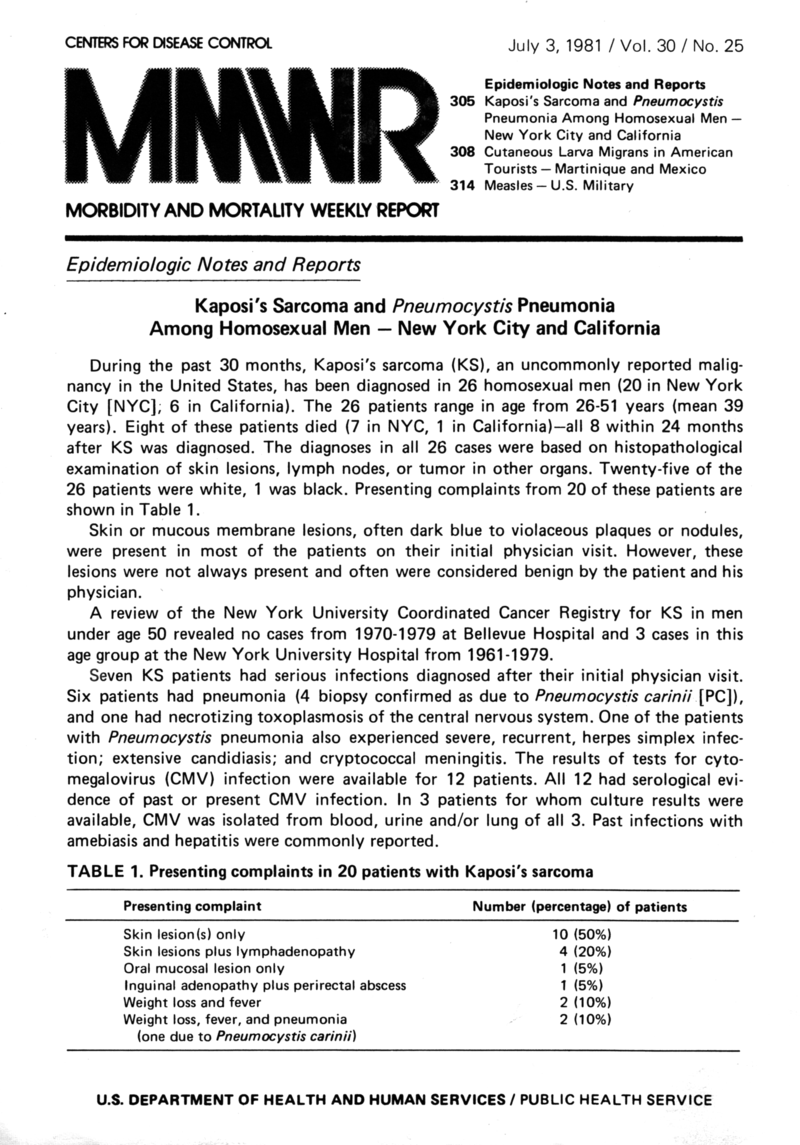
Less than a month later, the MMWR reported additional cases of PCP as well as Kaposi’s sarcoma in 26 previously healthy homosexual men in Los Angeles and New York dating back to 1978. Kaposi’s sarcoma is a very rare form of cancer, previously usually seen in older men of Jewish/Mediterranean descent. Again, it was virtually unheard of in young men. It was assumed that something was affecting their immune systems, preventing them from fighting infections and malignancies.
On the same day that this second MMWR article was published, The New York Times also ran the story.
At the time, there were many theories about what was shutting down patients’ immune systems. It was believed to be somehow connected to a “homosexual lifestyle,” which led to the stigmatizing media description GRID (Gay-Related Immune Deficiency), first used in 1982. By 1983 the disease was also linked to people who inject drugs, hemophiliacs who received blood products, and Haitians. This produced another stigmatizing phrase, the “4H Club” (homosexuals, heroin users, hemophiliacs, and Haitians).
However, in 1982 the CDC did in fact give it a proper name: “Acquired Immune Deficiency Syndrome,” or “AIDS.”
Only in 1982, when the disease was identified in heterosexual patients, did The Wall Street Journal publish an article on February 25: “New, Often Fatal Disease of Homosexuals Turns Up in Women and Heterosexual Men.”
The fact that it was transmitted to recipients of blood products suggested that the cause had to be viral, since only a virus could pass through the filtration process. In 1983 two competing teams—one American and one French—announced that they had found the virus that causes AIDS, and a dispute continued over who did so first. Each team gave it its own name. In 1985 a third name was chosen: “Human Immunodeficiency Virus,” or “HIV.” By then, the virus had spread not only in America but also in Canada, South America, Australia, China, the Middle East, and Europe. Since 1981, more than 70 million people worldwide have been infected with HIV, and about 35 million people have died of AIDS.
The June 5, 1981 MMWR is now widely regarded as the start of the HIV/AIDS pandemic and as the first publication about HIV/AIDS. Although it is only a case report, it demonstrates the value of these frontline publications. But Dr. Mass’s article is the first publication of any kind known worldwide. It is hard not to feel sad looking back at those words, realizing how little people knew—how they could not grasp the scale of the problem, the beginning of the plague. But they are also a lesson: only by recording and publishing the “strange and wonderful” can we begin to share practice, recognize patterns, and identify emerging diseases.
December 19 — on the occasion of his 75th birthday, Leonid Brezhnev is awarded his last, fifth Gold Star of Hero.