
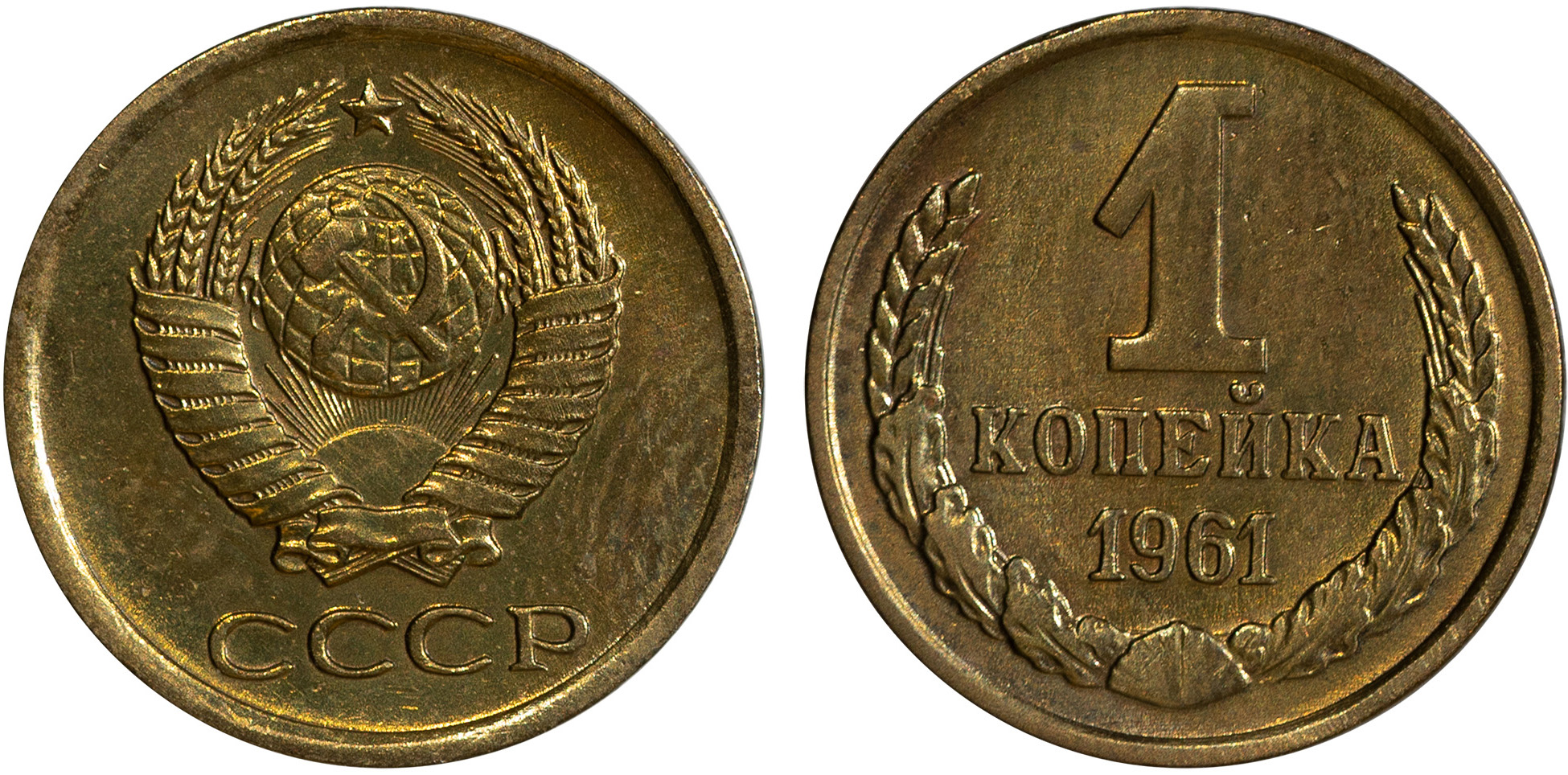
Monetary reform.
The reasons for replacing settlement notes also lay in the inconvenience of using the existing paper money for calculations and in the declining role of coins in those calculations. When the country had already learned about the upcoming reform, it was precisely this reason—reducing the exchange to a simple redenomination—that was most often replicated in the press. For example, the newspaper “Soviet Trade” (issue of May 26, 1960) explained the need for the reform as follows: “The mismatch between the existing price scale and the modern level of development of our economy is expressed, first of all, in the fact that the volume of gross output, trade turnover, and the wage fund has to be calculated in hundreds of billions and trillions of rubles. It is therefore not accidental that, under the existing price scale, enormous amounts of money are in circulation. The amount of money corresponds to the needs of the country’s monetary circulation, but the huge quantity of banknotes and small change creates certain difficulties in cash operations and in the population’s settlements.”
The main reasons for the monetary reform of 1961, which combined an explicit redenomination with a hidden devaluation, were as follows:
- - Rising inflation.
- - A growing shortage of mass-consumption goods.
- - Costly state programs (space exploration, weapons development, geological surveying, etc.).
- - Undervaluing the Soviet currency against world currencies when selling raw materials (primarily oil) abroad allowed the country to obtain substantial profits in rubles used in the domestic market.
The population was informed about the reform in advance. Its essence was explained by the Decree of the Council of Ministers of the USSR No. 470 of May 4, 1960, “On changing the price scale and replacing the money currently in circulation with new money,” which proclaimed the easing of monetary circulation and giving greater full value to the Soviet ruble. Nevertheless, an alarming signal for citizens was the departure of Arseniy Grigorievich Zverev, who had headed the country’s financial system since 1938, from the ministerial post. Zverev, who left the minister’s chair on May 16, according to economists’ recollections, disagreed with carrying out the reform. Initially, he planned to restore the ruble’s purchasing-and-payment power and increase the population’s solvent demand for goods and services, and only then carry out the redenomination and weaken the ruble relative to world currencies. Otherwise, the economy would be oriented toward exporting raw materials and purchasing foreign goods.
The population remembered well the confiscatory nature of the 1947 reform, and therefore greatly feared for their accumulated cash. After the Decree was published, those who had reserves of funds split into two groups and rushed to savings banks to withdraw money urgently. The first began opening small deposits so as not to keep cash on hand. The second, thinking that this time deposits would be confiscated, began buying durable goods and long-storage food. Citizens without large reserves also flocked to shops, worrying that prices would rise after the reform. Since 1-, 2-, and 3-kopeck coins remained in circulation and their purchasing power increased tenfold, the most quick-witted citizens tried by all means to stockpile this small change. In artistic form, this operation was neatly shown in the film “Money Changers”. A viewer may wonder why the main characters drove around the area collecting small change in shops and at markets instead of exchanging banknotes at savings banks. But it turns out that a directive was sent to the administration of the State Labor Savings Banks and to trade organizations prohibiting the exchange of paper money into these three coin denominations.
Can Khrushchev’s reform be called confiscatory? In the view of most researchers, it does not fall into that category. At the announced rate, ten old rubles for one new ruble, both presented cash and deposits were exchanged. More than 28.5 thousand exchange points were organized in the country. In the first days of January, when the peak rush occurred, some of them worked in two shifts. However, after that the influx of citizens noticeably decreased, and some points even had to be closed. Mobile exchangers were sent to remote settlements. Within a month, more than 90% of the 1947 banknotes had left circulation. However, about 4.5% of the old money was not presented for exchange and remained in people’s hands. But this is a вполне normal phenomenon. For example, after the 1998 redenomination carried out by the Bank of Russia, the population still held 2.7 billion rubles of the old design (as of 31.12.1998). When recalculating prices, tariffs, and wage rates, fractional parts of a kopeck (half a kopeck and above) were rounded to a whole kopeck. For example, payment at a city payphone, previously 15 kopecks, from January 1 equaled two new kopecks. However, prices for bread, fermented dairy products, and some children’s goods were rounded downward.
Rounding could have been avoided if a half-kopeck denomination, unused since the late 1920s, had been introduced. But its return was considered inconvenient, so numismatists know only a few trial pieces. However, a number of goods were sold in pairs so that their total price would be a multiple of a kopeck. For example, two 18-sheet school notebooks cost three kopecks, and a pair of unmarked envelopes cost one kopeck. Other alloys were chosen for minting. The lower denomination group received brass instead of aluminum bronze, giving a cooler shade of gold.
The smallest denomination in the coin series remained the kopeck. But now it gained purchasing value. Nikita Sergeyevich Khrushchev himself spoke about the “heavier” coin as follows: “Now it happens like this: a kopeck lies on the sidewalk, and someone walks by and won’t bend down to pick it up. But when there is new money, a kopeck won’t be lying around; it will definitely be picked up, because that’s a box of matches.” A kopeck could be exchanged for a sewing needle, a piece of chalk, a 12-sheet notebook, a simple pencil, a lollipop candy, a small button, and a postage stamp. A one-kopeck vending machine poured a glass of carbonated water without syrup, and a kiosk vendor sold an issue of “Pioneers’ Truth.”
After successfully carrying out the exchange of money, the USSR government faced the fact that market prices decreased not tenfold, as expected, but only by four and a half times (therefore the reform cannot be considered an ordinary redenomination). For example, in a store the new price of a kilogram of potatoes became ten kopecks, but at the market one had to pay three times more for the same weight. The difference in cost began to lead to high-demand goods “flowing” from state retail stores to markets, while only hard-to-sell goods remained in the display cases. Therefore, over several years it was necessary to raise state prices for a number of goods. But the reform undoubtedly had a favorable impact on the country’s economy. Among its positive results, the following can be highlighted:
- - Printing and processing money took lower costs.
- - The volume of paper money in circulation decreased, while the number of coins in circulation grew.
- - Any coin acquired purchasing power.
- - A favorable ruble exchange rate arose for supplying USSR products to the world market.
Since free circulation of foreign currency in the country was prohibited, the population scarcely noticed that the clever redenomination turned the dollar, previously costing 4 rubles, not into 40 but into 90 new kopecks. True, this moved most imported consumer goods into the category of expensive items, which later contributed to the development of a cult of material possessions. However, the прежние wage rates, amid the lowered ruble rate, ensured competitiveness for many Soviet goods, which led to an increase in export deals. The rise in the price of jewelry due to the reduction of the gold content of the Soviet currency (0.987412 grams per ruble of 1961) also cannot be called a system-forming event.