
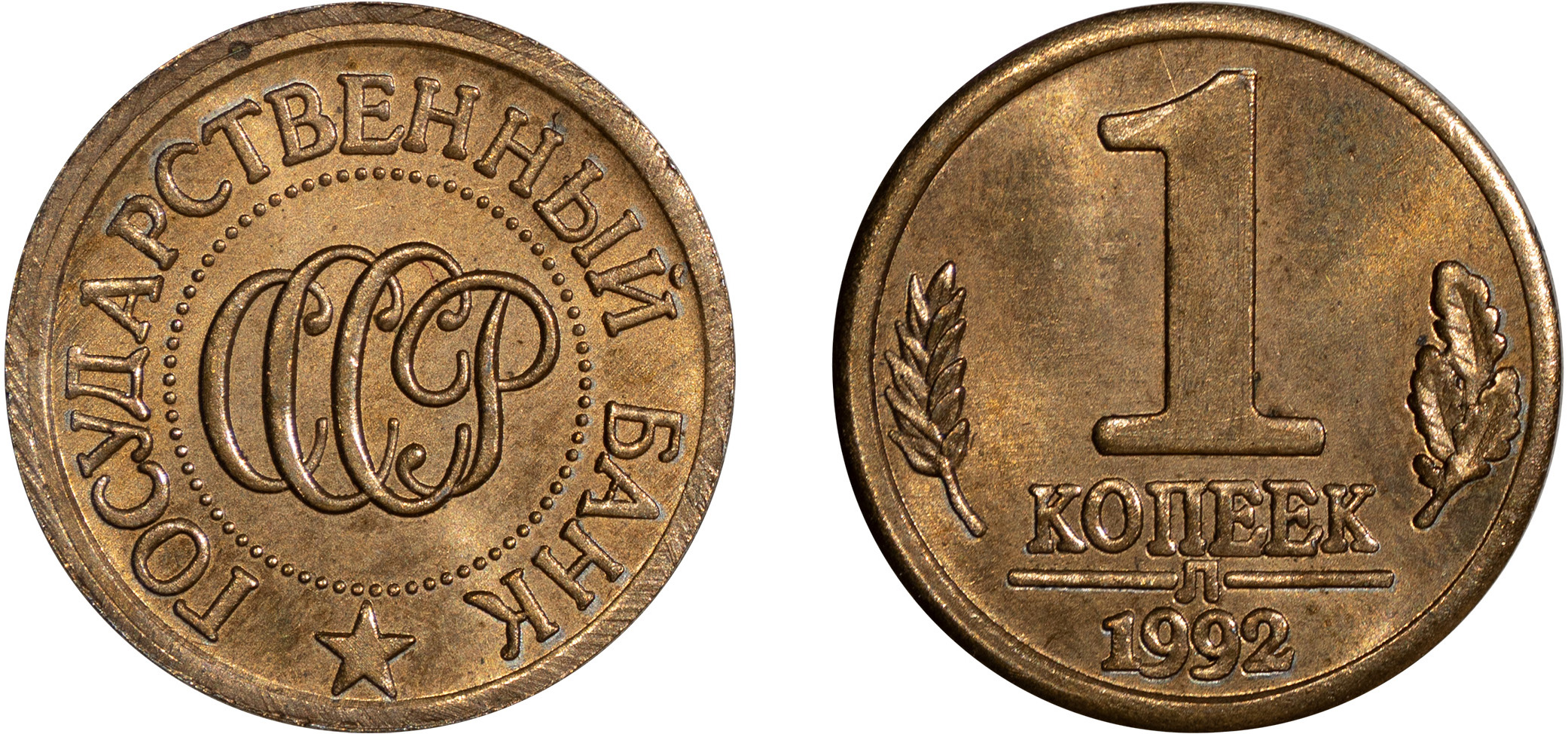
Steel clad with brass, magnetic. Plain edge. Diameter 14.7 mm. Weight 1.34 g.
Trial coins dated 1992 and issued in the name of the State Bank of the USSR (the very last coins of the Union of Soviet Socialist Republics). The coins belong to the output of the Leningrad Mint: under the denomination on each coin there is the letter "L". On the obverse, an italic abbreviation "USSR" appears in the center, surrounded by the inscription "State Bank", separated by a traditional flat five-pointed star. Such an obverse design is quite logical: during the "semi-disintegration" of the USSR, it was inappropriate to use the image of the former state coat of arms. Yet faith in its "indestructibility and indivisibility" still lingered; the only uncertainty was the exact number of republics that would be included in the "renewed" USSR. Accordingly, a fail-safe neutral "lettering" option was tested. The reverse of the trials is identical to the design of the circulation 50- and 10-kopeck coins of 1991.
These trials were likely developed closer to the end of 1991 or the beginning of 1992, since inflation had not yet wiped out small kopeck denominations, which is also confirmed by the very existence of the surviving trials. The material chosen for striking was already proven: the prototype was the 1991 circulation steel ten-kopeck coin clad with brass, as the cheapest to manufacture.
April 30 — in Geneva it was announced that the World Wide Web technology (World Wide Web), developed by European Laboratory for Particle Physics (CERN) staff member, Englishman Tim Berners-Lee (Tim Berners-Lee), would be free for everyone.
May 5 — the Crimean parliament proclaimed Crimea's independence and scheduled a referendum for August to confirm this status.
May 6 — the constitution of the Republic of Crimea was adopted.
May 7 — in Russia, vodka and pure alcohol began to be sold at free prices for the first time.
May 13 — the Verkhovna Rada of Ukraine revoked the declaration of Crimea's independence.
July 1 — in Latvia, postage stamps of the former USSR were declared invalid for paying postal services. On this occasion, on June 30 a unique event in philatelic history was organized: a special cancellation of mail with a postmark of the last day.
October 15 — serial killer Andrei Chikatilo was found guilty of 52 murders.
January 10 — abolition of fixed prices for bread and milk.
As part of the so-called stabilization program, in January 1992 the government liberalized prices for milk and bread. "Shock therapy" was an attempt by Russia to transition to a market economy.
In practice, "shock therapy" suffered a shocking failure. This concerns both its consequences for the Russian economy and the emptiness of the promises that it would result in a transition from a socialist to a market economy.
In previous years, the USSR economy used state-regulated prices for the absolute majority of produced goods (works, services). Discussions among the country's top leadership about the possibility of moving to free prices began several years before the collapse of the USSR. At a meeting of the CPSU Central Committee Politburo on November 3, 1989, N. I. Ryzhkov expressed the view that the food problem in the country would not be solved "if by 1991 we do not come to free prices". In 1991, the crisis led to the loss of control over money supply growth in the national economy, while the ongoing production decline led to a reduction in the volume of goods supply. Attempts at a gradual transition from administered prices to negotiated prices did not solve the problem. By the end of 1991, the ratio of money supply to goods supply had reached a threefold level, indicating a threatening economic imbalance. This manifested itself in a growing shortage of goods, especially food, in large cities. For most specialists it became obvious that the country's national economy needed to move onto market tracks, which would require abandoning state regulation in the field of pricing. It was assumed that pricing functions would be transferred directly to business entities, which would set prices under the influence of competition, based on existing supply and demand.
Price liberalization was the first item in Boris Yeltsin's program of urgent economic reforms, proposed to the 5th Congress of People's Deputies of the RSFSR, held in October 1991. The proposal met with the congress's unconditional support (878 votes "for" and only 16 "against").
In fact, radical liberalization of consumer prices was carried out on January 2, 1992, in accordance with the Decree of the President of the RSFSR dated 03.12.1991 No. 297 "On Measures to Liberalize Prices" and the Resolution of the Government of the RSFSR dated 19.12.1991 No. 55 "On Measures to Liberalize Prices", as a result of which 90% of retail prices and 80% of wholesale prices were freed from state regulation. At the same time, state control over price levels for a number of socially significant consumer goods and services (bread, milk, public transport) was retained (and for some of them it remains to this day). At first, markups for such goods were limited; however, in March 1992 it became possible to remove these limits, which most regions took advantage of. In addition to price liberalization, starting in January 1992 a number of other important economic reforms were implemented, in particular wage liberalization, freedom of retail trade was introduced, etc.
Initially, the prospects of price liberalization raised serious doubts, since the ability of market forces to determine goods prices was limited by a number of factors. First of all, price liberalization began before privatization, so the national economy remained predominantly in state ownership. Second, the reforms were launched at the federal level, while price control had traditionally been exercised at the local level, and in some cases local authorities preferred to retain this control directly, despite the government's refusal to provide subsidies to such regions. In January 1995, prices for approximately 30% of goods continued to be regulated in one way or another. For example, authorities put pressure on privatized stores, using the fact that land, real estate, and utilities still remained in the hands of the state. Local authorities also created obstacles to trade, for example by banning the export of food to other regions. Third, powerful criminal groups emerged that blocked access to existing markets and collected tribute through racketeering, thereby distorting market pricing mechanisms. Fourth, poor communications and high transport costs complicated the ability of enterprises and individual citizens to respond effectively to market signals. Despite these difficulties, in practice market forces began to play a significant role in pricing, and economic imbalance started to decrease.
Price liberalization became one of the most important steps toward transitioning the country's economy to market principles. According to the reform authors themselves, in particular Gaidar, thanks to liberalization the country's stores were filled with goods in a fairly short time, their assortment and quality increased, and the main prerequisites were created for forming market mechanisms of economic management in society. As Gaidar Institute researcher Vladimir Mau wrote, "the main thing achieved as a result of the first steps of economic reforms was overcoming the goods shortage and averting from the country the threat of impending hunger in the winter of 1991-1992, as well as ensuring internal convertibility of the ruble".
Before the reforms, representatives of the Russian Government claimed that price liberalization would lead to moderate price growth, an adjustment between supply and demand. According to the generally accepted view, fixed prices for consumer goods in the USSR were set too low, which caused increased demand and, in turn, shortages. It was assumed that as a result of the adjustment, the goods supply expressed in new market prices would be about three times higher than the old one, which would ensure economic equilibrium.
Vodka coupons, which often replaced money in conditions where the latter was rapidly losing value amid hyperinflation. Coupons for many consumer goods remained in use until the end of 1993.
However, price liberalization was not coordinated with monetary policy. As a result of price liberalization, by mid-1992 Russian enterprises were left virtually without working capital. Beginning in April, the Central Bank began large-scale lending to agriculture, industry, former Soviet republics, and monetary issuance to cover the budget deficit. This was followed by inflation, which totaled 2600% for 1992. Such high inflation was caused by an increase in government spending in the liberalization year by almost 14% of GDP and by the fact that no monetary reform was carried out in the liberalization year. Illarionov thus emphasizes the fundamental difference between Gaidar's policy and that of other post-socialist governments.
Polish economist Leszek Balcerowicz places the blame for the negative consequences of price liberalization and other Russian economic reforms on political conflicts that hindered normal government work. Price liberalization led to hyperinflation, depreciation of wages, incomes, and savings, rising unemployment, and an intensification of the problem of irregular wage payments. The combination of these factors with the economic downturn, increased income inequality, and uneven wage distribution across regions led to a rapid drop in real wages for a significant part of the population and to impoverishment. The share of poor and very poor households between 1992 and 1995 increased from 33.6% to 45.9%.
In addition, hyperinflation led to an overly sharp decline in purchasing demand, which at first only worsened the economic downturn. In 1998, GDP per capita was 61% of the 1991 level—an effect that surprised the reformers themselves, who expected the opposite result from price liberalization, though it was observed to a lesser extent in other countries where "shock therapy" was implemented.
Explaining the reasons for high inflation, the reformers argued that they were not related to price liberalization itself. They cited political pressure, primarily from the Supreme Soviet, which forced money issuance, as well as an inflow of rubles printed in neighboring republics.
According to a number of economists, under conditions of near-total monopolization of production, price liberalization effectively led to a change in the bodies that set prices: instead of a state committee, the monopolistic structures themselves began to do so, resulting in a sharp rise in prices and a simultaneous reduction in production volumes. Price liberalization led to price growth significantly outpacing money supply growth, resulting in a real contraction of the money supply. Thus, over 1992-1997 the GDP deflator index and the consumer price index increased by about 2400 times, while the M2 money supply aggregate increased by about 280 times. As a result, the "real" money supply shrank by more than 8 times. At the same time, there was no comparable increase in the velocity of money circulation that could have compensated for the contraction. The situation was aggravated by the fact that as a result of privatization the money supply faced an additional burden of servicing shares, bonds, etc., which previously had not been objects of transactions. Due to these processes, by 2000 the money supply amounted to about 15% of GDP, while in transition economies it was then 25-30% of GDP, and in developed countries 60-100% of GDP. With a shortage of money, it became so expensive that the real sector of the economy was stripped of financial resources. The lack of money in the economy also accelerated other negative processes: a decline in economic growth, replacement of missing money supply with surrogates, and increased naturalization of exchange (barter transactions).
According to economist Glazyev, price liberalization not accompanied by the creation of restraining mechanisms led "not to the creation of mechanisms of market competition, but to the establishment of control over the market by organized criminal groups extracting сверхprofits by jacking up prices"; moreover, the mistakes made "provoked cost hyperinflation, which not only disorganized production but also led to the devaluation of citizens' incomes and savings".
In the USSR until the late 1980s, only coins with denominations of no more than 1 ruble were used in circulation, but due to hyperinflation, 100-ruble coins appeared in circulation.
Hyperinflation wiped out Soviet-era savings. Despite laws adopted under which deposits in Sberbank were supposed to be indexed in line with the ruble's purchasing power, the Government repeatedly refused to recognize this internal debt, citing likely harmful consequences for the country's financial stability. Critics of the economic policy of Gaidar's government, including among supporters of liberal reforms, compare this process to confiscation. (Source: "New Path")