
In 1923, the “Severoles” association purchased part of the shares of the “Anglo-Russian Grumant” company, and in 1925 the joint-stock company “Russian Grumant” was established with its headquarters in Moscow; in 1927 it, in turn, acquired the “Pyramid Mountain” site from a Swedish company. Then, in 1931, the “Soyuzlesprom” association bought the rights to the “Grumant” enterprise.
In 1932, in Berlin, a contract was signed for the “Arktikugol” trust to acquire land plots and the Barentsburg mine, previously owned by the Dutch company “Nespiko.” At the same time, “Arktikugol” purchased from the Dutch another land plot—“Boheman Tundra,” located on the northern coast of Isfjorden. The land plots, the mine, machinery, inventory, equipment, and other assets specified in the contract concluded on July 25, 1932 between the two parties were sold for one million 250 thousand Dutch guilders.
On May 7, 1935, the USSR acceded to the Svalbard (Spitsbergen) Treaty of Paris dated February 9, 1920. The “Arktikugol” trust was established, and its first head was M. E. Plisetsky, the father of the famous ballerina. It was here, on icy Spitsbergen, that the pride of Soviet ballet—Maya Plisetskaya—took her first steps into the world of art in a children’s amateur troupe. By 1936, Soviet miners on the archipelago had extracted the millionth ton of coal.
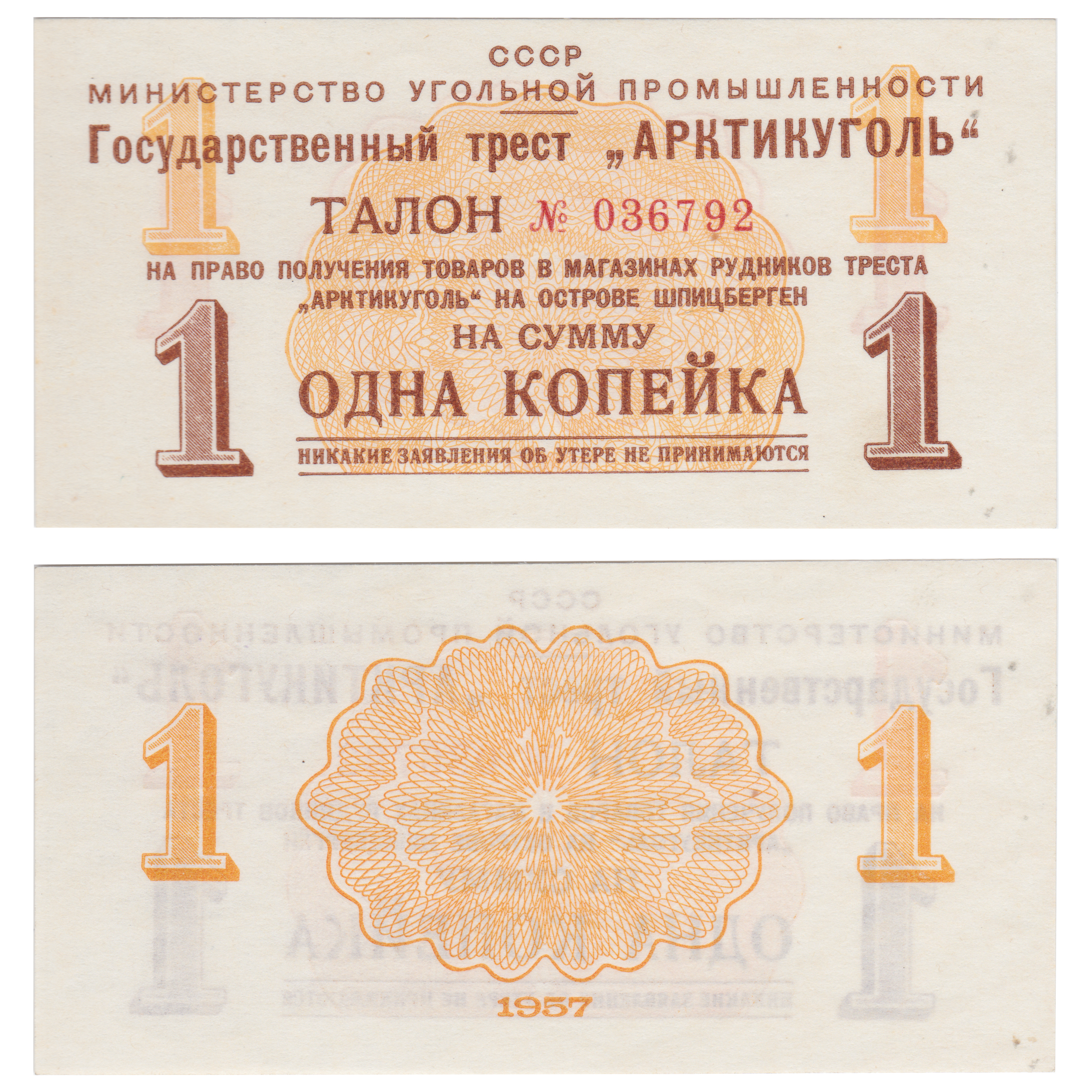
The “Arktikugol” trust tokens were issued from the 1930s through 1979 in eight issues. Issues 1 and 2 had no year indicated; the 1940 and 1946 issues were without kopeks; the 1951, 1957, 1961, and 1979 issues had no year indicated.
Today, only one Russian mine operates on Spitsbergen—“Barentsburg.” The “Pyramiden” and “Grumant” mines have been mothballed for economic reasons.